
Airbnbs banned in residential Ford River
STRs with permits allowed to continue
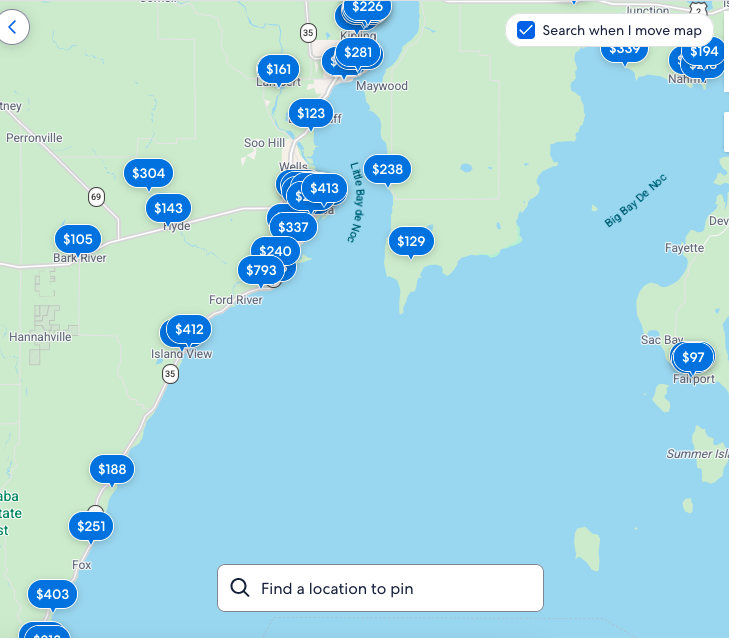
A plethora of Vrbo listings show that waterfront properties are popular for short-term rentals. Prices shown are for a six-day stay. (Screenshot)
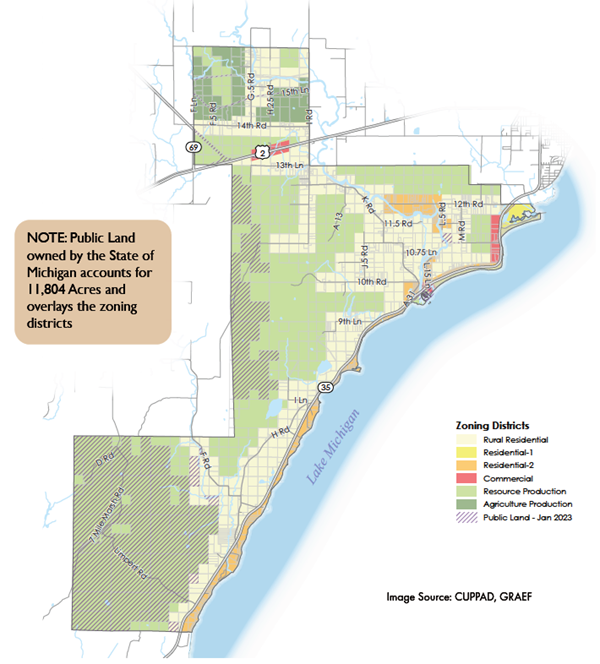
Shown is a zoning map of Ford River Township. Only properties in the very small commercial zones are allowed to open short-term rental units, though ones in other districts that already have permits are allowed to continue. (Map via Ford River Township)
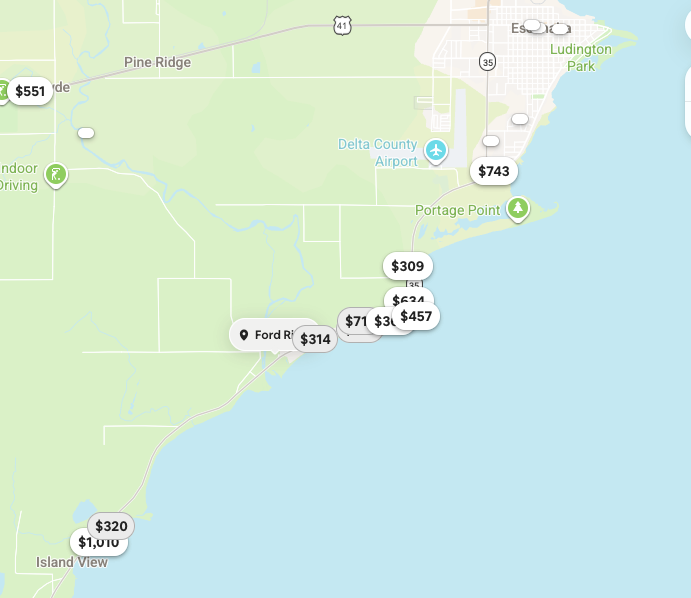
On Airbnb, prospective vacationers can see the approximate location of short-term rentals. (Screenshot via Airbnb)
A plethora of Vrbo listings show that waterfront properties are popular for short-term rentals. Prices shown are for a six-day stay. (Screenshot)
Shown is a zoning map of Ford River Township. Only properties in the very small commercial zones are allowed to open short-term rental units, though ones in other districts that already have permits are allowed to continue. (Map via Ford River Township)
On Airbnb, prospective vacationers can see the approximate location of short-term rentals. (Screenshot via Airbnb)
Trending
FORD RIVER -- During its June meeting, the Ford River Township Board voted to adopt an ordinance amendment to effectively outlaw the operations of short-term rentals (STRs) -- commonly booked on platforms like Airbnb and Vrbo -- in all zones except commercial.
In this country and others, the question of how to regulate such operations has been the subject of debate in recent years; most existing legislation did not factor in STRs before they rose to popularity. It's a layered issue with multiple viewpoints as to the benefits and problems. Property owners proclaim that they should have the freedom to do what they want with their houses; long-term residents say they don't want a cycle of ever-changing vacationers instead of steady neighbors; long-term renters complain there are fewer places to live when homeowners choose to chase the cash cow of STR.
Most municipalities have yet to enact any sort of ordinance governing STRs, making Ford River's development noteworthy. But the journey was not tidy.
In March 2020, the township’s planning commission considered the fact that STRs were not mentioned in the zoning ordinance, but members did not believe they should be banned, minutes from the March 5 meeting show. "More research will be done," the notes remarked.
In a September 2020 meeting of the Ford River Township Board, the topic of short-term rentals received "lengthy discussion" before a member reminded the board that the matter should be handled by the planning commission. According to meeting minutes, it had been brought up because Supervisor Rachael Fountaine quit before handling the STR question.
Over a period of years, the Ford River Planning Commission in conjunction with Central Upper Peninsula Planning and Development (CUPPAD) Regional Commission began formulating plans to incorporate a section about short-term rentals into the township's zoning ordinance.
In the meantime, property owners in Ford River were running short-term rentals from at least 2019, residents say. Some obtained Special Use Permits from the township; others did not.
The lack of equal enforcement both in Ford River and other communities led to frustration. People running clean, compliant, permitted Airbnbs felt that a couple out-of-control ones -- or even false rumors -- were giving the whole market a bad name.
Recently, a development that may be seen as a climax came before the public after two proposed pieces of legislation were drafted in March of this year.
At the May 2026 meeting of the township board, one ordinance -- establishing rules about maintenance and inspection of short-term rentals, but notably not where they were allowed -- was voted in. It requires each property owner running an STR in the township to apply for a Rental Certificate and be subject to annual inspections, among other details.
The second STR-related item presented that night did not pass -- but it did on June 15.
That second item (classified as "new business 14b" on the May 18 agenda) was to amend the zoning ordinance so that STRs were allowed in commercial zones but disallowed in R-2 (the “residential two” zone type).
Supervisor Steve Nelson explained that when he voted down the ordinance in May, he and others were asking for reanalysis, and requested that the planning commission consider allowing STRs in R-R (rural residential).
"Rural residential... is not just a residential neighborhood. It’s also somewhat of a semi-commercial district when you go through with all conditional uses that can be approved. ...We allow sawmills, we allow bars," Nelson said.
Several citizens spoke in favor of STRs on May 18, while others were against them. The supporters were chiefly property owners who already operated STRs; naysayers primarily worried about the character of neighborhoods declining when frequented by rotating tourists.
Despite the review, the planning commission made no changes to the proposed ordinance amendment, and it returned to the township board on June 15 in the same form that it had a month prior.
This time, the amendment passed. STRs will now be listed as an acceptable use in district C (commercial) only. However, any STRs currently in operation with Special Use Permits from the township will be "grandfathered in" and allowed to continue business.
Nelson said that he had received letters and heard from people who wanted STRs allowed in the R-1 and R-2 districts. Only one letter was read aloud at the meeting, though; Jayne Church read one in opposition, which attendees felt was unfair.
After discussion, Church made the motion to adopt the ordinance as presented by the planning commission -- that is, to allow STRs only in commercial districts. When it came to a vote, Nelson, Church and Bob Valentine voted yes, and Amanda Wagner and Debbi Brown voted no. With the majority in favor, it passed.
Some commended the planning commission for doing their homework.
"The purpose of the planning commission is to do this exact sort of thing. ...I think as a board, we have an obligation to listen to our planning commission. They were methodical. They went through a process. They took their time. They consulted with experts. They reviewed the law," said Valentine. "Absolutely it's controversial. There were points for and against it, (but) I think overwhelmingly, the citizens have spoken, and they want it restricted to the commercial zones."
Plenty of residents in R-1, R-2 and RR might have liked to open Airbnbs, but the vote was a victory for neighbors afraid of all-night parties and damage by strange guests.
Though she voted against the amendment, Brown -- Ford River Township clerk -- said that she respected the decision of the board and the work of the planning commission; however, her concern is enforcement.
"The ordinance that we have didn't get enforced, and that's what created all the complaints -- because of the illegal STRs," Brown said.
Several rentals are available on Airbnb and Vrbo. Property owners in Ford River Township currently listing their homes on said sites without special use permits from the municipality may be shut down.
The next Ford River Township Board meeting is Monday, July 20 at 7 p.m.