
Lake Superior copper mines impacted U.S. refining
Trending
By the end of the 19th century, the Lake Superior copper district had already begun its decline in terms of copper production and its percentage of mineral contribution to the United States copper market.
While the Copper Country could boast of contributing approximately 90% of the nation's copper to the Union war effort during the Civil War, by the onset of the First World War, the region could make no such claim.
In 1914, the United States produced about 77% of the entire world's copper supply. However, the Lake Superior mines combined comprised just of the U.S. total had slipped to between 15 and 20% of that share.
While its copper production had declined dramatically in the 50-year period from 1864 to 1914, the Copper Country had already become a leader in technological advancements that revolutionized refining processes. Many of these advances were developed during the Civil War, many of them were adopted in other mines regionally and nationally, and they set the stage for World War I copper production.
Early Upper Peninsula copper mills lost up to a third of their copper in the “slimes” (fine sand waste) because standard gravity stamps were too heavy to process the smaller, crushed particles.
Among the developments that revolutionized copper milling were the Collom Jig and the Evans Slime Table. John Collom, a mechanic and engineer at the Cliff Mine, devised a plunger-style jig (initially called a slime separator) that used a gentle upward flow of water and mechanical pulsing to separate valuable copper from lighter waste rock based on density.
A jigger, a type of gravity concentrator that separates materials of different densities, separated small particles of copper from rock.
As explained by the Keweenaw Series of Michigan report, the crushed copper-bearing rock was mixed with high volumes of water to spread out over a wire screen, through which a pulsating stream of water flowed. The pulsating water kept the rock and copper particles in motion, while the heavier particles (copper) settled into a catch box, or settling box, below the screen.
After passing through the Collom Jig, the "slime" next went to another local invention of Atlantic Mining company engineer, William Evans, which was the Evans Slime Table. This was a rotating table that also relied on high volumes of water to further separate and treat the slime from the jig.
The separator created two classes of product, explained Charles M. Rolker in his presentation, "The Allouez Mine and Ore Dressing, as Practiced in the Lake Superior Copper District." The products were called heads and tails.
Rolker’s report was printed in the Proceedings of the Annual Meeting of the Lake Superior Mining Institute, Vol. 2, in 1894. By then, however, many advancements, innovations and refinements had been made to t Lake Superior copper refining.
By the outbreak of World War I, C&H's absolute dominance of the American market, partially due to diminishing mineral content in the copper lodes. To prolong its own life, C&H, in the early 20th century, began corporate takeovers of its neighboring mining ventures, including the Ahmeek, Osceola, and Tamarack companies. They became subsidiaries, which increased C&H's production to roughly 50% of Lake Superior’s entire copper output during WWI. In 1916 alone, C&H's annual reports recorded production of 160 million pounds of refined copper, but this was the total including the company's subsidiaries.
In the second decade of the century, C&H pioneered, then adopted, new methods of refining copper, as well as reclaiming copper particles lost in earlier standard methods of mine rock treatment.
Since the mid-19th century, most Copper Country mills relied on steam stamps and gravity-separation tables to crush mine rock and separate the copper content from it. However, the processes allowed small particles of copper to escape with the waste sands. Since 1868, C&H had dumped its stamp sands into Torch Lake, redrawing the shoreline and creating underwater fields of waste. C&H knew the sands held an estimated 1% copper content. However, at the turn of the 20th century, no technology had yet been developed to reclaim the lost copper.
C. Harry Benedict, a hydro-metallurgist with C&H, addressed this, leading to his development of an ammonia-leaching process. Through much experimentation, he developed a closed, cyclic chemical process using an ammonia solution, which was patented in 1915. With the process in place and a new leaching plant completed, the next step was reclaiming the sands from the Torch Lake bed.
Benedict later described the process in his book Lake Superior Milling Practice.
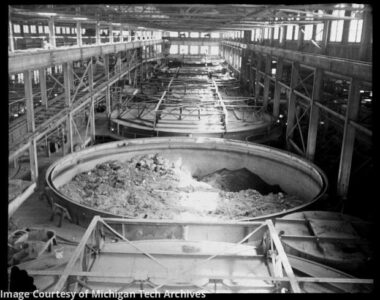
Using electrically-powered dredges, the sands were pumped from the lake and piped to facilities onshore, where they were ground to a very fine powder, using Hardinge pebble mills.
The product was then sand was flooded into giant, covered steel tanks containing a cupric ammonium carbonate solution. Air was pumped into the tanks to provide oxygen. The chemical reaction allowed the ammonia to selectively dissolve the pure metallic copper, binding it into a rich liquid called a “pregnant” leach solution. The liquid was pumped into distillation stills and treated with boiling steam. The heat drove off the volatile ammonia and carbon dioxide gases. This caused the dissolved copper to precipitate out of the liquid as a heavy, dark copper oxide powder.
The evaporated ammonia and carbon dioxide gases were captured, condensed, and recycled back to the beginning of the plant to treat the next batch of sand. The copper oxide powder was sent straight to the Lake Linden smelter to be melted into pure metallic copper bars.
The first large-scale ammonia leaching plant opened at Lake Linden in February 1917, when the U.S. entered World War I. The new technology gleaned millions of pounds inexpensively produced copper for C&H to achieve military production quotas and deadlines.
The process served the War Department two decades later, when the government again relied C&H’s specialized ammonia leaching plant, this time to process 60,000 tons of brass clad-steel scrap shells during the Second World War. The ammonia cleanly dissolved and salvaged 21 million pounds of copper from the shell casings without destroying the underlying steel.