Pathologist, domestic violence expert testify in Jackson trial
Prosecution rests their case
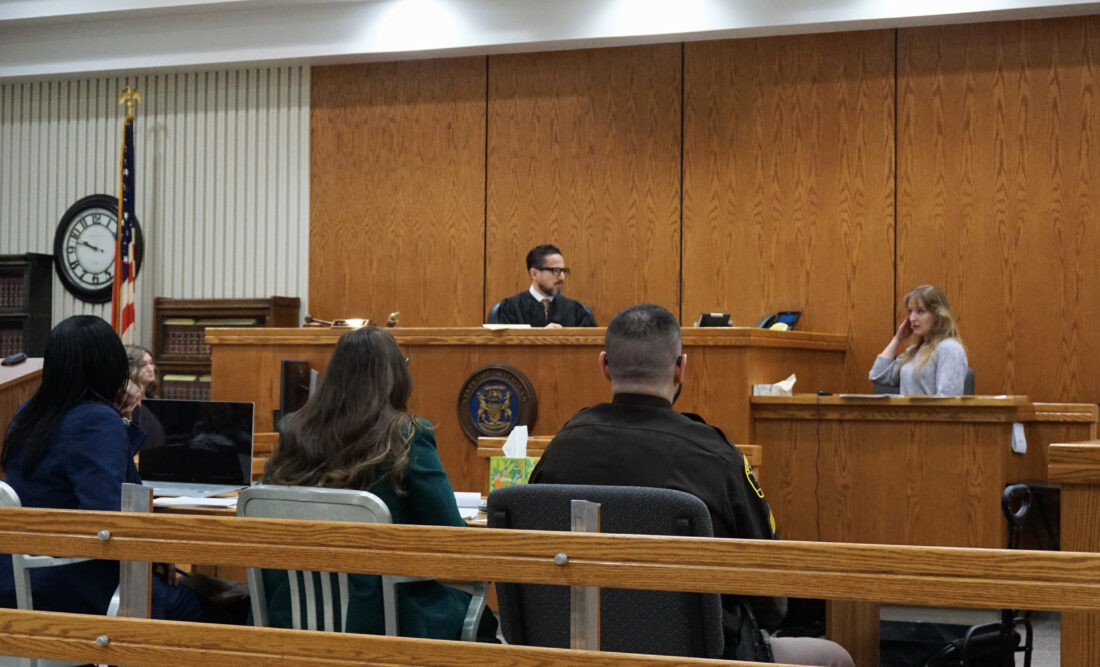
Dr. Anna Tart, forensic pathologist, testified to Harley Corwin's autopsy results during the murder trial of Tavaris Jackson on Tuesday. Dr. Tart formerly worked at the Medical Examiner's Office at Western Michigan University. (Sophie Vogelmann | Daily Press)
ESCANABA – The Michigan Attorney General’s Office rested its case in the murder trial of Tavaris Jackson on Tuesday. The jury heard testimony from the pathologist who participated in conducting Harley Corwin’s autopsy and a domestic violence expert.
Dr. Anna Tart, a forensic pathologist, testified as an expert in forensic, anatomic and clinical pathologies. Tart participated in Corwin’s postmortem examination, or autopsy, on July 11, 2023, at Western Michigan University.
Tart determined Corwin’s cause of death was gunshot wounds to the head, and the manner of death was homicide.
The fetus’ cause of death was determined to be intrauterine fetal demise, meaning the fetus no longer had a heartbeat and was not viable inside the uterus. Tart testified the fetal death was directly related to Corwin’s death.
Tart said her exam included both external and internal reviews of the body. During the exam, she observed Corwin was pregnant at the time of her death and noted visible injuries to the skull.
A toxicology test performed as part of the autopsy found ethanol in tissue from Corwin’s liver. Tart testified that the positive result was most likely caused, at least in part, by decompositional changes in the body. No other drugs or intoxicants were detected.
Swabs were also collected for sexual assault testing but were turned over to the investigating agency, because Tart’s office does not conduct those tests.
During the external examination, Tart documented four defects in Corwin’s skull, which she determined were caused by two apparent gunshot wounds, each with an entry and exit point.
One wound entered the right side of Corwin’s face and exited through the left occipital area of the skull. The second wound entered the right rear side of Corwin’s skull and exited through a separate point on the left occipital area.
Tart testified she could not determine which gunshot wound occurred first or establish an exact date and time of death due in part to decomposition. Her report states Corwin died on or after July 4, 2023. This date can be amended given new evidence, according to Tart.
During the internal examination, Corwin’s fetus was examined and determined to be a male fetus with a gestational age consistent with the early third trimester, approximately 28 weeks.
The fetus appeared to have been healthy prior to death, Tart said. She further testified that the fetus would not survive without immediate medical intervention following Corwin’s death.
The jury also heard from Holly Rosen, who testified as an expert in domestic violence. Rosen previously served as the director of MSU Safe Place, a domestic violence survivor shelter and support program at Michigan State University.
Rosen discussed various tactics perpetrators use against victims of violence.
“Most people think of domestic violence as physical violence or sexual violence, but there’s a lot of other tactics that are used as well to keep someone trapped and isolated within the relationship,” Rosen said. “Some of those tactics include intimidation, economic abuse, minimization or denial, abusing children, emotional abuse, coercive control or threats…”.
Rosen also testified that the period of time when a victim is leaving or has left a relationship is often the most dangerous.
“So if a victim is packing and is discovered, the violence is likely to escalate, and the abuser is likely to trap them and scare them and insult them… or if they’ve already left and the abuser finds out about it, the stalking will escalate [and] they will try to seek them out,” Rosen said. “[The abuser] will threaten [the victim’s] family members and their loved ones where the [victim] might try to stay if they have nowhere else to go.”
Rosen further detailed several reasons why victims of domestic violence may not disclose or report the abuse. She said reporting or disclosing the abuse can put victims at an increased risk of danger.
Rosen also defined “non-intuitive victim behaviors” for jurors – behaviors that may not make sense to the general public, such as staying with the abuser, defending or covering for the abuser, minimizing the abuse or recanting reports of abuse.
“So if there’s an assault and someone comes and says, ‘Why is all the furniture over thrown?’ A victim might cover up and say, ‘Oh, the kids were roughhousing’ because they don’t want anyone to know what’s going on,” Rosen said. “If the abuser finds out that [the victim] disclosed what happened, there would be problems for [the victim] and their children.”
She also detailed why many victims may remain in on-and-off relationships with an abuser, stating that victims may stay because they love the abuser, feel loyalty to the abuser — whether forced or willing — or remain optimistic that the relationship may improve. Financial barriers and fear may also cause victims to feel trapped.
Rosen testified that she did not review any specific allegations related to Jackson’s case, other than the people’s allegation that domestic violence was involved in the homicide.
Jackson, 35, faces one count of open murder – a felony punishable by up to life in prison – in the death of his ex-girlfriend, 22-year-old Harley Corwin. Her body was discovered on July 8, 2023, across from Fuller Park in Ford River Township.
Jackson is also charged with one count of possession of a firearm during the commission of a felony, a two-year felony, and one count of assault resulting in the death of a fetus, also punishable by up to life imprisonment.
He remains lodged in the Delta County Jail.
—
Sophie Vogelmann can be reached at 906-786-2021 or svogelmann@dailypress.net.
Local News

St. Vincent de Paul grand reopening Saturday in Gladstone

Special Olympics basketball tournament a boon for Esky
Former girlfriend describes assaults in Jackson trial
ESCANABA – Another former girlfriend of Tavaris Jackson testified Tuesday as the murder trial against him ...
Pathologist, domestic violence expert testify in Jackson trial

Bridge rebuild outside Rock to cause lengthy summer detour