Michigan officials warn residents of ongoing scam tactics
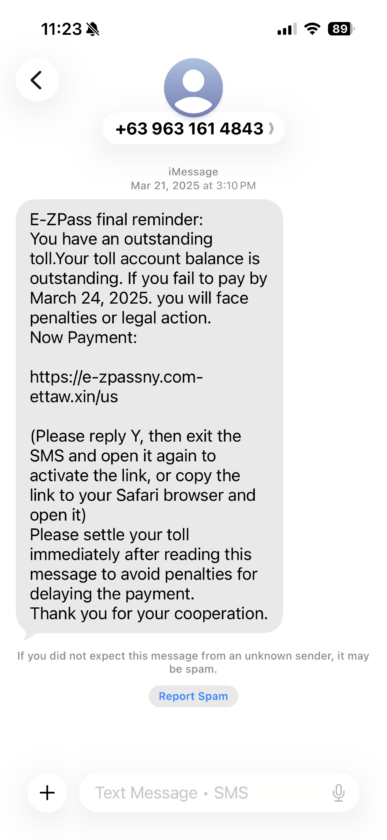
The attorney general additionally issued a new consumer alert residents to fraudulent text messages claiming unpaid tolls or tickets. Toll and ticket scams are designed to steal personal and financial information, often pressuring recipients to act quickly to avoid penalties. (Photo courtesy of the Michigan Department of Attorney General)
ESCANABA — In light of ongoing scams, Michigan Attorney General Dana Nessel and the Delta County Sheriff’s Office are warning the public to stay vigilant.
On Thursday, Nessel reissued her phishing and website spoofing consumer alerts following reports of fraudulent Facebook event pages impersonating art fairs and festivals, including Plymouth’s Art in the Park.
Spoofing is described by the Federal Communications Commission as when a caller deliberately falsifies the information transmitted to a caller ID to disguise their identity.
The Michigan Attorney General’s Office said the fake event pages on Facebook often use real photos, descriptions and branding to appear legitimate to vendors and the public.
Vendors are often instructed by scammers to reserve booth space via text message and send payments through Zelle directly to the individuals operating the accounts, according to the attorney general’s office.
“Spoofing scams like this one harm both businesses and the public,” Nessel said. “They can damage the reputations of prominent art fairs and festivals, erode customer trust, and lead to hard-working entrepreneurs getting scammed out of their money. Before submitting payments to hold a spot, vendors should verify the event through its official website.”
According to the attorney general, spoofed Facebook pages are often recently created and have very few followers. Legitimate art fairs’ and festivals’ pages are typically more established and do not usually demand immediate payment from prospective vendors.
Officials also recommend using a credit card with fraud protection whenever possible. Payments sent through apps or other non-secure methods are often difficult — if not impossible — to recover if they end up in the hands of a scammer.
The attorney general additionally issued a new consumer alert to warn residents of fraudulent text messages claiming unpaid tolls or tickets. Toll and ticket scams are designed to steal personal and financial information, often pressuring recipients to act quickly to avoid penalties.
“Fake toll and ticket texts have been sent to phones across Michigan for a while now, but fraudsters are constantly evolving to try to steal our hard-earned money,” said Nessel. “This alert will help residents stay a step ahead of these scams. Remember, if you receive one of these texts, don’t respond. Report them as spam on your device.”
The Delta County Sheriff’s Office also recently posted a warning about scams on its Facebook page.
“The Sheriff’s Office routinely takes complaints from citizens who have been the victim of a scam,” the Facebook post stated. “There are many different variations of scams out there, but one of the biggest indicators is when perpetrators request payment through gift cards.”
The post included a graphic outlining key warning signs to help spot scams. One of the most common scammer tactics is creating a sense of urgency — pressuring someone to act immediately before they have time to think or verify the situation.
Scammers can also rely on fear, such as impersonating a friend or family member or claiming that someone is in serious trouble, to manipulate targets into responding quickly.
Another warning sign is a request for sensitive information, such as Social Security numbers, passwords or financial details. Scammers can become aggressive or threatening if questioned, or claim victims have won a prize from a contest they never entered to prompt quick action.
The public should be wary of scammers requesting payments through unusual payment methods, including gift cards, Bitcoin ATMs, cash transfer apps or other cryptocurrencies.
The attorney general’s office cited recent data from the Federal Trade Commission in a news release, stating that Americans reported losses exceeding $228 million to gift card scams in 2023 alone, with the actual number likely higher due to under-reporting.
In January 2023, Nessel created the Focused Organized Retail Crime Enforcement, or FORCE, team to combat organized retail crime in Michigan.
“Organized crime syndicates are increasingly conducting large-scale retail fraud here in Michigan and across the country,” Nessel said. “I am proud of the work my FORCE Team does with Michigan State Police and the Postal Inspection Service to stop these illegal schemes and hold those responsible accountable.”
The sheriff’s office advises residents to trust their instincts — if something feels off or too good to be true, it likely is.
“If you are ever in doubt, call your local police department,” the sheriff’s office wrote.
Those who believe they have been targeted by a scam are encouraged to file a complaint with the Michigan Attorney General’s Office and sign up for email alerts on the office’s website.
—-
Sophie Vogelmann can be reached at 906-786-2021 or svogelmann@dailypress.net.
Local News
Soo Locks bottleneck after opening
SAULT STE. MARIE -- Though the Soo Locks opened for the season on Wednesday, a standstill followed. As ice ...

We Rock the Spectrum fun for kids of all abilities
Michigan officials warn residents of ongoing scam tactics
Ludington Street construction is needed despite disruption, DDA chair says

Investigating maple for rehydration