Gladstone commission faces disgruntled citizens
City adopts budget and PA 33 tax, hears from public
-
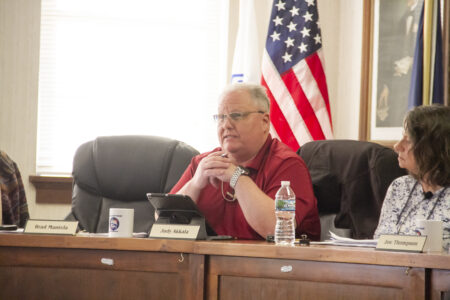
- On Monday, Gladstone City Commissioner Brad Mantela addresses claims about city spending made in a citizen-sent mailer. Commissioners, attorneys and audits all indicate that Gladstone’s taxes and spending are being done properly. (R. R. Branstrom | Daily Press)
-
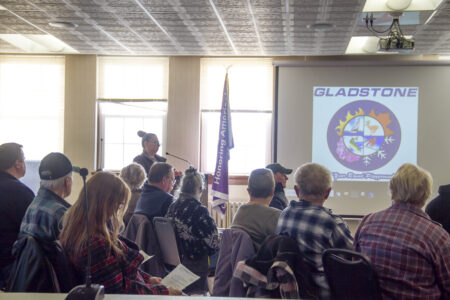
- A Gladstone resident raises questions and expressions frustration over the tax bill. Though commissioners were not allowed to respond at Monday’s meeting, they encouraged citizens to reach out to commissioners or city staff by email or phone. (R. R. Branstrom | Daily Press)
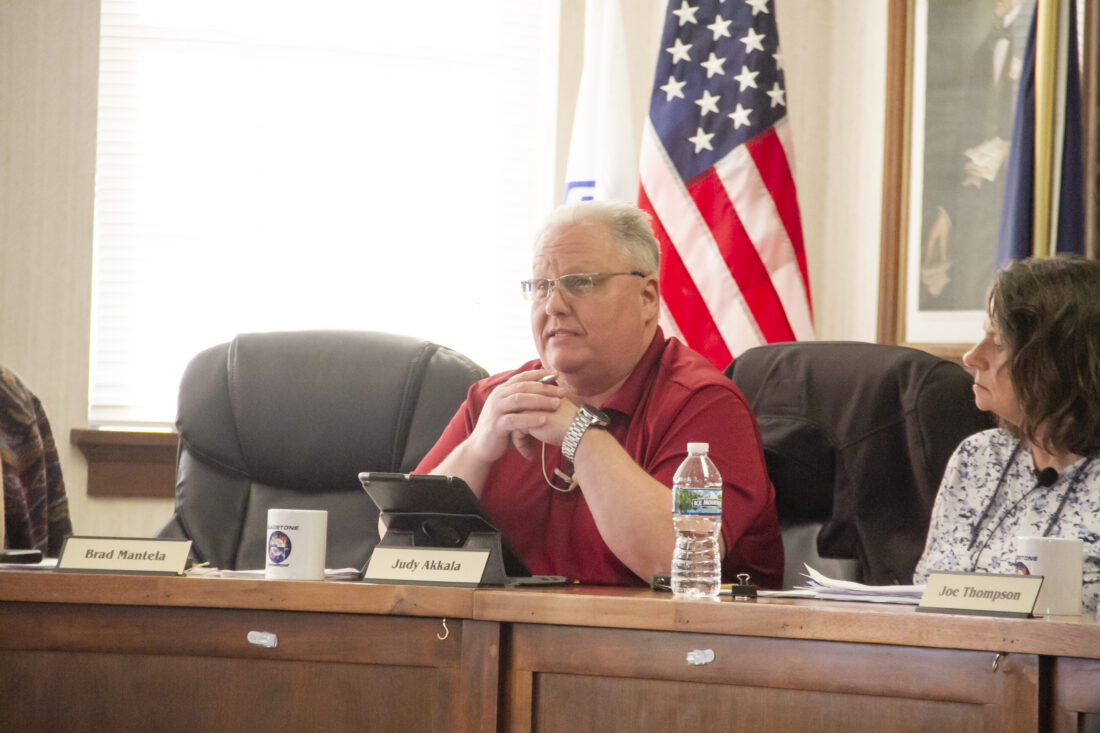
On Monday, Gladstone City Commissioner Brad Mantela addresses claims about city spending made in a citizen-sent mailer. Commissioners, attorneys and audits all indicate that Gladstone's taxes and spending are being done properly. (R. R. Branstrom | Daily Press)
GLADSTONE — In Gladstone City Hall, public hearings for the city budget as well as for repeated implementation of Public Act 33 — a tax assessment to fund police and fire — took place on Monday evening. Roughly 15 members of the public — which is about 14 more than usual — attended the Gladstone City Commission meeting of which the hearings were part.
The commission approved the presented budget and renewed Public Act 33 of 1951 (PA 33), which will again impose 4.5 mills on property owners over the next year. A mill is one-tenth of a percent of property value.
During the hearings at the start of the meeting, a few people expressed frustration with taxes, a couple spoke in support, but most seemed to have questions. Some people’s questions were personal and specific — such as how much their taxes personally would go up — while others asked about the management of funds for public safety.
“I’d like to see printed somewhere what our officers are responding to on a weekly basis — and/or our fire department, that way people might get a better grasp of what they’re paying for,” said Jacqueline Burton.
“If you raise taxes, it should be voted on,” said Bob Westerlund. “I’m a senior citizen… My wages don’t go up as fast as my taxes and everything else does. You’re taxing senior citizens out.”
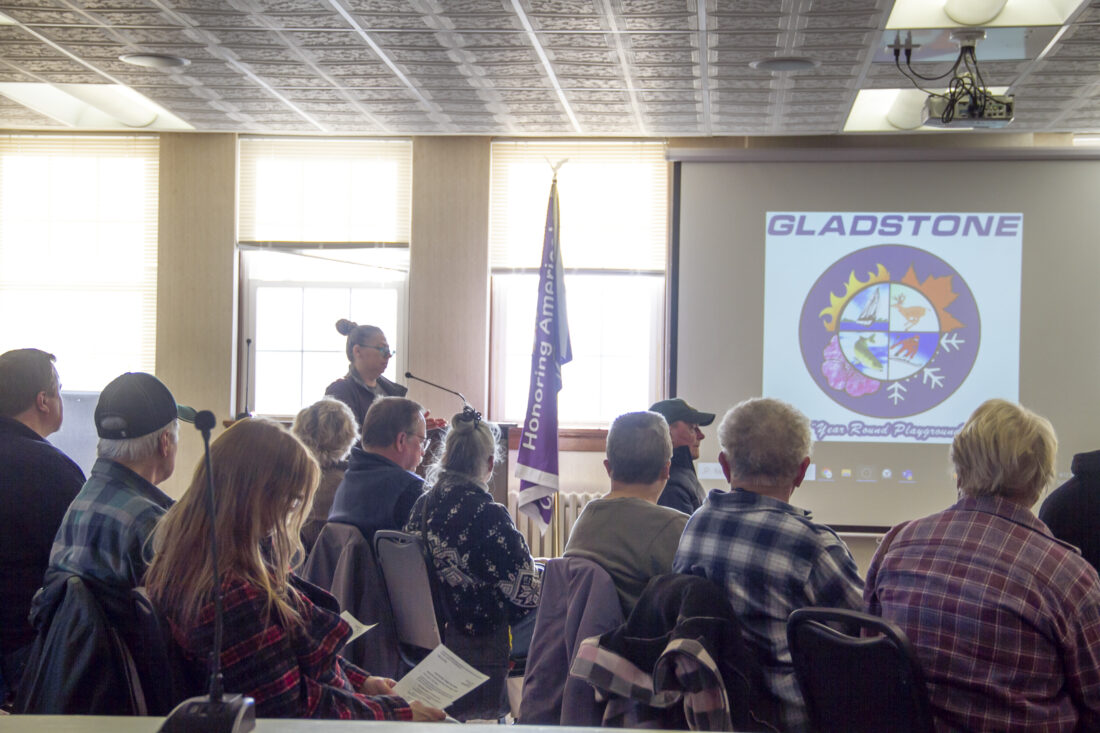
A Gladstone resident raises questions and expressions frustration over the tax bill. Though commissioners were not allowed to respond at Monday's meeting, they encouraged citizens to reach out to commissioners or city staff by email or phone. (R. R. Branstrom | Daily Press)
Communities with populations of less than 15,500 people are qualified to utilize PA 33, and they may — but are not required to — put it to a vote of the citizens. Voters in the city did not get a chance to vote for PA 33, which was first set in place in Gladstone in 2024.
One member of the public who spoke at the podium during the hearing on Monday was former city commissioner Robert Pontius, who thanked the current board for making sure police and fire were funded thoroughly, remarking that law enforcement is a “core functionality” and necessary. “This isn’t something that’s optional, something that is an add-on — this is extremely important,” Pontius said.
But being taxed always rubs lots of people the wrong way.
Upset with having to pay certain city-imposed taxes, the populace voted in November 2024 to remove the municipality’s ability to levy special assessments from its charter.
Under the type of special assessments the City of Gladstone used to levy before that point to pay for public improvement projects, the cost to citizens was supposed to correlate with the value of their property and with the project. Because of the 2024 vote, the city no longer has the capacity to charge citizens in that way.
The tax applied through PA 33 is also referred to as a “special assessment” and is also calculated based off a property’s taxable value; however, rather than going towards a permanent physical feature like road surface, money collected through PA 33 is specifically for police and fire. In the City of Gladstone, that means its Public Safety Department.
Although Gladstone voters removed the city’s authority to levy regular special assessments by striking it from the charter, a city charter change is not able to remove the state-approved PA 33, which has again been applied for a third year.
In the 2024 to 2025 fiscal year, 4.5 mills was collected through PA 33. $538,405 was raised that year and again in 2025 to 2026.
Portions of the amount gathered have been bookmarked for different things. Some has been spent, while in other areas the account continues to grow.
The first year, $155,000 went towards a new fire truck; $50,000 to roof repair; $44,000 for firefighter and public safety gear; $53,000 towards a fund for a new squad car; $60,000 for a school resource officer; and $176,405 went towards regular operations.
The roof of the public safety building has been repaired, the resource officer secured, and regular operations of course have been funded.
The Gladstone Public Safety Department continues to save money for new vehicles and seeks new officers to hire.
In approving the budget on Monday, the Gladstone City Commission agreed to levy 4.5 mills for PA 33 again. Two mills will appear on the summer tax bill, while 2.5 will be charged in winter.
Gladstone City Manager Rob Spreitzer reminds residents that the tax only applies to property owners and will not be charged to renters. Additionally, he pointed out that while the city collects taxes, only a portion stays in the city itself; much is distributed. Some of the total collected go to the Intermediate School District, Bay College, Community Action, DATA, 911 dispatch, Gladstone Area Schools, Veterans Affairs, etc.
Another item for irritated taxpayers to note: Since the Gladstone Area Schools’ bond debt has decreased and their attempts at a new bond proposal were shot down, Gladstone residents may find that their total tax bills in 2026 are lower than they were in the years prior.
One Gladstone resident who’s fought the city before, Mike O’Connor — also known as “Citizen Mike” — is again arguing that the city is defrauding its citizens. Prior to this week’s meeting, he sent mailers to residents, urging them to ask questions about why their rates were so high. O’Connor’s answer is that the city is illegally applying PA 33 and overbilling for utilities to pay off a retirement fund debt.
Since O’Connor reports that he has filed a complaint with the Michigan State Police that was referred to the Attorney General’s Office, the Daily Press has reached out to both entities for comment and is awaiting responses.
But city staff and commissioners have met with O’Connor to try to understand where his math is coming from and to explain that all the money Gladstone spends and collects is accounted for.
During the time for commissioners’ comments at the end of this week’s meeting, Commissioner Brad Mantela took time to address claims in the mailer and explained that each payment the City of Gladstone receives and spends is properly documented.
Each year, the city is audited by professional certified public accountants. Anderson, Tackman and Company reviews, line by line, the money coming into and out of each city fund. While there have been the occasional small errors that are rectified, the firm has stated that the city’s accounting practices are in accordance with the law and found no fraud.
Past audits by Anderson, Tackman & Co. are visible on the city’s website at Gladstone.mi.gov, as are details on the new budget for 2026 to 2027 — which was approved on Monday — as well as those for previous years.
Regardless, recognizing that there has been confusion among residents and taxpayers, Spreitzer said on Wednesday that he’d like to work on ways the City of Gladstone can make their messages to residents clearer, perhaps including plainer explanations alongside the legal speak that gets mailed out.
Local News
Gladstone commission faces disgruntled citizens

Bus to local casino crashes in Green Bay
Tweet Garot Mechanical expands to UP; acquires Prime Specialty Contracting
ESCANABA – Tweet Garot Mechanical, a long-standing mechanical contracting firm from Wisconsin, has acquired Prime ...
Local teacher’s aide charged with child abuse
Hard-working road crews still at it