
Students practice water filtration
and learn about VanAire's real-world applications
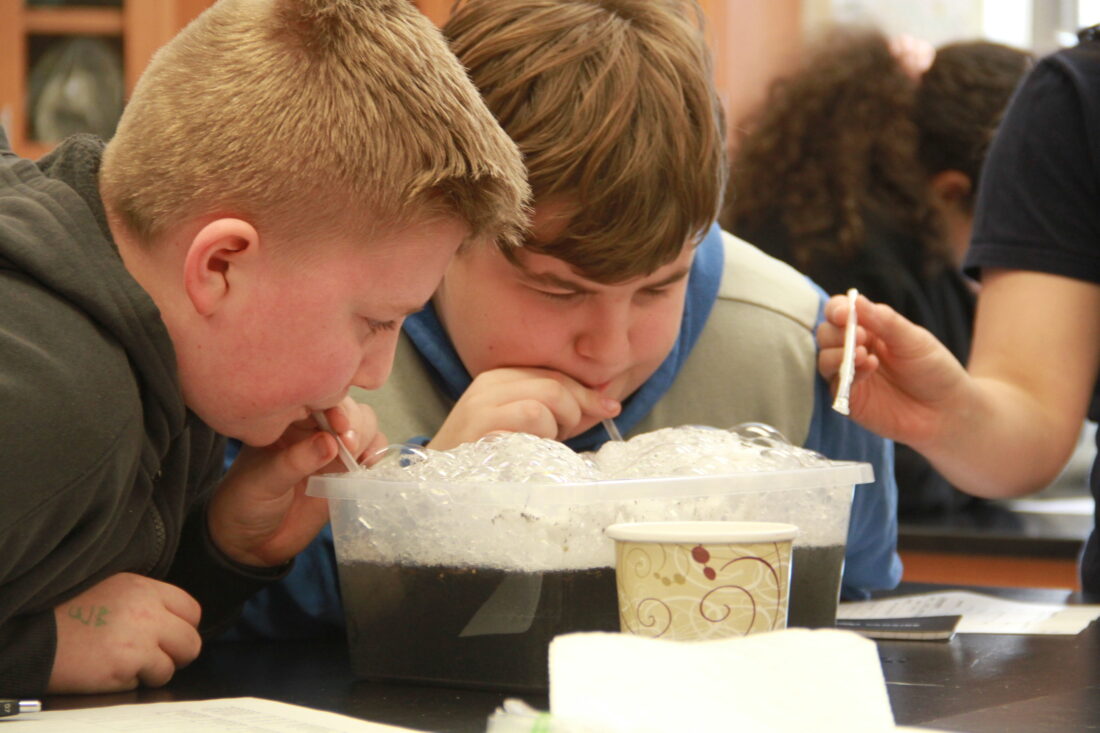
Using straws serving as aerators, Thomas Ketchum and Braxton Bullard blow bubbles into a container of dirty water to see what effect it will have. (R. R. Branstrom | Daily Press)
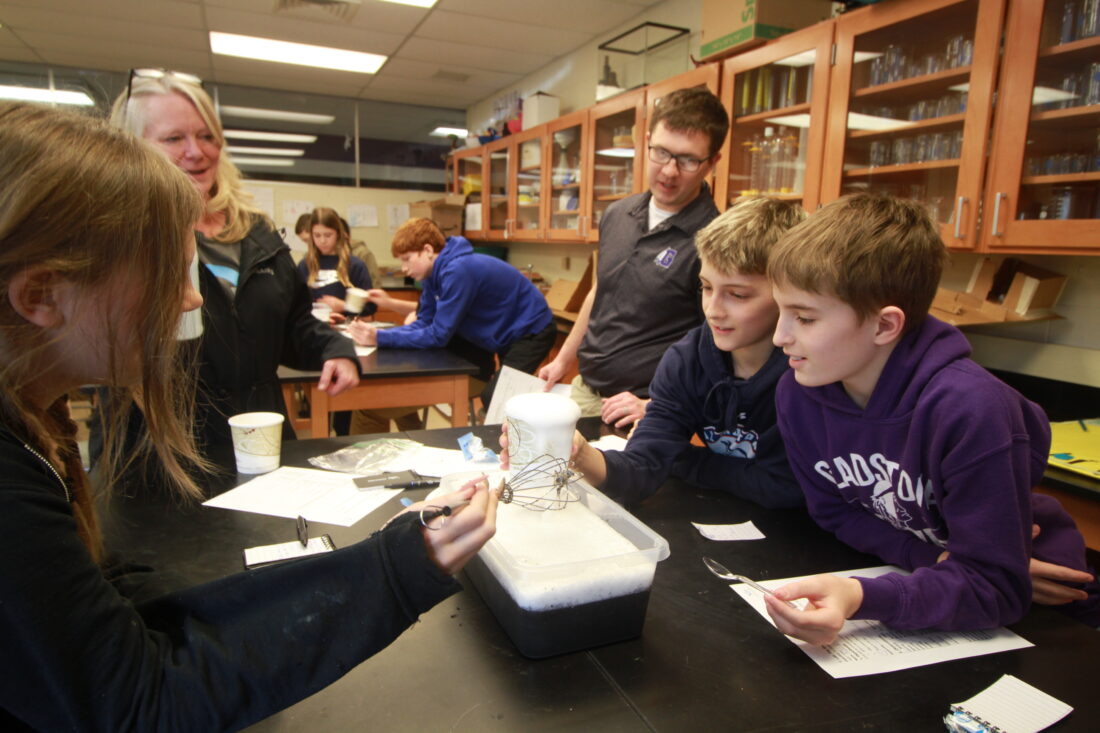
Sixth-graders Madalynn Moose, Avery Silta and Abel Ellison prepare to pour a solution of baking soda and vinegar into the container before them during a lab on Wednesday while Jodi Possi from VanAire and teacher Carlton Isaacson watch. (R. R. Branstrom | Daily Press)
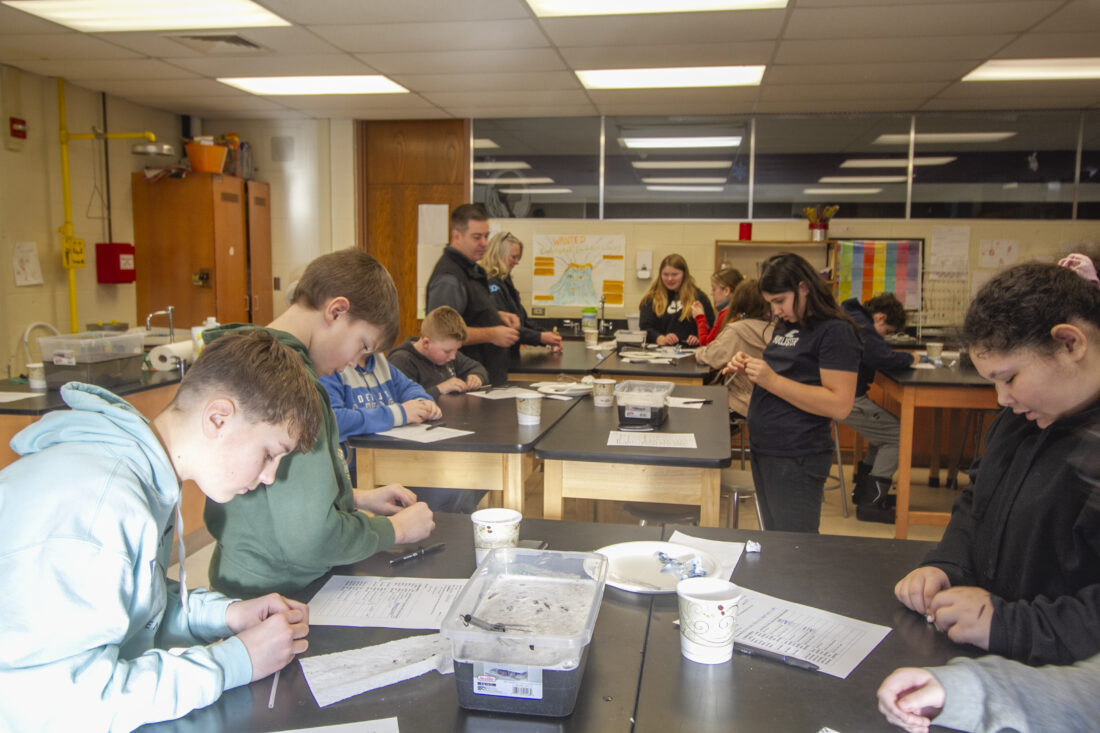
Students poke holes in straws they will use as aerators during a water filtration experiment conducted by VanAire in Mr. Isaacson's sixth-grade science class. (R. R. Branstrom | Daily Press)
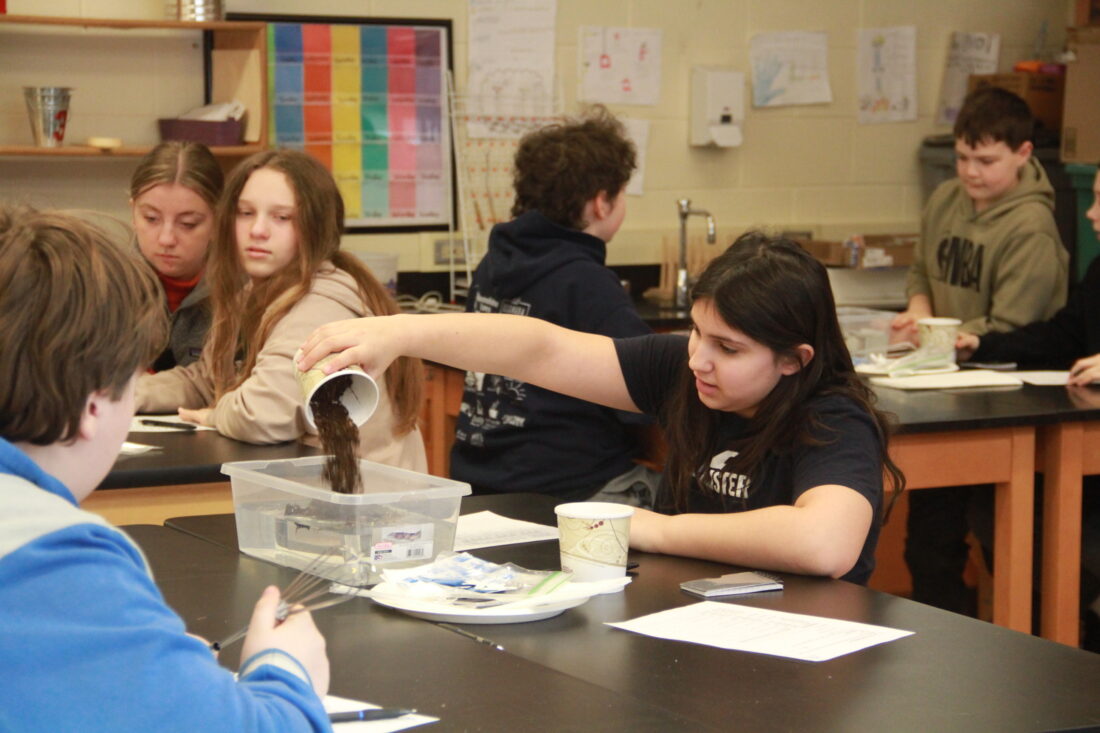
Caroline Bojorquez pours potting soil into a container holding water as one of the first steps of a lab conducted at Gladstone Middle School recently. (R. R. Branstrom | Daily Press)
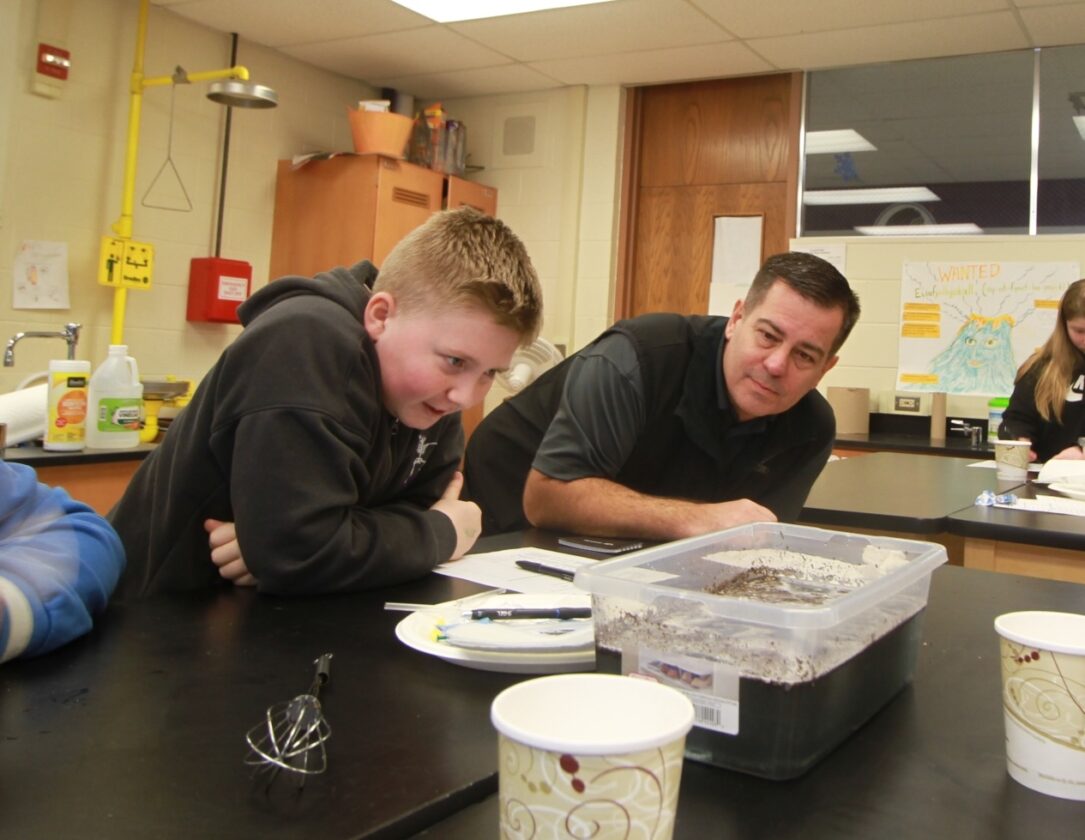
While looking at the subject of the day's experiment, sixth-grader Thomas Ketchum hypothesizes to Jeff Torvinen of VanAire about what he thinks will happen during the course of the activity. (R. R. Branstrom | Daily Press)
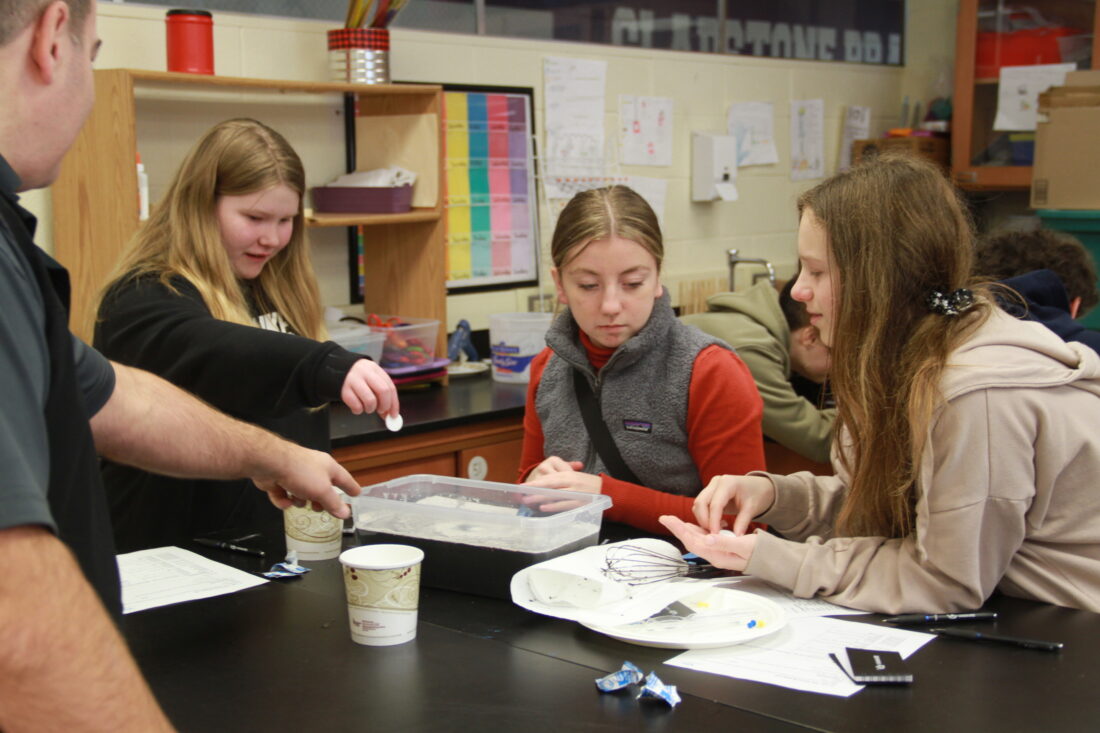
Grace Ford, Sarah Wetthuhn and Samantha Herbert introduce cleaning tablets to the mixture of dirty water before them under the eye of VanAire Wastewater Systems Director Jeff Torvinen. (R. R. Branstrom | Daily Press)
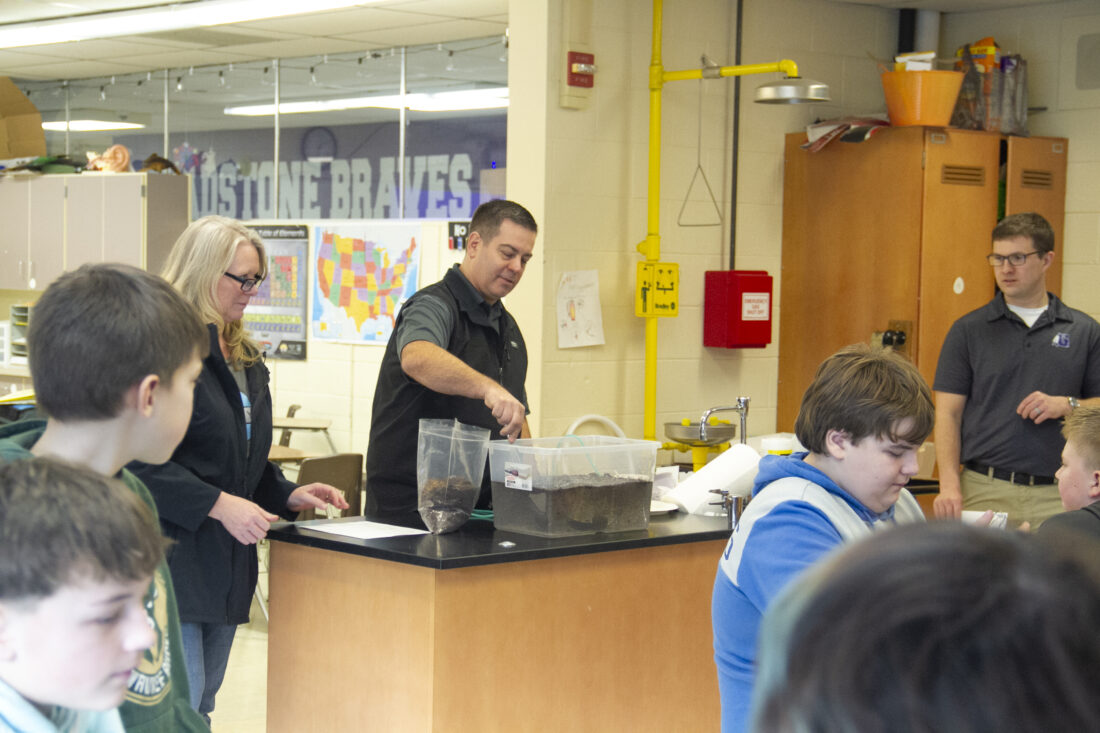
VanAire Wastewater Systems Director Jeff Torvinen shows students what steps they will need to take during a hands-on lab while his colleague Jodi Possi (left) and Gladstone Middle School science teacher Carlton Isaacson (right) watch. (R. R. Branstrom | Daily Press)
Using straws serving as aerators, Thomas Ketchum and Braxton Bullard blow bubbles into a container of dirty water to see what effect it will have. (R. R. Branstrom | Daily Press)
Sixth-graders Madalynn Moose, Avery Silta and Abel Ellison prepare to pour a solution of baking soda and vinegar into the container before them during a lab on Wednesday while Jodi Possi from VanAire and teacher Carlton Isaacson watch. (R. R. Branstrom | Daily Press)
Students poke holes in straws they will use as aerators during a water filtration experiment conducted by VanAire in Mr. Isaacson's sixth-grade science class. (R. R. Branstrom | Daily Press)
Caroline Bojorquez pours potting soil into a container holding water as one of the first steps of a lab conducted at Gladstone Middle School recently. (R. R. Branstrom | Daily Press)
While looking at the subject of the day's experiment, sixth-grader Thomas Ketchum hypothesizes to Jeff Torvinen of VanAire about what he thinks will happen during the course of the activity. (R. R. Branstrom | Daily Press)
Grace Ford, Sarah Wetthuhn and Samantha Herbert introduce cleaning tablets to the mixture of dirty water before them under the eye of VanAire Wastewater Systems Director Jeff Torvinen. (R. R. Branstrom | Daily Press)
VanAire Wastewater Systems Director Jeff Torvinen shows students what steps they will need to take during a hands-on lab while his colleague Jodi Possi (left) and Gladstone Middle School science teacher Carlton Isaacson (right) watch. (R. R. Branstrom | Daily Press)
Trending
GLADSTONE — This week, sixth-grade students at Gladstone Middle School participated in a science experiment led not by their usual teacher, Carlton Isaacson, but by a special guest team -- Jodi Possi and Jeff Torvinen, representatives from local business VanAire.
The lesson, which gave the kids a chance to engage in a hands-on activity that illustrated in the classroom a process related to the water filtration that VanAire and its clients perform on a grander scale, was one step towards participation in Design-an-Ad, a program through the Daily Press that challenges schoolchildren to draw advertisements for local companies.
The local newspaper has annually partnered with area schools and business for Design-an-Ad for over 30 years. Each year, when the project is announced, some long-time participants sign up, and occasionally different businesses or teachers jump aboard as well.
This year, Gladstone science teacher Carlton Isaacson is participating in Design-an-Ad for the first time. Wanting to be able to connect the project with school curriculum, he asked the Daily Press to set him up with a company whose work involves something science-related.
Enter VanAire, a precision manufacturer headquartered in Gladstone that designs and produces valve automation hardware and water filtration equipment. They've been housed in the industrial park atop the bluff for decades, but 2026 is the first year they decided to let schoolchildren create ads for them through the Daily Press initiative.
Upon learning that they would get the opportunity to meet with the class and explain what VanAire does to the students before instructing them to create print advertisements for the company, Human Resources Director Possi and Wastewater Systems Director Torvinen -- with the aid of ChatGPT -- developed a lab experiment tailored to the sixth-graders at Gladstone Middle School.
It fit in incredibly well to the given time period, and during the session, Isaacson was able to build on the topics Possi and Torvinen mentioned by asking his students to recall what they had learned about water earlier in the year. The class is currently studying the five senses, and will find tie-ins to that curriculum, too.
In order to help the kids understand how systems developed by VanAire help major companies like Haribo, McDonalds, Perdue and more clean water for food processing and other important jobs through dissolved air flotation, the lab featured multiple methods for using air to clean dirty water.
Split into group of about three to four, students first made containers of water dirty by pouring soil into the containers and stirring the mixtures. They hypothesized about what would happen to the dirt if bubbles of air were introduced. One by one, they introduced a series of air-bubble-producing substances and observed the ensuing reactions.
The students tried denture cleaning tablets, alka-seltzer, baking soda and vinegar, and breath-fueled aerators (blowing through plastic straws). Through each method, they noticed, a little bit of dirt was carried to the top of the water after hitching a ride on the rising bubbles.
Following the lab, Isaacson's students watched two videos prepared by VanAire that showed their products in action and explained a bit about the company.
The kids were challenged to brainstorm over the weekend. Next, they will be tasked with drawing ads for VanAire, which will be submitted to the Daily Press and then to VanAire to select a winning design for publication in the paper.
Other businesses will be partnering with other classes at various grade levels on similar Design-an-Ad projects. Winning student designs will be printed in late March.
– – –
R. R. Branstrom can be reached at rbranstrom@dailypress.net and 906-786-2021, ext. 140.