Marquette and Oshkosh athletes to test new sport in Germany
U.S. luge team trains in Negaunee
-

- Mason Palacek of Oshkosh, Wis. and Thomas Matthews of Marquette, Mich. pose for a photo between races at the Alpine Luge World Cup this year. They competed alongside USA teammates Katie Cookman, Torrey Cookman, Elise Palecek and McKenna Wnuk, all of whom have returned home for school. The two pictured currently remain in Europe to test out a new iteration of luge. (Courtesy photo)
-
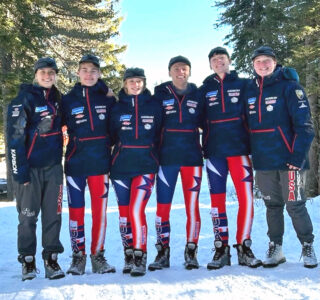
- The team representing the USA in natural/alpine luge events in 2025 to 2026 is shown. From left to right are McKenna Wnuk from Lapeer, Mich.; Thomas Matthews of Marquette, Mich.; Katie Cookman of Marquette, Mich.; Torrey Cookman of Marquette, Mich.; Mason Palecek of Oshkosh, Wis.; and Elise Palecek from Oshkosh, Wis.
-
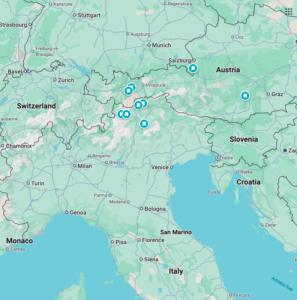
- Flagged on the map are natural luge tracks where international competition was held in the 2025 to 2026 season. The northernmost marked spot — south of Salzburg — are where two American athletes from the U.P. and Wisconsin will test out alpine luge this weekend. (R. R. Branstrom)
-
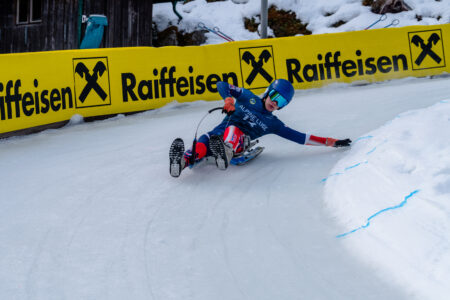
- It takes practice, skill and use of legs and arms to navigate curves on a sled. (Courtesy photo)
-
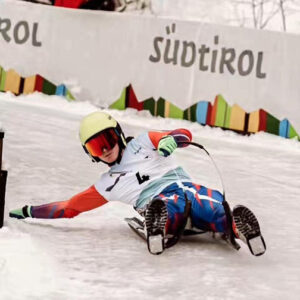
- Leonard Pizziola of Ishpeming slides down a track in the European Alps during the 2024 winter natural luge season. (Photo courtesy Laura Farnsworth via the Mining Journal)
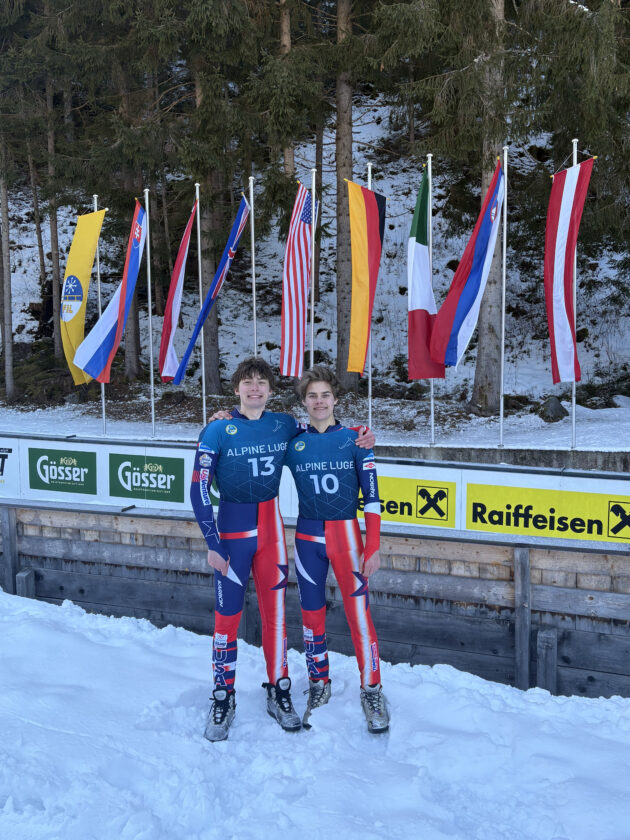
Mason Palacek of Oshkosh, Wis. and Thomas Matthews of Marquette, Mich. pose for a photo between races at the Alpine Luge World Cup this year. They competed alongside USA teammates Katie Cookman, Torrey Cookman, Elise Palecek and McKenna Wnuk, all of whom have returned home for school. The two pictured currently remain in Europe to test out a new iteration of luge. (Courtesy photo)
ESCANABA — Two members of the USA National Alpine Luge Team — 16-year-old Thomas Matthews of Marquette, Mich. and Mason Palecek, 18, from Oshkosh, Wis. — will be sliding in the official rollout of alpine luge in Berchtesgaden, Germany this weekend.
The U.S. alpine luge team, of which Matthews and Palecek are just two members, practices on the only track of its kind in North America — which is located in Negaunee in Michigan’s Upper Peninsula.
Luge, a sport that involves sledding down an icy track, is one of three major “sliding” sports, the others being bobsled and skeleton. Luge sliders lie on their sleds supine (face-up) and feet-first.
There are two main types of luge: artificial, which takes place on constructed tracks with banked walls and artificial refrigeration; and natural (or “naturbahn”), which is the kind that has been practiced at Lucy Hill in Negaunee. However, what is called alpine luge is emerging and may end up replacing natural.
Past slider and current coach of the U.S. alpine luge team, Keith Whitman of Escanaba, recently sat down with the Daily Press to explain how the sport is evolving.
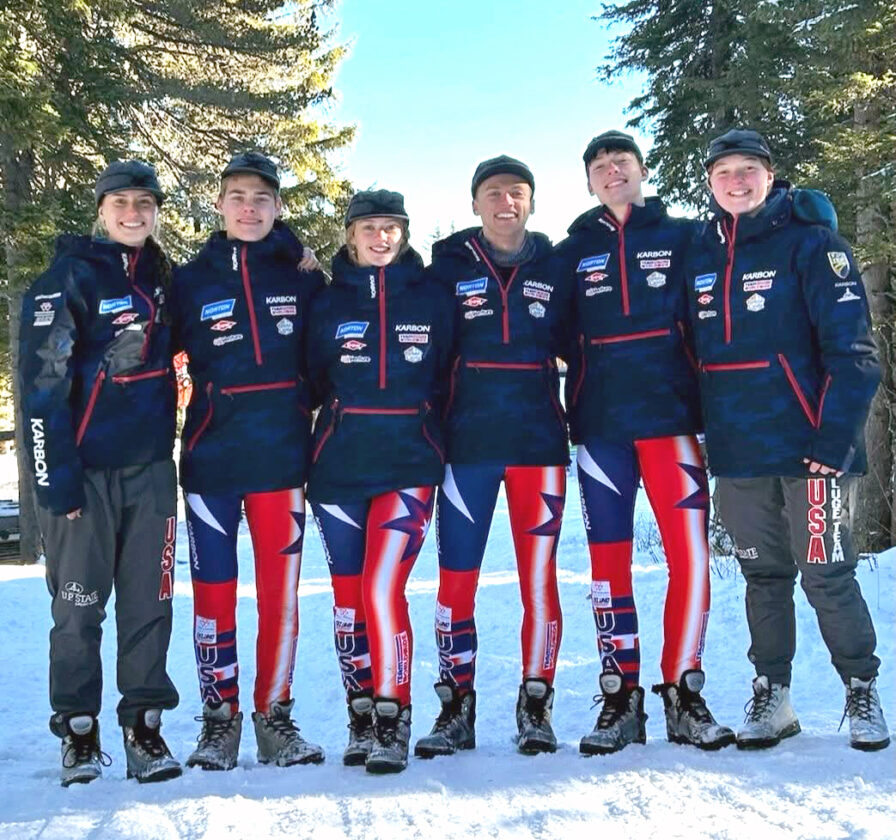
The team representing the USA in natural/alpine luge events in 2025 to 2026 is shown. From left to right are McKenna Wnuk from Lapeer, Mich.; Thomas Matthews of Marquette, Mich.; Katie Cookman of Marquette, Mich.; Torrey Cookman of Marquette, Mich.; Mason Palecek of Oshkosh, Wis.; and Elise Palecek from Oshkosh, Wis.
While artificial luge is presently the only type of luge in the Olympics, organizers and athletes of natural luge are hoping to transition towards an alpine variety that may also become an Olympic sport. Natural luge traditionally includes wooden walls, which can be dangerous; alpine runs would be performed on existing ski slopes and might use hay bales or snow for its walls, said Whitman. It would be somewhat slower, safer, and the sled would probably be slightly different.
As the natural track in Negaunee is the only one on the continent, creating a similar sport that could be enjoyed on ski slopes — which already exist in far more places — would make luging accessible to more people. Additionally, ski hill venues could offer more space for viewers.
Up until 2025, the U.S. team that trains in Negaunee was known as the U.S. Natural Luge Team, and the global competitions they attended in Europe were part of the Natural Track Luge World Cup. Through the International Luge Federation (FIL), the world championships have taken place since 1979. A junior competition was added a few years later.
This season — which began in 2025 — the event began its rebrand. When the team roster was announced in November, it bore the new name of the sport.
The 2025 to 2026 U.S. Alpine Luge Team includes co-captain Torrey Cookman, aged 21, from Marquette, Mich.; co-captain Katie Cookman, age 18, from Marquette; Thomas Matthews, age 16, also from Marquette; Mason Palecek, 17, of Oshkosh, Wis.; Elise Palecek, age 20, Oshkosh, Wis.; and McKenna Wnuk, age 21, from Lapeer, Mich.
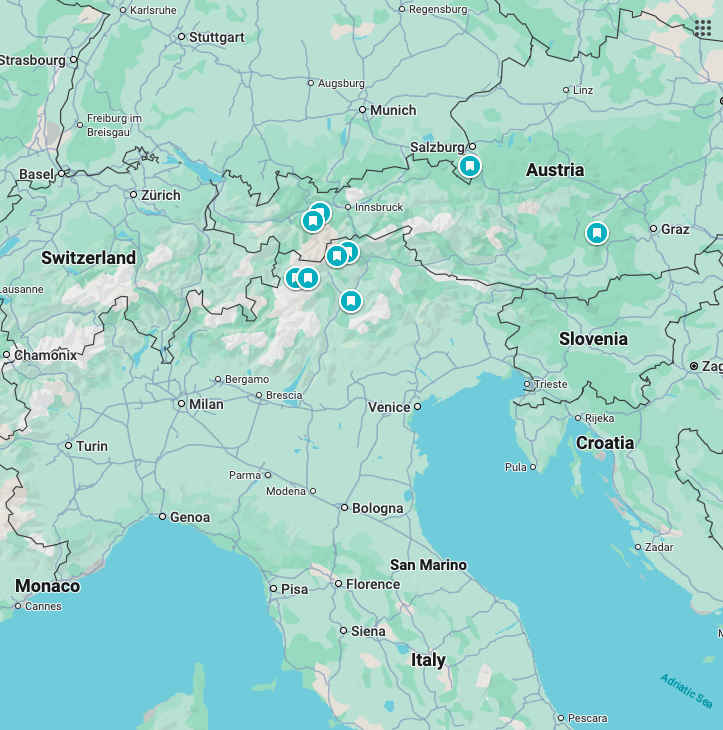
Flagged on the map are natural luge tracks where international competition was held in the 2025 to 2026 season. The northernmost marked spot -- south of Salzburg -- are where two American athletes from the U.P. and Wisconsin will test out alpine luge this weekend. (R. R. Branstrom)
From December and into February, the world championships took place at a handful of slopes in Austria and Italy — as they have in past years. Though the sliders used the same sleds as they had in previous years and raced on the same natural luge tracks, this season the event was called the “Alpine Luge World Cup.”
Torrey, Katie, Mason, Elise, Thomas and McKenna practiced and competed on hills in Winterleiten, Umhausen, Passeiertal, Deutschnofen, Laas, Latsch and Jaufental — all in the Italian and Austrian Alps. Those participants aged 20 and under were eligible to participate in Junior World Cup events, which were also held in the same region in December through February.
With education prioritized over athletics, some of the American students had to head back home before the end of the championship for school.
Now, Thomas and Mason are the only athletes from the U.S. team remaining in Europe. They’ll get the opportunity to take part in the “testrennen” (test race) of alpine luge at Jenner Berchtesgaden in Germany — on the Austrian border, just a little south of Salzburg.
“The development of the new sports equipment continues,” stated the FIL about the test racing on its website. “At the end of February, various race formats and equipment set-ups will be tested under competition conditions in the Jenner ski area in Berchtesgaden.”
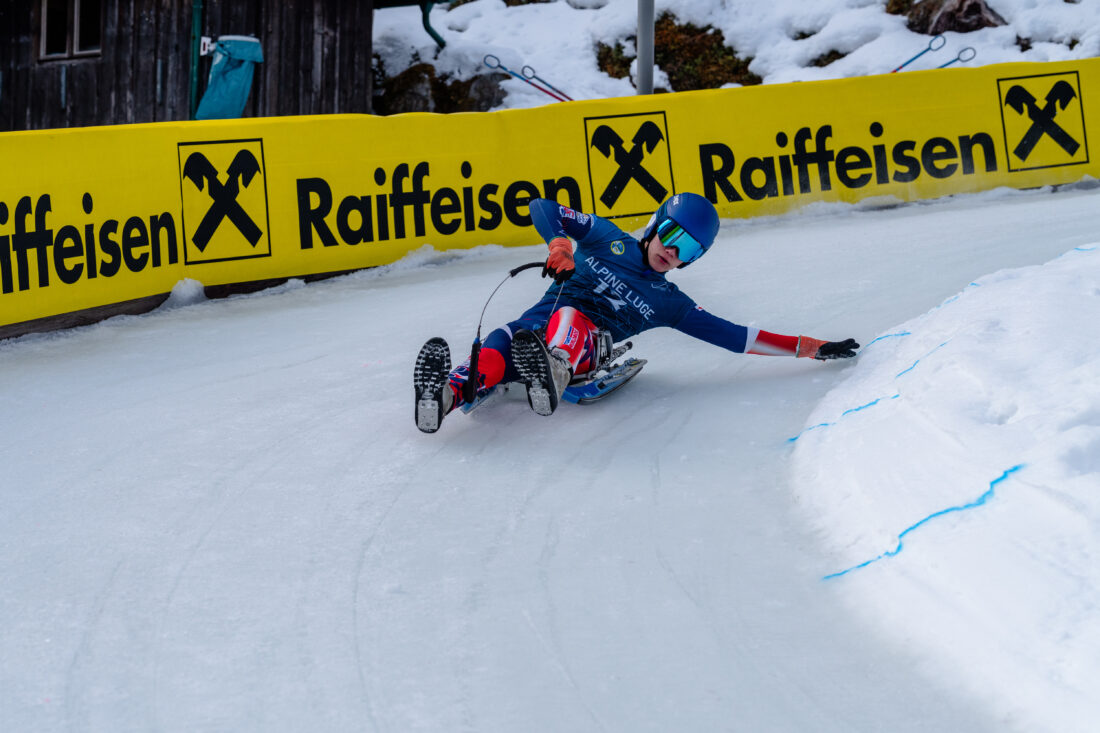
It takes practice, skill and use of legs and arms to navigate curves on a sled. (Courtesy photo)
Though the transition began this year with calling the existing sport “alpine luge,” the sliders so far this year have only practiced and competed on the natural tracks they already know. This weekend’s testrennen will inform the FIL on what elements work — and how the world of non-artificial luge may soon change. The future is yet unknown.
It’s possible that natural tracks like the one in Negaunee may continue to be used for the newly-named sport, and that others on ski slopes will join the list. Presently, a list of 71 sites in Switzerland, Italy, Austria, Slovenia, Germany, Poland, Canada, Russia and New Zealand are named on the FIL site as hosting natural/alpine ice tracks.
“Alpine luge is held on natural ice and snow tracks,” states the FIL. “These are adapted to existing mountain paths and roads. Artificially banked curves are not permitted. The tracks’ surface must be horizontal. They are naturally iced; there is no artificial refrigeration.”
Of the 12 countries that competed in this season’s World Cup for alpine luge on natural tracks, the U.S. took fifth place in overall points.
To watch race footage, to see standings of the various events and to learn more about luge, people may visit www.fil-luge.org.
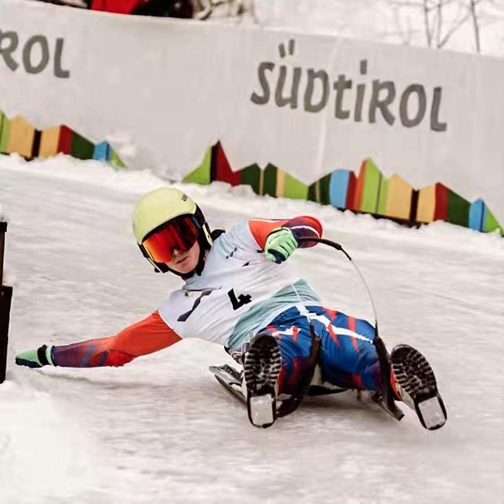
Leonard Pizziola of Ishpeming slides down a track in the European Alps during the 2024 winter natural luge season. (Photo courtesy Laura Farnsworth via the Mining Journal)
For those interested in trying out the sport themselves, the Upper Peninsula Luge Club opens Lucy Hill in Negaunee to the public on Saturdays from 10 a.m. to 12 p.m and 1 p.m. to 3 p.m. Reservations may be made at www.upluge.org.
– – –
R. R. Branstrom may be reached at 906-786-2021, ext. 140, or rbranstrom@dailypress.net.
Local News
Gladstone weighs public comment change, allows DDA to apply for grants
GLADSTONE — At their regular meeting on Monday, the Gladstone City Commission tabled the matter of possibly ...
Marquette and Oshkosh athletes to test new sport in Germany
Search continues for missing Marquette man
Daily Press’ ‘Moonlight and Memories’ Senior Prom canceled
ESCANABA - Due to unforeseen circumstances, the Daily Press’ ‘Moonlight and Memories’ Senior Prom has been ...
High wind cancels ski jumping