Escanaba City Council holds public hearing, approves golf cart resolution
Ebike discussion to follow
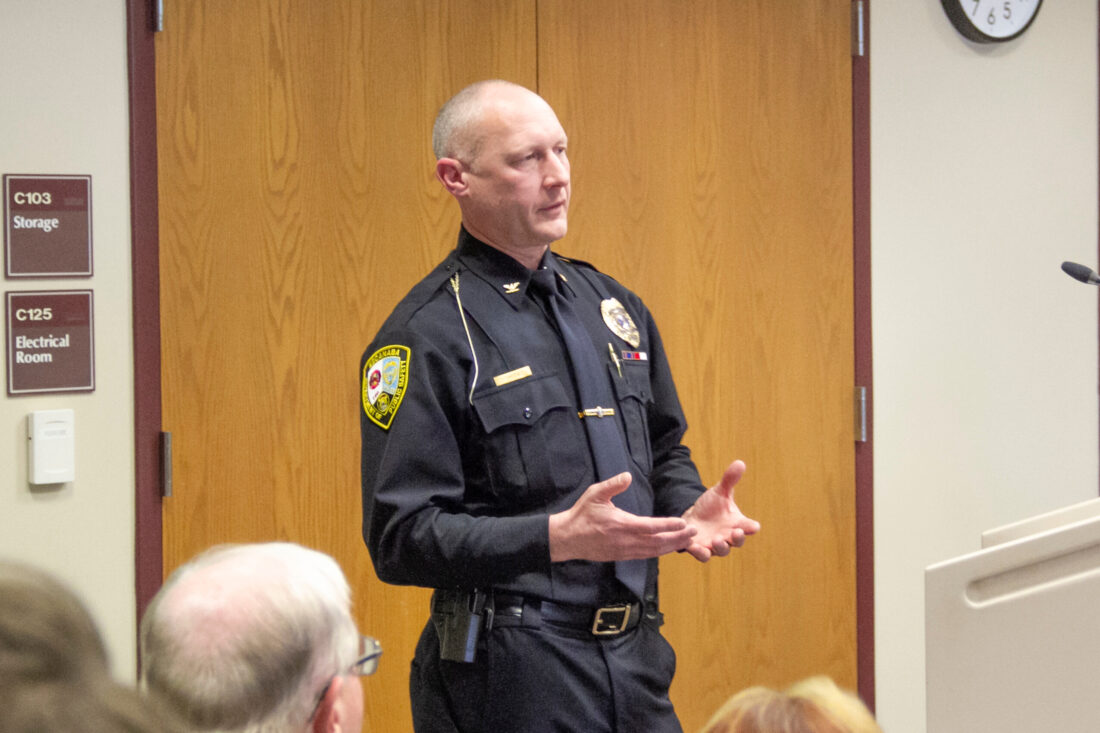
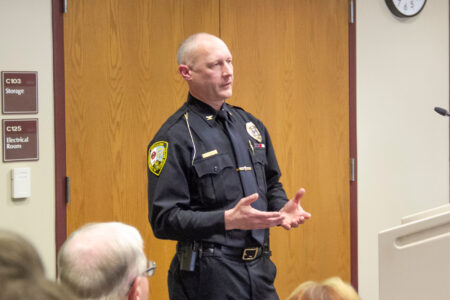
Escanaba Public Safety Director Darren Smith addressed the Escanaba City Council Thursday to recommend approval of Resolution 26-03, authorizing the operation of golf carts on designated public roadways within the city pursuant to Michigan Vehicle Code. (R. R. Branstrom | Daily Press)
ESCANABA – The Escanaba City Council on Thursday held the second public hearing on the city’s 2026-27 fiscal year budget preparation. This was the second of five scheduled public hearings on the matter.
During the public hearing, Executive Director Chelsea Hart of the Bonifas Arts Center in Escanaba addressed the board, thanking them for their continued support over the years.
“This year in particular, we needed to lean on our supporters as we navigated the aftermath of the fire we had last May,” said Hart. “But because we had champions to help us get back on our feet, we were able to pivot and continue providing arts and culture events, classes and shows to the community.”
The city provides annual financial assistance to the Bonifas, having provided $5,000 from the city’s general fund in the 2025-26 fiscal year budget.
Council also approved the proposed resolution authorizing the operation of golf carts on designated public roadways within the city.
Escanaba Public Safety Director Darren Smith addressed the council, noting he convened the Traffic Safety Advisory Committee on Tuesday to review the proposal. The committee supported the approval of the resolution.
“I recommend that we do allow and create a resolution to allow golf carts on public streets in Escanaba,” Smith said. “It doesn’t mean that it’s going to be a free-for-all and you can just do anything and go anywhere and create havoc.”
Under the Michigan Vehicle Code, golf cart operators must be at least 16 years old and possess a valid driver’s license. Operators must comply with traffic signal requirements and ride as far to the right of the road as possible. Helmets are not required.
The resolution further states golf carts may not be operated on sidewalks or pass between lines of traffic. Golf cart operators are limited to a maximum speed of 15 MPH and may only operate on streets with speed limits of 30 MPH or less.
Operation of golf carts is also prohibited from one-half hour before sunset to one-half hour after sunrise. Operators would be prohibited from driving golf carts on highways, though they may legally cross at intersections.
The approved resolution further details golf carts would not be permitted on several high-traffic streets identified by Smith, including Ludington Street, Lincoln Road, Stephenson Avenue, Sheridan Road, Washington Avenue, 10th and 14th streets, 3rd Ave S, 5th Ave S and 3rd Ave N . Smith stated this list is not all-inclusive.
“The officers have good discretion on how they handle things,” Smith said. “If we have repeat offenders, they’ll get citations. These are all local ordinance, civil infractions. Fines start at $50 and they can increase up to $250 or higher.”
Issues such as unsafe conditions – including exceeding passenger limits – would be left to an officer’s discretion.
“Our intent isn’t that people are driving across town in these,” stated City Manager James McNeil. “We would probably have to come back and tighten this up. But for the amount of historical traffic we’ve seen, this allows it to more or less continue and to kind of deal with the problems that we have seen.”
Council Member Tyler DuBord said the resolution could be revisited if further concerns arise.
“If we find from feedback from public safety that there’s concern, we can add more restrictions definitely to the ordinance or we could rescind it again,” DuBord said. “So it’s a trial thing, but I do feel that it does help the golfers be more at ease, too.”
DuBord added that some golfers have previously expressed concerns about being pulled over while traveling from their homes to the golf course within the city – a worry he said would likely be alleviated upon adoption of the resolution.
McNeil and Smith noted that public safety officials regularly receive complaints about golf cart use. The resolution aims to allow officers to devote their attention to higher-priority calls rather than responding to routine golf cart complaints.
“We get a lot of calls about people driving [golf carts], sometimes in a way that’s safe, sometimes in a way that’s not safe,” McNeil said.
McNeil noted that discussion of ebikes is to follow.
In other business, the council:
– Heard from four members of the Escanaba Yacht Club (EYC) who spoke during public comment regarding the proposed lease agreement with the city. Members highlighted the club’s longstanding role in the community, noting that the EYC has supported local initiatives and regularly opened its doors to the public. The council most recently discussed the lease at its Feb. 5 regular meeting, where council members indicated they would like an agreement that reflects rising costs and recognizes the harbor’s importance to the city. Representatives from the EYC were not in attendance at the Feb. 5 meeting.
– Approved hiring and retaining the services of Integrated Safety Solutions of Amherst Junction, Wis., for “Qualified Electrical Work Training” for the Water/Wastewater Departments in the amount not to exceed $6,000.
– Approved the purchase of a new mixer from Xylem Water Solutions of Pewaukee, Wis., for the Wastewater Department in the amount not to exceed $17,500.
– Approved a $137,814 bid from Roy Ness Contracting of Escanaba for new Escanaba Public Safety locker rooms and upgraded bathrooms. The project is expected to begin in March.
Local News
Manistique’s Highway 2 Community Drive-In Theater announces 2026 schedule
It’s ski jump weekend
Escanaba City Council holds public hearing, approves golf cart resolution
Proposal for psychiatric hospital replaces suggestion for ICE detention at former prison
Urgent need
MARQUETTE — The U.P. Regional Blood Center in Marquette is experiencing a critical need for blood donations of ...