Crucial commodity conveyed
Ice broken for salt
-
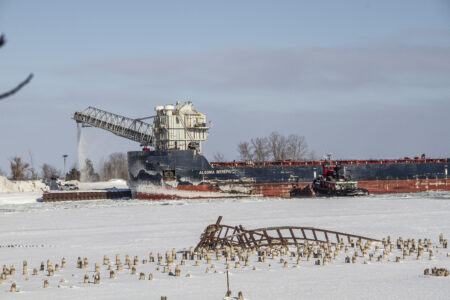
- Rock salt spews from the self-unloading arm on the partially-ice-encrusted Algoma Intrepid at the C. Reiss Company dock in Escanaba on Jan. 23 while the icebreaking tug Jimmy L works at her side. In the foreground, the skeleton of a former dock recalls Escanaba’s shipping history. (R. R. Branstrom | Daily Press)
-

- The stern of the Algoma Intrepid is shown from the U.S. Coast Guard Cutter Mackinaw near Beaver Island on Jan. 25 after leaving Escanaba to head towards Goderich, Ont. (Photo courtesy of U.S. Coast Guard)
-
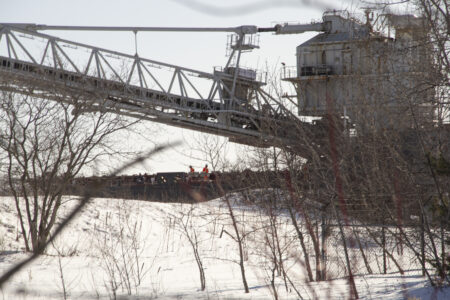
- Two workers in blaze orange walk along the deck of the Algoma Intrepid, docked in Escanaba. (Courtesy photo)
-
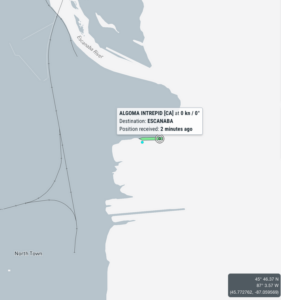
- The positions of the freighter Algoma Intrepid and icebreaking tug Jimmy L (represented by the dot near the bow of the big ship) are shown as they were in Escanaba at 12:45 p.m. on Jan. 23. (Screenshot from marinetraffic.com)
-
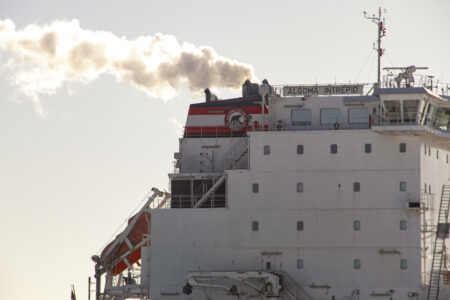
- The Algoma Central Corporation’s logo is seen atop the stern of the Intrepid, which made a delivery in Escanaba last week. (R. R. Branstrom photo)
-
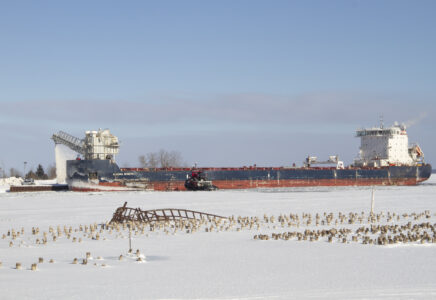
- As salt is dropped at the dock of a 146-year-old company, the remains of one of Escanaba’s former ore docks hearken back to the place’s reputation as a renowned hub. (R. R. Branstrom | Daily Press)
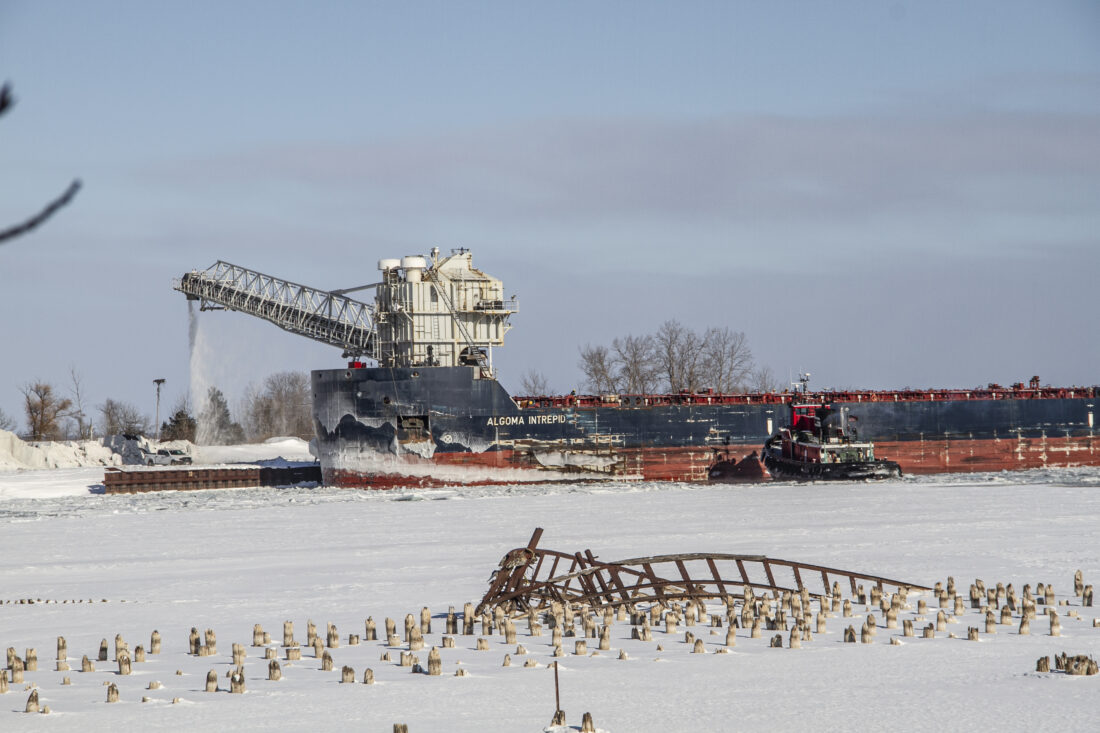
Rock salt spews from the self-unloading arm on the partially-ice-encrusted Algoma Intrepid at the C. Reiss Company dock in Escanaba on Jan. 23 while the icebreaking tug Jimmy L works at her side. In the foreground, the skeleton of a former dock recalls Escanaba's shipping history. (R. R. Branstrom | Daily Press)
ESCANABA — Last week, a Canadian freighter accompanied by an icebreaking tug chugged into Little Bay de Noc and delivered a massive load of salt to an Escanaba dock.
The buzz about the impending arrival of the boats caused excitement in the area. For one, with a nearly fully-frozen bay, some ice anglers were disgruntled that their activities were being disrupted. For another, a visit from a 650-foot-long freighter is worth recognizing.
The deepwater port of Escanaba used to see more shipping traffic when the town was host to multiple ore docks and various industries boomed. The harbor had six ore docks at one time, and in the 1980s, Escanaba was the busiest iron port in the world. Ore was shipped by rail to Escanaba from multiple mines in the region and then loaded onto boats for delivery elsewhere. Lumber and coal were heavily trafficked, too.
In modern day, the commodities and demand have changed. The mines that flourished a century ago are closed. Canadian National Railroad stopped using Escanaba’s last iron ore dock in 2017.
But the age of the freighter is not done.

The stern of the Algoma Intrepid is shown from the U.S. Coast Guard Cutter Mackinaw near Beaver Island on Jan. 25 after leaving Escanaba to head towards Goderich, Ont. (Photo courtesy of U.S. Coast Guard)
The behemoths that are lake freighters still shuttle cargo across the Great Lakes, enthralling fans who track, watch and photograph the massive vessels. Ships are still an essential form of commercial transport.
One company in particular has made a business of shipping resources in bulk in these waters for close to century and a half. It was their dock in Escanaba that received the 19,000-net-ton delivery of rock salt from Goderich, Ont. on Jan. 23.
The C. Reiss Coal Company was founded in Sheboygan, Wis. by German immigrant Clemens Reiss in 1880. In the early days of the company, shipments were transported by schooner. Reiss dealt in coal, wood, salt, and building materials. For a while, a subsidiary called the Reiss Steamship Company also operated in the area.
The company has long had docks in Escanaba; in 1913, an addition was built onto the existing Reiss coal dock in Esky.
About 50,000 tons of coal are handled at the present Escanaba coal dock owned by the the business now known as The C. Reiss Company, relayed CEO Keith Haselhoff. The salt dock near the mouth of the Escanaba River — which is where the Algoma Intrepid delivered its enormous load last Friday — handles approximately 100,000 tons of road salt every year, weather-dependent, he said.
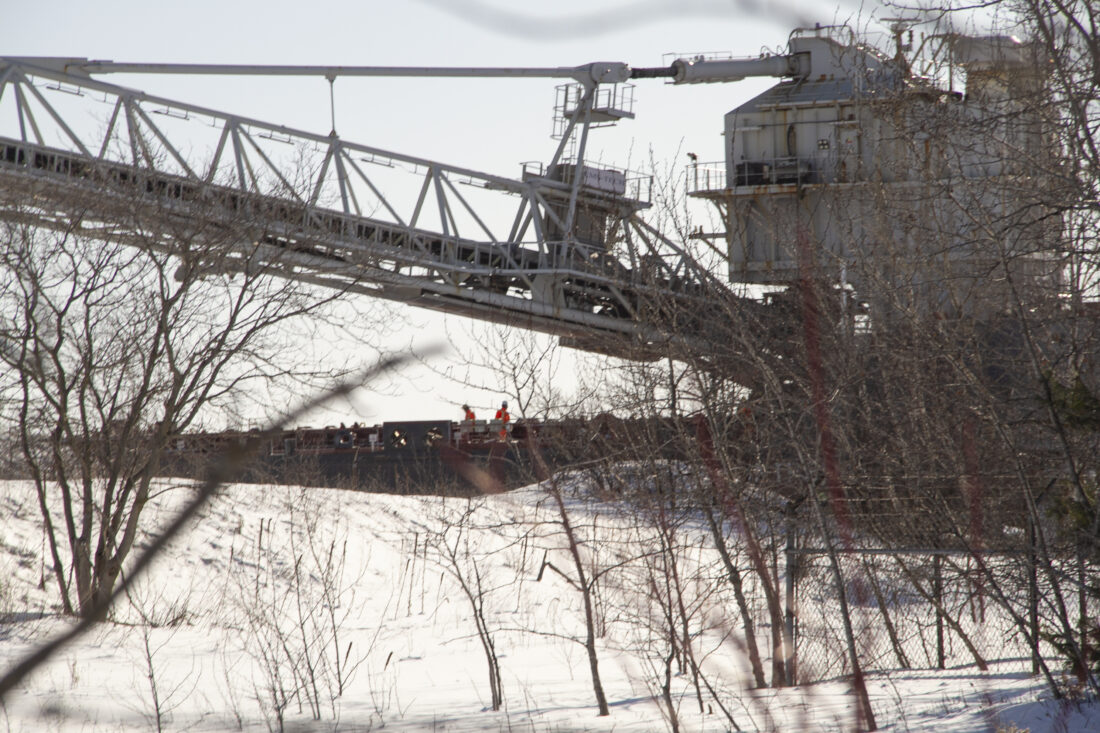
Two workers in blaze orange walk along the deck of the Algoma Intrepid, docked in Escanaba. (Courtesy photo)
C. Reiss also has locations in Duluth, Minn.; Superior, Wis.; Ashland, Wis.; Green Bay, Wis.; and Sault Ste. Marie, Mich.
The Algoma Intrepid, a six-year-old self-discharging bulk carrier built in Croatia, flies under the Canadian flag. Owned by the Algoma Central Corporation, it belongs to the Equinox class and has a carrying capacity of 25,019 tons deadweight. The freighter frequents Goderich, Ont. — home to the largest underground salt mine in the world.
Goderich had been the Intrepid’s previous stop before Escanaba. There, salt is mined by a customer of the C. Reiss Company.
The delivery that reached Escanaba on Jan. 23 was 19,000 net tons of rock salt ready to hit roads.
At the dock, “we facilitate the vessel being offloaded, we maintain the piles in accordance with all rules, laws, and regulations, and then we load the trucks with the salt for delivery to the customer’s storage building,” said Haselhoff. “Most of the salt is contracted to go to municipalities including the state, counties, townships, and cities. This salt makes it throughout much of the Upper Peninsula as far west as Ironwood, east to Seney and north to Copper Harbor.”
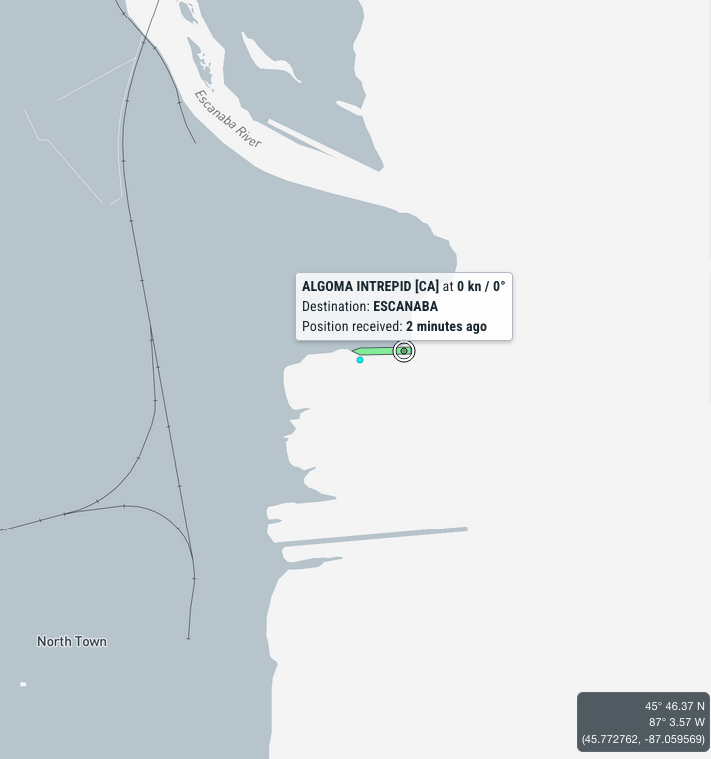
The positions of the freighter Algoma Intrepid and icebreaking tug Jimmy L (represented by the dot near the bow of the big ship) are shown as they were in Escanaba at 12:45 p.m. on Jan. 23. (Screenshot from marinetraffic.com)
As the area is currently in the midst of a frigid winter and the lakes are becoming more and more solid by the day, the ship did not travel alone along its icy route. A series of cutters have been accompanying the Intrepid and other freighters, helping to forge paths and clear buildup.
As the monstrous freighter unloaded mountains of salt at the Reiss dock in Escanaba, the Jimmy L danced at its side, reminiscent of a remora on a shark.
A 110-foot icebreaking tug, the Jimmy L is no small fish, though. It was built in 1939 and served the U.S. Coast Guard under the name Naugatuck for many years. It was the first Coast Guard vessel to arrive on scene to search for the Edmund Fitzgerald after the fateful storm of November 1975.
After being decommissioned in ’79, the Naugatuck became the Timmy B for about 15 years. The tug has been the Jimmy L since 1994 and calls Sturgeon Bay, Wis. home.
Other icebreakers, both private and Coast Guard vessels, also assisted in escorting the Intrepid.
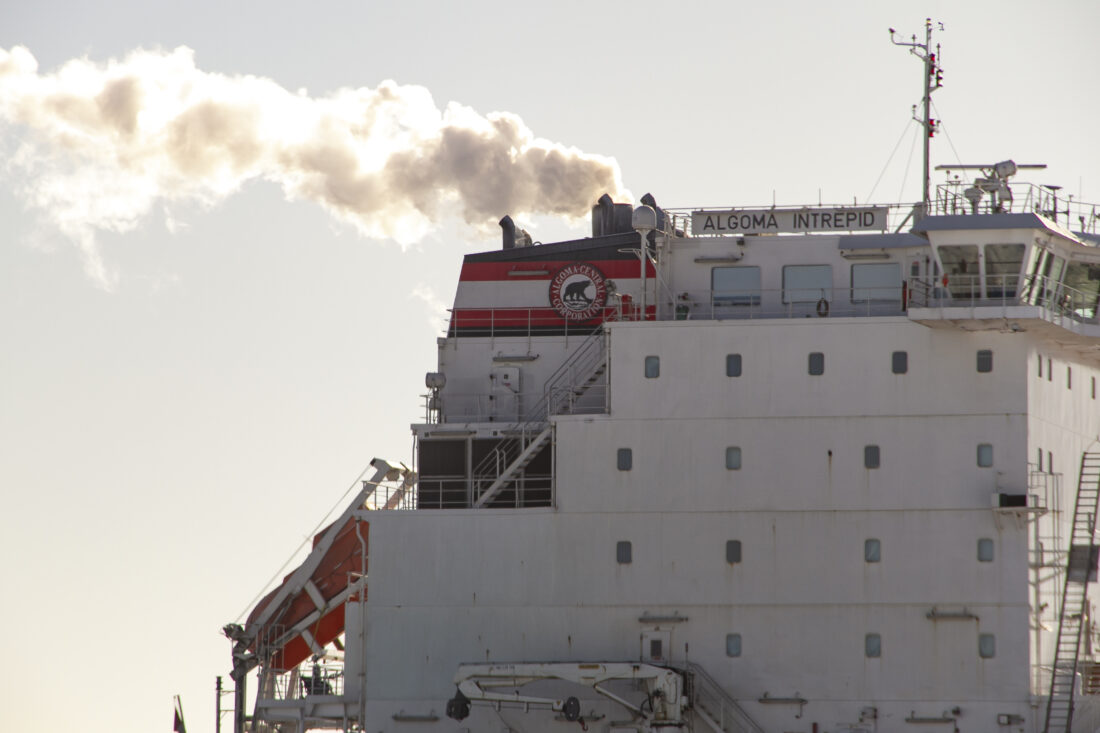
The Algoma Central Corporation's logo is seen atop the stern of the Intrepid, which made a delivery in Escanaba last week. (R. R. Branstrom photo)
The Coast Guard Cutter Mobile Bay, also out of Sturgeon Bay, was another big help on this part of Lake Michigan.
A couple days later, after the Intrepid departed Escanaba and set off once again for Goderich, the USCGC Mackinaw helped it get through a frozen passage near Beaver Island.
“The cutter arrived on the scene and made passes through the surrounding ice to free the vessel and assist it back to navigable waters. … This mission was completed in support of Operation Taconite, a Great Lakes ice-breaking mission focused on safeguarding lives while ensuring the efficient movement of vessels during the icy conditions,” wrote the Coast Guard on the morning of Jan. 25.
After its most recent stop in Goderich on Lake Huron, the Intrepid set off on another journey on the morning of Jan. 30 and is now bound for Milwaukee, where it is due to arrive on Feb. 2.
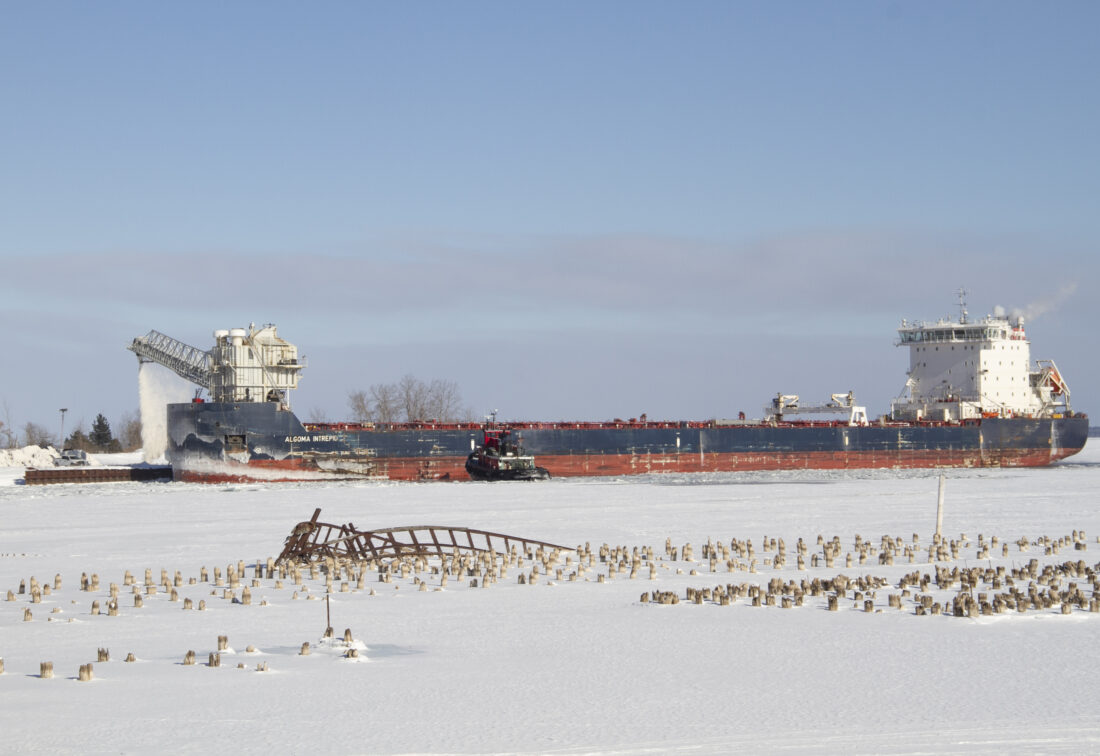
As salt is dropped at the dock of a 146-year-old company, the remains of one of Escanaba's former ore docks hearken back to the place's reputation as a renowned hub. (R. R. Branstrom | Daily Press)
Local News
Crucial commodity conveyed

Driver dead after truck v. train
Two in Daggett face multiple charges, including first degree criminal sexual conduct
MENOMINEE COUNTY - The Menominee County Sheriff’s Office executed a search warrant at a residence in Lake ...

Update: One severely injured, one dead, after crash with train
Senior Prom Night to foster dancing and nostalgia this March
ESCANABA – Seniors eager to relive the magic of prom - or experience it for the very first time - are invited to ...