Gladstone students practice agriculture in pilot program
Trial year paves way for future
-
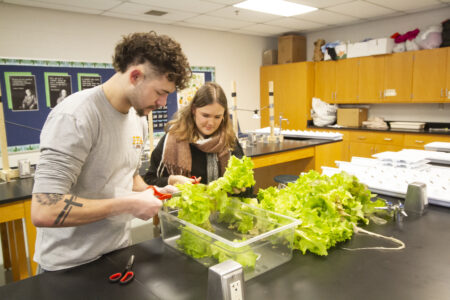
- Gladstone senior Mason Peltin, a student who helped drive the formation of the agricultural science class at the high school, and German exchange student Marie Koziel prepare lettuce grown in class for the cafeteria. (R. R. Branstrom | Daily Press photo)
-
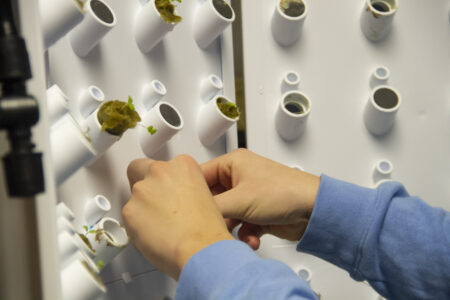
- During Michelle (“Shelley”) Shurlow’s agricultural science class, sophomore Aiden Ericksen plants summer crisp lettuce seedlings in a Rockwool growing medium in the indoor hydroponic wall at Gladstone High School that used to belong to the Gardening Club. (R. R. Branstrom | Daily Press photo)
-

- In the kitchen of the Gladstone High School cafeteria, Samantha (“Sam”) DeCremer builds salads using lettuce grown in a classroom and harvested minutes before. (R. R. Branstrom | Daily Press photo)
-
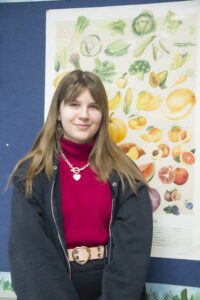
- Gladstone senior Noel Lee is one of the students enrolled in the inaugural agricultural science class at Gladstone High School. While all students study the same material in the classroom, each chooses their own course in an online portion. Lee studies floral design. (R. R. Branstrom | Daily Press photo)
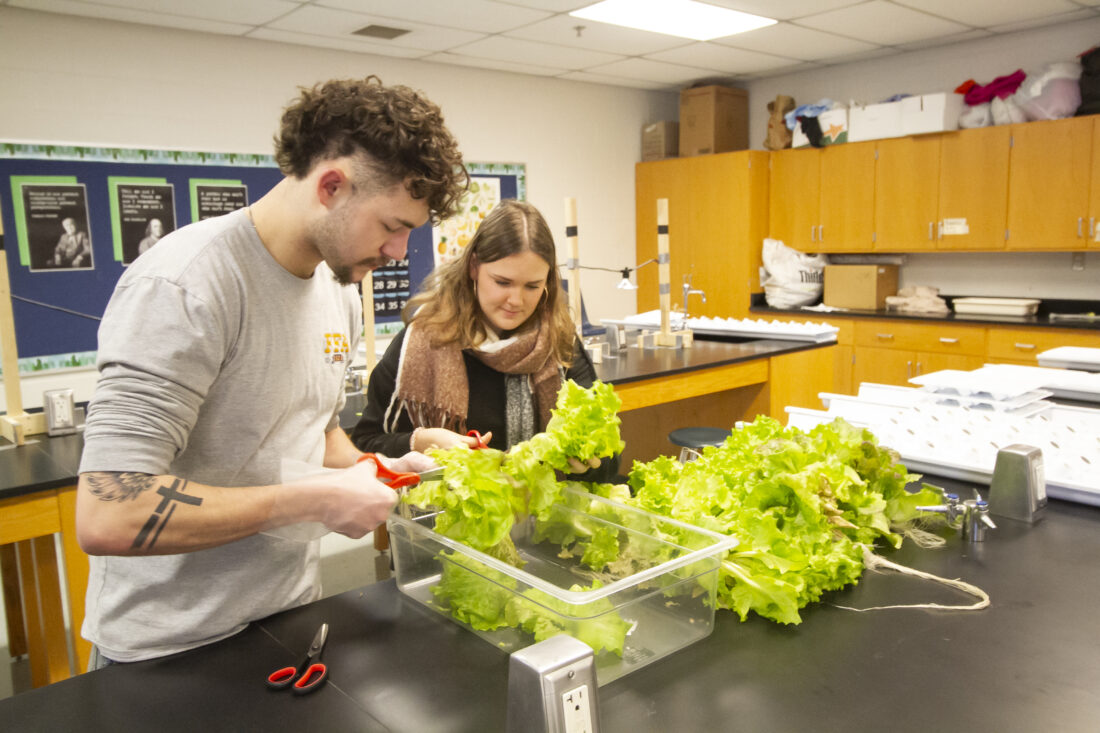
Gladstone senior Mason Peltin, a student who helped drive the formation of the agricultural science class at the high school, and German exchange student Marie Koziel prepare lettuce grown in class for the cafeteria. (R. R. Branstrom | Daily Press photo)
GLADSTONE — Agricultural science, taught by Mrs. Michelle (“Shelley”) Shurlow, is underway at Gladstone High School for the very first year. Currently an elective, the class gives a group of students education on various elements of agriculture through hands-on experience, guest speakers, field trips, and online learning.
The goal is for the program to ultimately become connected with Michigan State University’s College of Agriculture and Natural Resources and get approved to be a Career and Technical Education (CTE) program. But in order to achieve that status, Shurlow explained, the school must first demonstrate its capacity to successfully conduct the course and prove that there is student interest.
Shurlow, who has been teaching English at GHS for three years, has previous experience teaching agricultural science downstate. She also operated a farm for about 10 years. But it wasn’t just the teacher or other administrators who kicked off this initiative — kids have been pushing for such a class for years.
“I’ve (wanted) the program in our school since freshman year,” said student Mason Peltin, now a senior. “My grandparents were horse farmers. …I guess it’s something I felt that we could need, would make our school different.”
Peltin remarked that while GHS was Division 1 in athletics because of its size, an additional science program would help the school stand out academically and possibly help gain more funding.
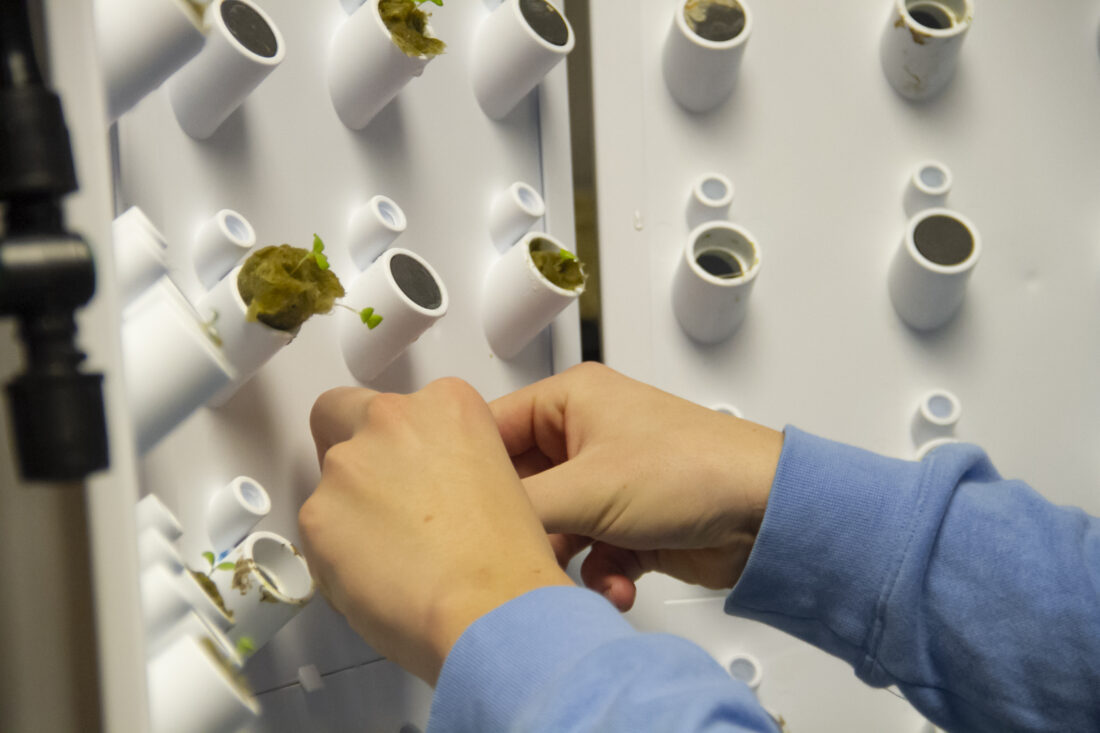
During Michelle ("Shelley") Shurlow's agricultural science class, sophomore Aiden Ericksen plants summer crisp lettuce seedlings in a Rockwool growing medium in the indoor hydroponic wall at Gladstone High School that used to belong to the Gardening Club. (R. R. Branstrom | Daily Press photo)
“Plus, I think it’s always good to learn where your food comes from,” he added.
Peltin spoke as he worked with lettuce the class had harvested from a Flex Farm hydroponic wall, but agricultural science is about far more than growing vegetables.
On the curriculum is animal science, natural resources and plant science.
“We teach 12 different segments,” Shurlow explained. “There’s different branches, so there’s several different sections under the blanket of animal science.”
The students have heard from professionals involved with different fields through both in-class talks and off-campus field trips. They have traveled to see aquaponics in operation in Hannahville; checked out North Farm, part of the MSU Upper Peninsula Research and Extension Center in Chatham; and been visited monthly by the Delta Conservation District.
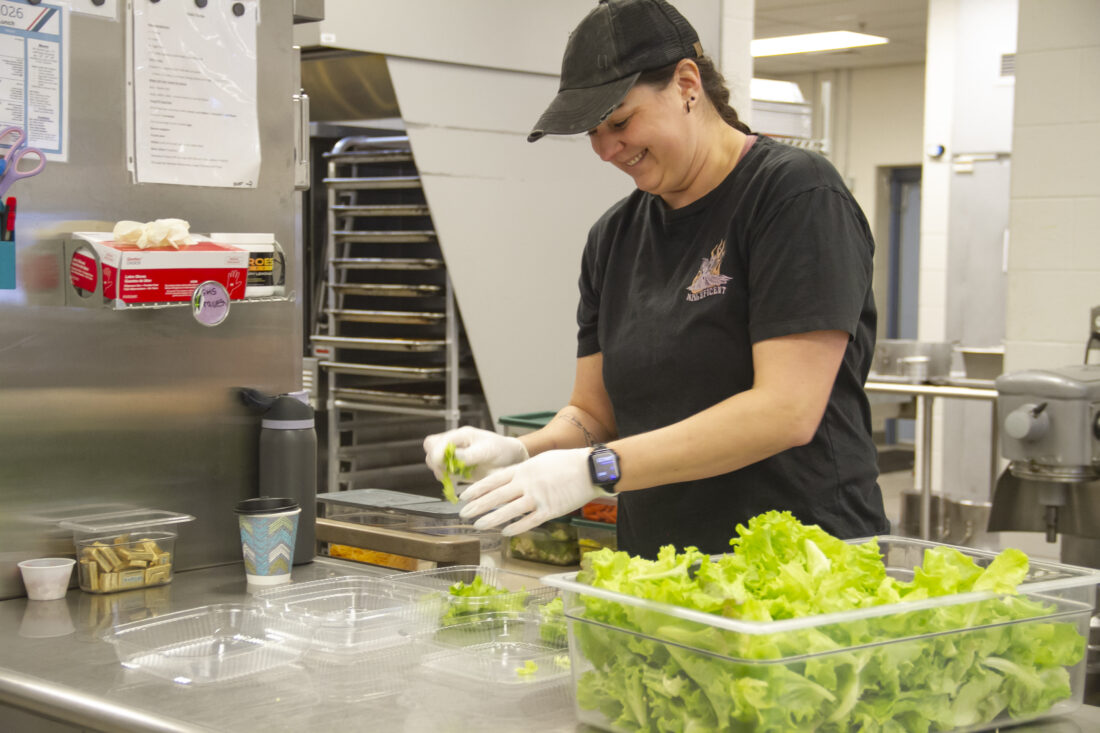
In the kitchen of the Gladstone High School cafeteria, Samantha ("Sam") DeCremer builds salads using lettuce grown in a classroom and harvested minutes before. (R. R. Branstrom | Daily Press photo)
Since there are many possible routes to be taken in agriculture, the students have many different careers in mind. The class allows for each to hone their own focus through iCEV, an online learning program in which students able to select from a number of unique courses. While all the classroom elements and field trips are the same for each student, their online studies differ.
Peltin, who is interested in eventually farming livestock, is taking a course that instructs on small engine technology.
Noel Lee, another 12th-grader, is enrolled in a floral design course.
“I’ve always really been interested in plants — and flowers especially,” Lee said. The agricultural science class as a whole has been better than she expected, and the floral design course has surprised her, she said.
“There’s a lot more technicalities than I initially thought; there’s a lot more structure and logic I would have ever imagined,” Lee said. In floral design, “there’s like, principles and elements of the designs — kind of like the elements and principles of art, but a bit more three-dimensional.”
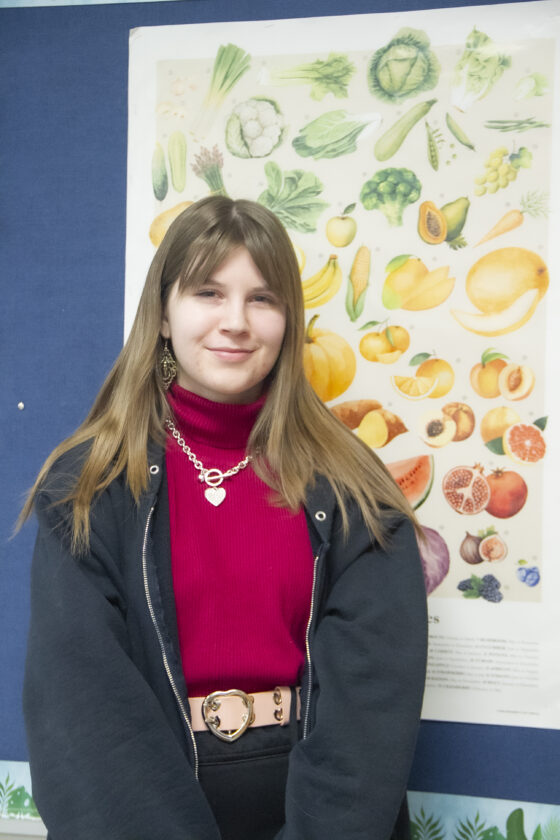
Gladstone senior Noel Lee is one of the students enrolled in the inaugural agricultural science class at Gladstone High School. While all students study the same material in the classroom, each chooses their own course in an online portion. Lee studies floral design. (R. R. Branstrom | Daily Press photo)
The students are learning about the ins and outs, materials, costs and applications of their chosen focus, making connections to the real world as opposed to abstract concepts restricted to a school desk.
But not yet being fully-fledged, there a few things Gladstone’s agri-science class doesn’t yet have. For one, when it becomes a multi-year program, students will be able to participate in supervised agriculture experience, or SAE, which is a core part of the education.
Aiden Ericksen, as the sole sophomore in the class, will likely be able to see agri-science at Gladstone develop after his current senior classmates graduate. Shurlow said she’s looking into connecting Ericksen with someone who can teach him to operate a tractor over the summer, which would count towards his SAE.
Another thing the class lacks at present is funding, though they’ve made do and received some donations from Hannahville. The Flex Farm model they’re currently using to grow lettuce was a hand-me-down from the GHS Gardening Club. Shurlow is aiming to purchase and erect a hoop house — like a less-permanent greenhouse that can be used to extend the outdoor growing season. Shurlow and aide Hailey Plimpton — currently a GHS senior dual-enrolled at Bay College — are working on fundraising ideas.
Though the class doesn’t yet have all the assistance and accreditation, students presently enrolled in the pilot agri-science program will be paving the way for future learners at Gladstone High School. They will also earn certifications when they pass their ICEV courses.
Other students and teachers are benefiting already in a tangential way — the lettuce grown by the class goes to the school cafeteria and is used to make salads. Principal Andy Jacques and Food Service Director Rachell Lippens both said the freshly grown leaves taste far better than store-bought lettuce.
“The kids love it,” Lippens said. “Not only does it look so much better than the bagged stuff, it’s healthier for them.”
After harvesting batches of Summer Crisp Muir and Summer Crisp Cherokee lettuce this week, the agricultural science students planted newly-sprouted seedlings in the hydroponic wall. In about 50 days, another vibrant batch will be ready to harvest.
Local News
Gladstone students practice agriculture in pilot program
Delta County Board adopts recreation plan
Garage burns
WELLS TOWNSHIP -- Local agencies responded Wednesday morning to a structure fire that fully-engulfed and ultimately ...

Man pleads no contest to murder charge

Bitter cold to persist at least until weekend