
Some Michigan hunters may be allowed to skip paper kill tags
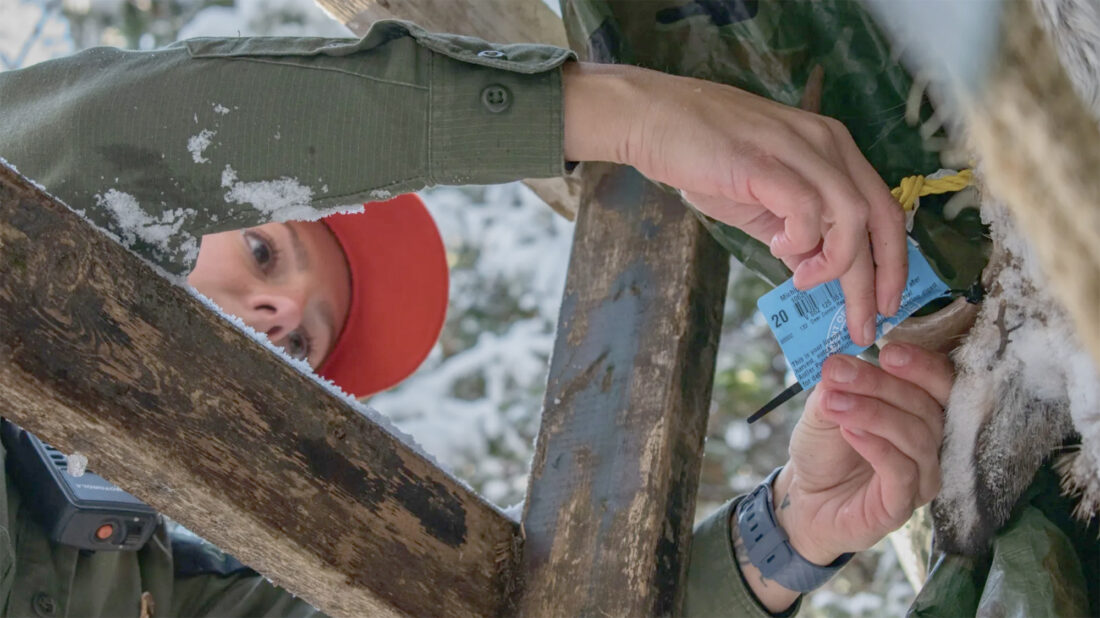
A Michigan conservation officer checks a deer kill to make sure it is properly tagged. (Courtesy of the Michigan Department of Natural Resources, via Bridge Michigan)
(This story was originally published by Bridge Michigan, a nonprofit and nonpartisan news organization. Visit the newsroom online: bridgemi.com.)
Michigan may allow hunters to use a mobile app to show they are authorized to kill certain animals.
Currently, hunters need a physical kill tag, which they can pick up at a license agent or receive through the mail. After an animal is killed, the hunter must fill out the tag by cutting small notches into it and attach it to the slain animal.
According to a memo from the Michigan Department of Natural Resources, “The expenses of the paper, hardware, and agent support and the potential inconvenience to hunters have led the Department to pursue the use of electronic kill tags.”
The DNR tested the electronic option during the last three turkey hunting seasons and about 18% of hunters chose the electronic tag.
Moving forward, the DNR recommends the state’s hunting and fishing regulator — the Natural Resources Commission — adopt an amendment that would expand the program, giving hunters the option to also use an app to fill out electronic kill tags for deer, bobcat, bear, fisher, marten and otter. Hunters would not need access to Wi-Fi or cell service to update their tags after a kill.
Obtaining a physical tag would still be allowed. The type of tag a hunter receives would depend on how they purchase their license. If a hunter purchases their license using the Hunt Fish mobile app, they’d get an electronic kill tag. If they purchase their license in person or as an eLicense online, they would receive a paper kill tag.
Some concerns
Jim Kralik, a Conway Township resident who’s hunted for more than 50 years, said he’s not a fan of electronic tags. He called them “an avenue for violation of existing game laws for the limited convenience of not carrying a physical tag.”
The DNR says hunters with electronic tags would still need to fill them out immediately after a kill and would need to open the app and show the tag to an officer if asked.
With the electronic tags, if a hunter leaves a slain animal unattended — for example, at a buckpole or for a friend to drive it — they would have to put a durable tag on the animal that has the hunting license number written on it in permanent ink. The durable tag can be removed once the animal is stored at the hunter’s house or dropped off at a processor or taxidermist.
Steve Cross, a Manton resident who goes to an Amish butcher, said he worried whether the shop he uses would be able to deal with an electronic tag. The DNR said it will “work with processors informing them of the new eHarvest tagging option and what to expect from customers.”
In support of the change
More than two dozen other states, including Montana, Ohio, Oregon and Wisconsin, already use digital tags.
Bloomfield Hills resident Graham Sloan has been hunting in Wisconsin for years and said he’s come to like using electronic tags.
“The first year when they transitioned to the new system was a little bit different not putting the tag on the deer, but the convenience can’t be beat,” Sloan said. “I’m looking forward to Michigan going to electronic deer tags.”
Michigan hunter Erik Schnelle, of the Belding area, said that, if the electronic tag option goes through, he’d welcome “not having to cut little triangles out of the license in the dark, in rain, snow and cold with a hunting knife.”
The Natural Resources Commission is expected to vote on the issue at its January meeting. If it approves the amendment, electronic kill tags would be available for designated animals beginning in the 2026 hunting seasons with sales first becoming available on March 1.

Local News

More details on Navy’s decision to cancel Marinette ship project
Some Michigan hunters may be allowed to skip paper kill tags

Hank’s General Store provides staples in central UP
Dickinson joins protest against mental health contract bidding
IRON MOUNTAIN — Dickinson County is now among dozens of counties in Michigan that have passed resolutions ...
Russian cargo jet grounded in UP 16 years may soon fly again
Bills signed to lower costs for Michigan Guard members
LANSING, Mich. — Gov. Gretchen Whitmer has signed Senate Bills 370, 540 and 542, which will lower the cost of ...