PFAS Action group offers ‘Eat Safe Fish’ map for Michigan
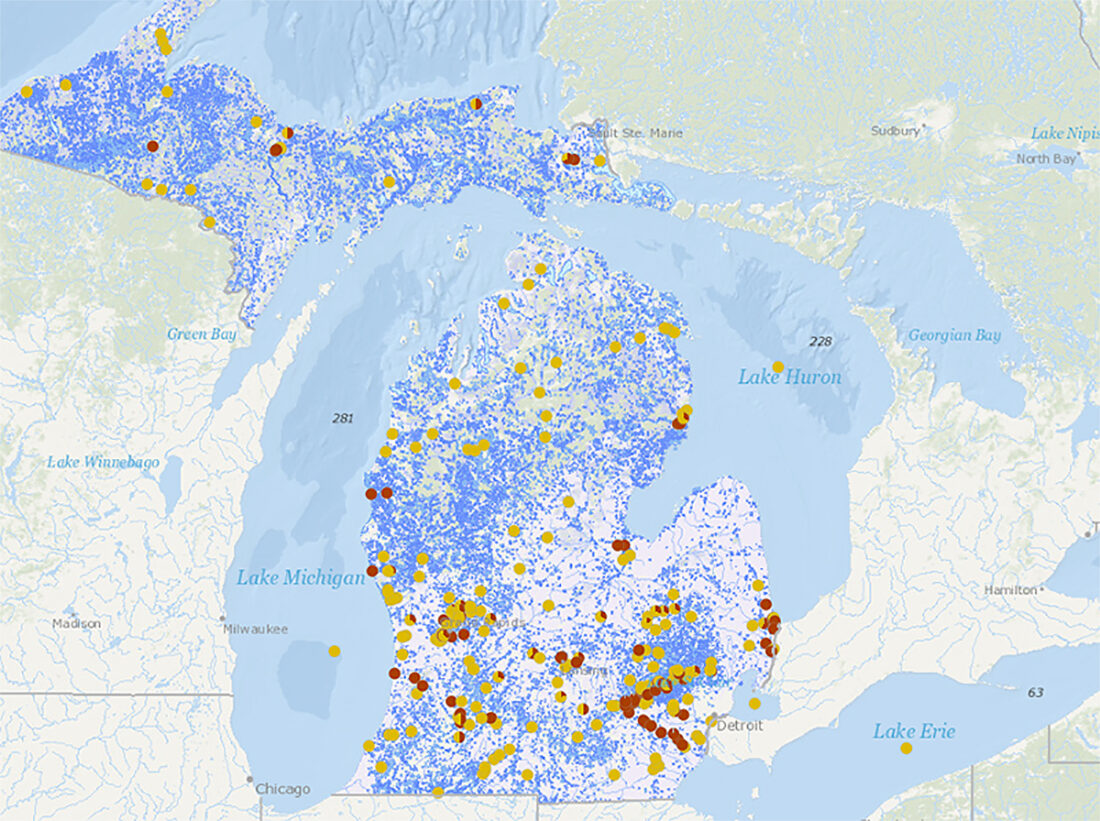
Earlier this week, the Great Lakes PFAS Action Network announced an interactive mapping tool to help advise Michigan anglers. (Screenshot via Michigan Advance)
Earlier this week, the Great Lakes PFAS Action Network announced an interactive mapping tool to help protect Michigan anglers looking to reel in a meal.
On Tuesday, the group launched its “Eat Safe Fish” mapping tool, which it developed in collaboration with the Ecology Center. The tool collects the Michigan Department of Health and Human Services 2025 “Do Not Eat” and consumption limitation advisories into an interactive map, allowing anglers to examine where contamination has been detected and which species of fish are safe to eat.
“For many Michiganders, fishing is not just recreation – it’s a tradition, a way of life, a means to put food on the table,” Tony Spaniola, the action network’s co-chair said in a statement. “As thousands of anglers head out to fish Michigan’s lakes, rivers and streams this winter, this tool serves as a critical resource to ensure people know if the fish they are catching are safe to eat. People shouldn’t have to comb through complicated government websites to figure that out.”
While users can search the map by water body, or species of fish, the map can also be segmented by state House, state Senate and congressional district.
In announcing the map tool, the Great Lakes PFAS Action network notes that the state’s “Eat Safe Fish Guides” were dramatically expanded in 2025, with new data showing dangerous levels of PFOS, a type of PFAS, in water bodies and fish across the state.
PFAS, also known as per- and polyfluoroalkyl substances or forever chemicals, are a family of substances that break down very slowly. They have been found in people and animals and are present in the water, air and soil in locations across the globe.
These chemicals are used in products like fire fighting foam, nonstick cookware, grease-resistant food packaging, and in stain and water-repellent carpets, upholstery, clothing and other fabrics. They have been tied to several negative health impacts, including increased risk of some forms of cancer, reduced immune system responses, interference with the body’s natural hormones, increased cholesterol levels, and several harmful reproductive and developmental impacts.
The action network notes that the “Do Not Eat” warnings now trigger when PFOS is detected in fish at 50 parts per billion, a significantly lower threshold than the previous 300 parts per billion standard. Consumption limitations have also shifted from 9 parts per billion to 1.5 parts per billion.
As a result the number of water bodies under a “Do Not Eat” advisory due to PFOS tripled to 102 in the state, while the number of waters with consumption limitations from PFOS totaled 786 across multiple fish species.
The state’s guide includes warnings on other contaminants like PCBs, dioxins and mercury.
———
Michigan Advance is part of States Newsroom, a national 501(c)(3) nonprofit. For more, go to https://michiganadvance.com.
Local News
PFAS Action group offers ‘Eat Safe Fish’ map for Michigan
Circuit Court
ESCANABA – These individuals were sentenced in Delta County Circuit Court on unrelated charges: — Ryan ...

Au Train artist wins award in Northern Exposure exhibition
District Court
ESCANABA – This individual was recently sentenced in Delta County District Court: — Evan Edward Tryan, ...

Two Michigan senators push for legislative oversight committee