
More details on Navy’s decision to cancel Marinette ship project
-
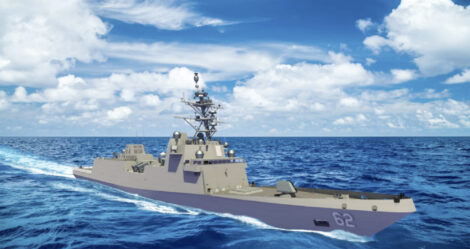
- This rendering of a Constellation Class Frigate was included in a June 2025 Government Accountability Office report. (Photo courtesy of the Government Accountability Office, via Wisconsin Public Radio)
-
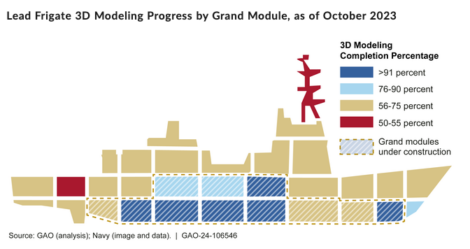
- The U.S. Government Accountability Office reported that the Constellation-class frigates being built for the Navy at Fincantieri Marinette Marine were still only partially designed a year after construction began.
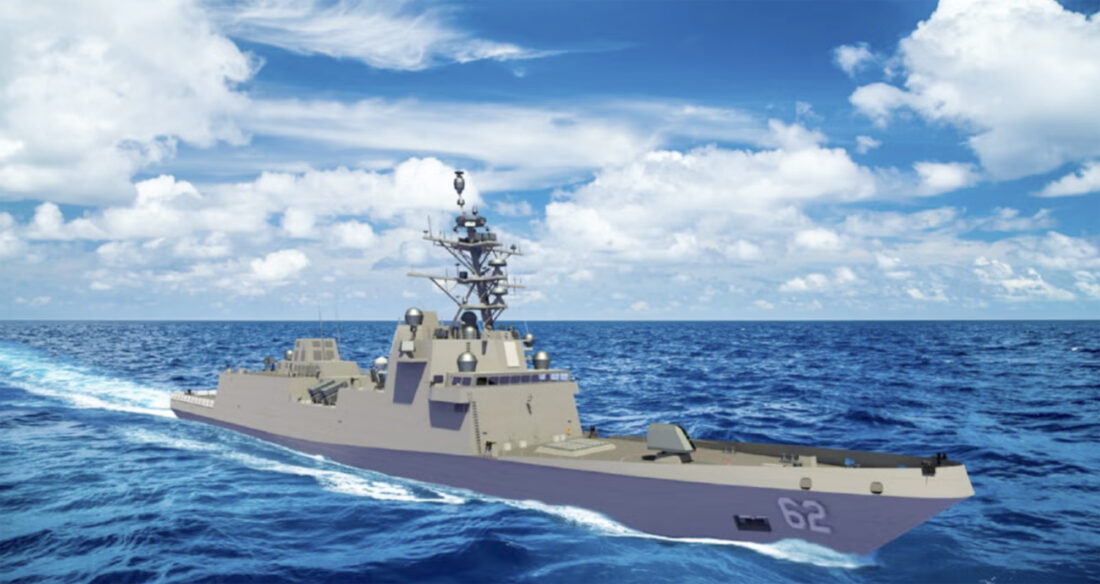
This rendering of a Constellation Class Frigate was included in a June 2025 Government Accountability Office report. (Photo courtesy of the Government Accountability Office, via Wisconsin Public Radio)
ESCANABA — More details have emerged on future plans for the national fleet after the U.S. Navy announced it was canceling a major project at the shipyard in Marinette, Wis.
A panel took place Dec. 6 during the Reagan National Defense Forum to discuss modernization of the military, offering insights behind the Navy’s decision to terminate construction of several Constellation-class frigates at Fincantieri Marinette Marine.
Because of the Navy’s cancellation, Fincantieri Marine Group — an Italian company that purchased Marinette Marine in 2009 — on Dec. 3 laid off 93 “primarily white collar positions” in Marinette that before that had 2,175 employees and contractors, some based in the Escanaba area.
In April 2020, FMM was awarded a contract for one lead frigate and the option for nine additional ships. The contract was for $795 million “for the concept design and construction of the first-in-class guided missile frigate of the ‘FFG(X)’ program for the U.S. Navy,” FMM stated at the time.
While the profit margin that FMM would have earned was not publicly disclosed, “the margins of government construction are typically lower than other sectors,” a spokesperson for the company noted.
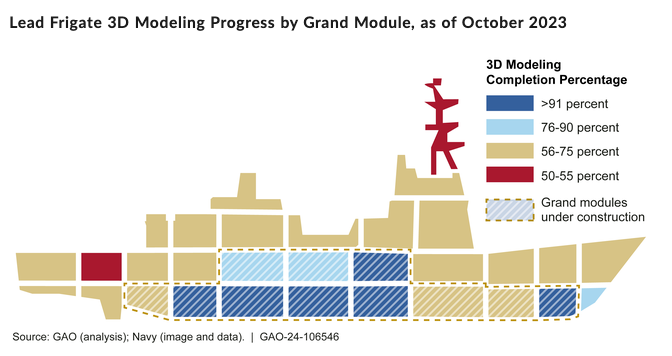
The U.S. Government Accountability Office reported that the Constellation-class frigates being built for the Navy at Fincantieri Marinette Marine were still only partially designed a year after construction began.
Including post-delivery availability support and crew training, the 2020 contract’s cumulative value was $5.5 billion.
While FMM is the prime contractor for Constellation-class frigates, Fincantieri Bay Shipbuilding in Sturgeon Bay — which mostly does commercial work — would assist in building frigate modules.
Fincantieri moved forward with a design for the frigate that was based off a “parent design” — that of a European multi-purpose frigate, FREMM, which Fincantieri also designs and is used by the Italian and French navies, but with adjustments for the American model.
The Navy issued FMM a $554 million contract for the second ship in May 2021.
Over a couple years, Fincantieri invested $800 million on shipyard improvements that included “a massive shiplift, modern computer-controlled panel line with robotic welding station, and several climate-controlled buildings (to) create conditions for our employees to be comfortable while working,” wrote Eric Dent, the company’s director of communication. While the investment was applied across Fincantieri’s four U.S. shipyards at Marinette, Green Bay, Sturgeon Bay and Jacksonville, Fla., a large portion went toward a 32,000-square-foot panel line building at FMM that would help with fulfilling the Navy contracts. That facility was dedicated in 2022.
The Navy exercised its option for follow-up vessels, and awarded FMM contracts for more Constellation-class frigates. Until the recent cancellation, FMM was supposed to be building six for the U.S. Navy; the first and second ships are under construction — the USS Constellation and the USS Congress.
In 2024, Norwegian Minister of Defence Bjørn Arild Gram confirmed that Norway was considering contracting with Fincantieri for Constellation-class frigates of their own, and the company looked forward to partnering with Norway, where they already operate subsidiary Vard Group. At present, Fincantieri has 18 shipyards on four continents, according to their website.
On Nov. 25, Navy Secretary John Phelan announced cancellation of the frigate program in what it referred to as a “strategic shift … for the Navy’s convenience.” This shift came as a surprise to many, since the understanding had been the Navy would acquire 20 Constellation-class ships for $22 billion total and will now end up with only two.
However, Phelan cited a need to hit “a more urgent timeline” and cost efficiency. “I will not spend a single taxpayer dollar unless it contributes directly to readiness and our ability to defeat future threats,” Phelan said in his Nov. 25 statement.
Several delays and cost overruns had occurred since the project began at Fincantieri Marinette Marine. In a report published in May 2024, the U.S. Government Accountability Office cited the fact that construction began before designs were completed. While the contract for the first ship had a delivery date of April 2026, recent estimates indicated it wouldn’t be ready until 2029.
“A key factor in this decision (to cancel the Constellation-class frigate program) is the need to grow the fleet faster to meet tomorrow’s threats. This framework puts the Navy on a path to more rapidly construct new classes of ships and deliver the capability our warfighters need in greater numbers and on a more urgent timeline,” Phelan said.
On the same day, Fincantieri announced they had reached an agreement with the Navy on working closely to help deliver new classes of vessels “in segments that best serve the immediate interests of the nation and the renaissance of U.S. shipbuilding, such as amphibious, icebreaking and other special missions.”
“We greatly value the shipbuilders of Wisconsin and Michigan. While work continues on the first two ships, those ships remain under review as we work through this strategic shift,” Phelan said. “Keeping this critical workforce employed and the yard viable for future Navy shipbuilding is a foremost concern. The Navy needs ships, and we look forward to building them in every shipyard that can.”
Dent confirmed the “rebalancing of workforce” was a direct effect of the Navy’s cancellation of the Constellation contract.
“In addition to the 93 FMM employees, several hundred of T&A subcontractors have been let go over the previous weeks as well,” Dent added. “Several of them have converted to becoming FMM employees and now have strong union jobs. Several hundred of the subcontracted shipbuilders have been transferred to sister-shipyard (Fincantieri Bay Shipbuilding) to provide on-site support for Winter Fleet maintenance efforts over the next three months. Our expectation is that the Navy will soon assign more substantial work that aligns with our investment and production capacity.”
On Dec. 5, the Navy and Marine Corps announced the next step in a plan to modernize the military vessels: “selecting to design for our medium landing ship, an operationally driven, fiscally disciplined choice that puts capability in the fleet on a responsible timeline,” Phelan said.
“We are also changing how we do business in shipbuilding,” U.S. Navy Admiral Daryl Caudle added. “Starting from a complete 3-D design and working hand in hand with the designer, the Navy is incorporating a disciplined set of class standard equipment so that this ship is maintainable, repairable, and able to meet its operational availability targets in the real world, not just on paper.”
Phelan added: “This non-developmental, built-to-print approach drives down cost, schedule and technical risk for both the Navy and industry.”
During the panel at the 2025 Reagan National Defense Forum on Dec. 6, Phelan addressed questions about canceling the contract.
“The Constellation-class frigate was canceled because, candidly, it didn’t make sense anymore to build it,” he said. “It was 80 percent of the cost of a destroyer, 60 percent of the capability. So you might as well build destroyers.”
Regarding delays in the ships’ design and construction at FMM, “I’d say the Navy was probably 50 percent culpable for the problems, and I think the shipbuilder was 50 percent culpable,” Phelan said.
He spoke highly of the processes and speed seen at shipbuilders in South Korea and Japan, adding, “I think what we’re trying to do is really encourage them to come to America — invest in America, invest in yards here, help us build up our maritime industrial base. And we will also send some business over there as well.”
President Donald Trump has hinted at something called the “Golden Fleet,” of which little specifics are known but that the public can expect to learn more about in the near future.
“We will continue to build ships that are the cornerstones of the fleet — carriers, destroyers, amphibs, submarines,” Phelan said, confirming that plans for a Golden Fleet were in development.
———
R. R. Branstrom can be reached at 906-786-2021, ext. 140, or rbranstrom@dailypress.net.
Local News
More details on Navy’s decision to cancel Marinette ship project

Some Michigan hunters may be allowed to skip paper kill tags

Hank’s General Store provides staples in central UP
Dickinson joins protest against mental health contract bidding
IRON MOUNTAIN — Dickinson County is now among dozens of counties in Michigan that have passed resolutions ...

Russian cargo jet grounded in UP 16 years may soon fly again
Bills signed to lower costs for Michigan Guard members
LANSING, Mich. — Gov. Gretchen Whitmer has signed Senate Bills 370, 540 and 542, which will lower the cost of ...