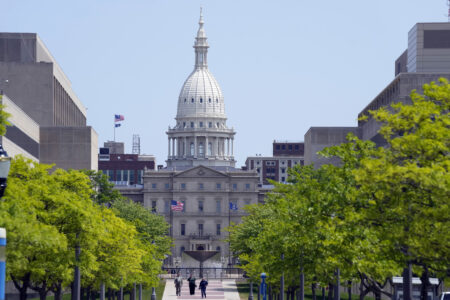
Michigan high court eyes limits on courthouse immigration arrests
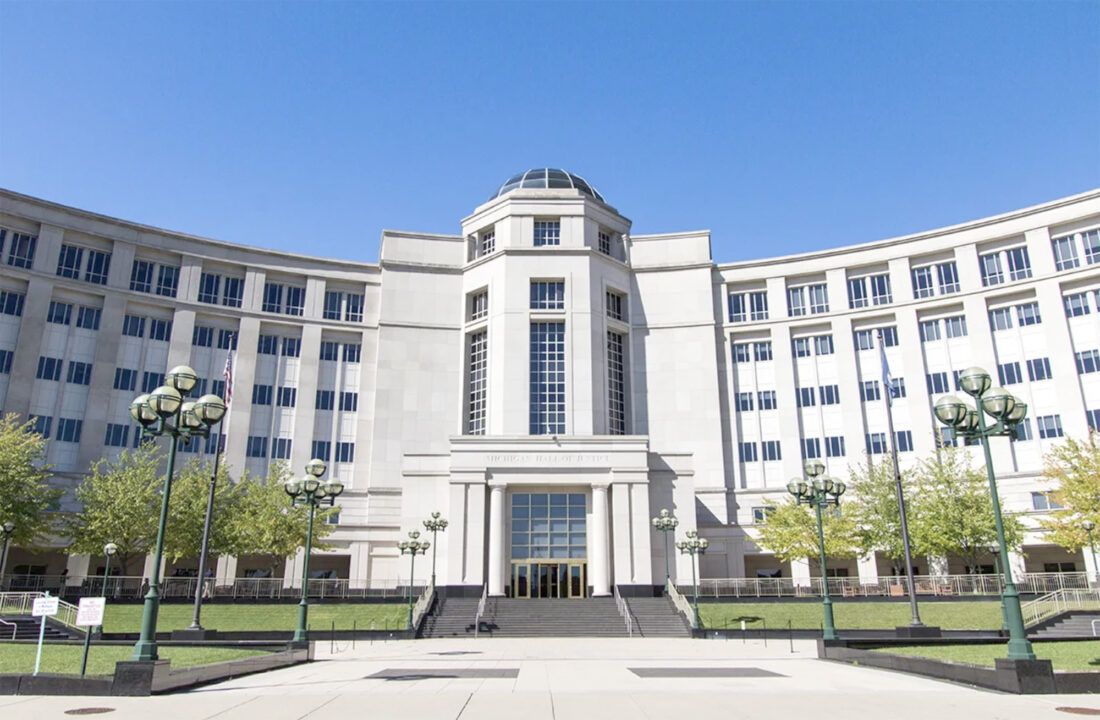
A proposed rule before the Michigan Supreme Court would bar civil arrests at state and local courthouses. (Photo via ehrlif / Shutterstock)
(This story was originally published by Bridge Michigan, a nonprofit and nonpartisan news organization. Visit the newsroom online: bridgemi.com.)
Law enforcement would be barred from making civil arrests — including immigration arrests of suspected noncitizens — in state and local courtrooms under a proposal being considered by the Michigan Supreme Court.
The proposed rule change announced last month would prohibit civil arrests of people “attending a court proceeding or having legal business” in any of Michigan’s trial or appellate courthouses. The rule as written would not interfere with criminal or court-ordered arrests.
If adopted, the amendment would add Michigan to the list of states attempting to limit immigration arrests following court proceedings, which have ramped up in recent months as President Donald Trump’s administration cracks down on illegal immigration enforcement.
States don’t have jurisdiction over what happens in immigration courts, which are federal property, and cannot bar arrests there.
But advocates argue Michigan should join New York, Connecticut, Illinois and other states in limiting arrests in local courts, which they contend could deter immigrants from attending court hearings.
“It’s an issue that affects everyone when you have any part of the population that is afraid to come and participate in our court proceedings,” said Susan Reed, executive director of the Michigan Immigrant Rights Center.
The Trump administration has unsuccessfully challenged similar policies in other states as “sanctuary” measures that obstruct lawful arrests.
Why now?
It’s unclear how many arrests have been made in courthouses, though one analysis from mathematician Joseph Gunther identified 2,388 likely arrests in federal immigration courts nationwide between May and July 2025, including nine in Detroit.
Immigration arrests appear to be less common when a person with no criminal history heads to a local courthouse to pay traffic tickets or testify in a hearing, but not unheard of.
Reed and Loren Khogali, director of the American Civil Liberties Union of Michigan, first called on Michigan courts to change the rules around civil arrests in April after an incident outside Plymouth’s 35th District Court where a US citizen was mistakenly detained by federal immigration enforcement.
Immigration enforcement in courthouses violates longstanding Michigan law protecting litigants from civil arrests and has “the potential to seriously disrupt the fair and efficient functioning of our state courts,” the directors of both organizations wrote in an April 11 letter.
Even the possibility of ICE or border patrol agents at courthouses can be enough to deter people from showing up to court at all, Reed said. That can complicate prosecutors’ ability to secure witness testimony and potentially endanger people who would otherwise seek state court assistance on issues like child custody or domestic violence.
“A rule would definitely go a long way to address fear,” Reed said. “To simply make the state court a place where state matters are adjudicated and not address these federal civil immigration matters there, it’s really a practical response by the Supreme Court that we’re very supportive of.”
The case for courthouse enforcement
Guidelines introduced under former President Joe Biden limited immigration arrests in courthouses and other so-called “protected areas” like schools, hospitals and places of worship. Those rules were reversed in January on the first day of President Donald Trump’s second term.
The latest guidance instructs US Immigration and Customs Enforcement officers to pursue civil immigration enforcement in or around courthouses “when they have credible information that leads them to believe” a person of interest will be present at a specific location.
The guidance indicates civil immigration enforcement actions in or near courthouses should take place in non-public areas of the facility where possible and be “conducted in collaboration with court security staff.”
Using courthouses as a venue for civil immigration enforcement can reduce safety risks for federal agents and the public, ICE Acting Director Todd Lyons wrote in a May 27 memo outlining the policy, because individuals entering courthouses are typically screened for weapons or other contraband by law enforcement before entering.
In October, the US Department of Homeland Security announced that it was on pace to deport 600,000 people by the end of Trump’s first year back in office, and as of Nov. 16, more than 65,000 people were being held in US detention facilities.
What other states are doing
Several states already had laws or policies on the books limiting civil arrests in local and state courts before Trump’s second term began, and officials in other Democratic-leaning states have more recently considered the change.
New York’s 2020 law — passed during Trump’s first term — has a similar framework to what Michigan is considering, only allowing federal agents who have a criminal warrant or an order from a judge to make arrests in state or local courthouses.
In filing the suit, Attorney General Pam Bondi had argued the New York law amounted to a “sanctuary” policy “to prevent illegal aliens from apprehension” that contradicted Trump’s January executive order declaring a national emergency at the southern border with Mexico.
A federal judge last month dismissed a lawsuit from the Trump administration that argued New York’s policy was unconstitutional and prevented federal authorities from apprehending criminals.
Illinois lawmakers approved a ban on courthouse civil immigration arrests in October, also creating a pathway for residents to sue immigration agents who violate their constitutional rights.
In Connecticut, state lawmakers recently passed legislation barring law enforcement officers from wearing face coverings in court in addition to limits on civil immigration arrests.
What’s next in Michigan
The Michigan Supreme Court — where six of seven current justices were appointed or nominated by Democratic governors — is collecting written public comments on the proposal, which must be submitted by Dec. 22 to be considered.
Justice Brian Zahra, the court’s lone Republican nominee, would have declined to publish the proposal for comment, according to the court order announcing the possible change.
Court spokesperson John Nevin said the court plans to hold a public hearing before taking action, which “might be as proposed, something different, or nothing at all.”
Most of the nearly 500 comments posted as of Dec. 1 support the proposed amendment, citing concerns that people who are attempting to handle legal matters the appropriate way might be deterred from doing so by federal immigration authorities.
“I have seen firsthand how fear keeps people from showing up for hearings, filing important documents, or even reporting harm,” Michigan attorney Jeremy Orr wrote in comments to the court. “When people are too afraid to enter the courthouse, they lose access to justice and the entire system suffers.”
Several opponents of the change said state courts shouldn’t interfere with federal enforcement activity, arguing that immigration law should be followed both inside and outside of courthouses.
“I do not believe the courts should be in the business of making laws from the bench,” Victoria Muterspaugh wrote in a comment submission. “Come here legally or ICE will see you to the door.”

Local News

Though controlled quickly, Harbor Tower fire injures two, displaces some

Bald Eagle Harley-Davidson hits the road, coming to Escanaba

Bay BPA advancing to nationals in Tennessee

Mugshot released: Local substitute teacher arrested for criminal sexual conduct
Mugshot released: Local substitute teacher arrested for criminal sexual conduct