Analysis warns state’s 2025 road deal may fall short, arrive late
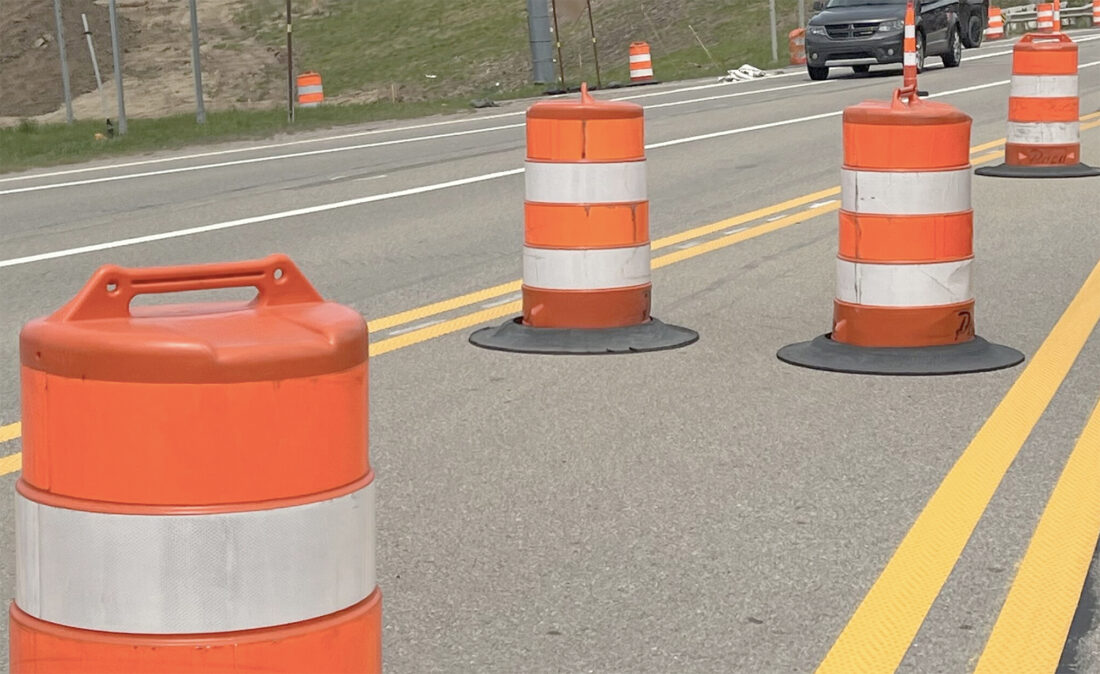
Road construction in Brighton, Michigan. (Jon King | Michigan Advance)
Michigan’s recently passed road funding measures have various pitfalls and oversights that might lead to the money not being delivered on time, while also making it difficult to predict if the legislation will actually improve statewide road and bridge infrastructure.
Those findings were delivered Thursday in a new report from the Citizens Research Council of Michigan, which analyzed the budget bills passed by the Legislature for the current 2025-26 fiscal year, including the transportation funding deal that underpinned many of the disagreements between the Republican-controlled House of Representatives and the Democratic-led Senate.
The report looked at the sources of new revenue, as well as how the funding would likely be distributed among the Michigan Department of Transportation, the state’s county road commissions, and local road agencies.
One of the key findings is that the oversights in the funding bills make it hard to predict if the bills would fund the roads as intended, and on time to really make a difference.
“By replacing the sales tax with an increase in the motor fuel tax rate, the Michigan Transportation Fund will receive a meaningful funding increase that should be dependable for years to come,” said Eric Paul Dennis, PE, research associate for infrastructure and author of the report. “But much of the other changes in this package appear haphazard and not well thought-out. Policymakers and road agencies will have to wait and see how much revenue from the Marijuana Wholesale Tax and Corporate Income Tax will become available.”
Dennis said that even if all of the anticipated revenue is provided, the uncertainty “imposes new difficulties in planning and programming construction projects.”
The package was intended to provide up to $1 billion in new road funding in 2026, and $2 billion by the 2030 fiscal year.
But much of that funding could be delayed from distribution, the report said, and might not be fully available. The report also found that the funding approach was overly complicated, inefficient and ineffective at making the available funds ready for the best use.
Of note, the Citizens Research Council of Michigan determined that the package did not address any other road and infrastructure issues aside from the funding needed to make it happen.
“It is unclear if the authors of the 2025 (package) intended for Michigan’s state road program to prioritize local agencies over MDOT so drastically,” the report said. “If so, it is unclear why. Such an approach is likely to increase the reliance of local road agencies on state funding with little accountability. Further, it is unclear if funding dedicated to MDOT will be sufficient to continue to improve and maintain the critical state trunkline system.”
The council also called the formula, which will give 50% of increased revenue sharing to local road agencies, antiquated, as it will then be distributed to local agencies in a way that has been done for many years.
“This has led to some local agencies being drastically underfunded while others likely receive more state revenue than makes sense,” the report said. “The 2025 (package) did nothing to address such inequities.”
As for the policy implications, the road agencies will likely be holding their breath to see if the new wholesale 24% tax on marijuana products sold in Michigan – a key piece of the new revenue model – will go up in smoke as it is being challenged in state court.
“Even if all anticipated revenue is provided, the uncertainty imposes new difficulties in planning and programming construction projects,” the report said. “More funding may be a partial temporary solution. But when applied to a broken system, more funding is just as likely to cause more problems.”
———
Michigan Advance is part of States Newsroom, a national 501(c)(3) nonprofit. For more, go to https://michiganadvance.com.
Local News
Analysis warns state’s 2025 road deal may fall short, arrive late

Christmas parade in downtown Escanaba
Public attitudes toward wolves split in the Upper Peninsula
Elle Jay Studio promotes mental wellness with physical treatments

Gun deer harvest drops in UP and statewide in 2025