Garbage truck breakdowns big problem for Public Works
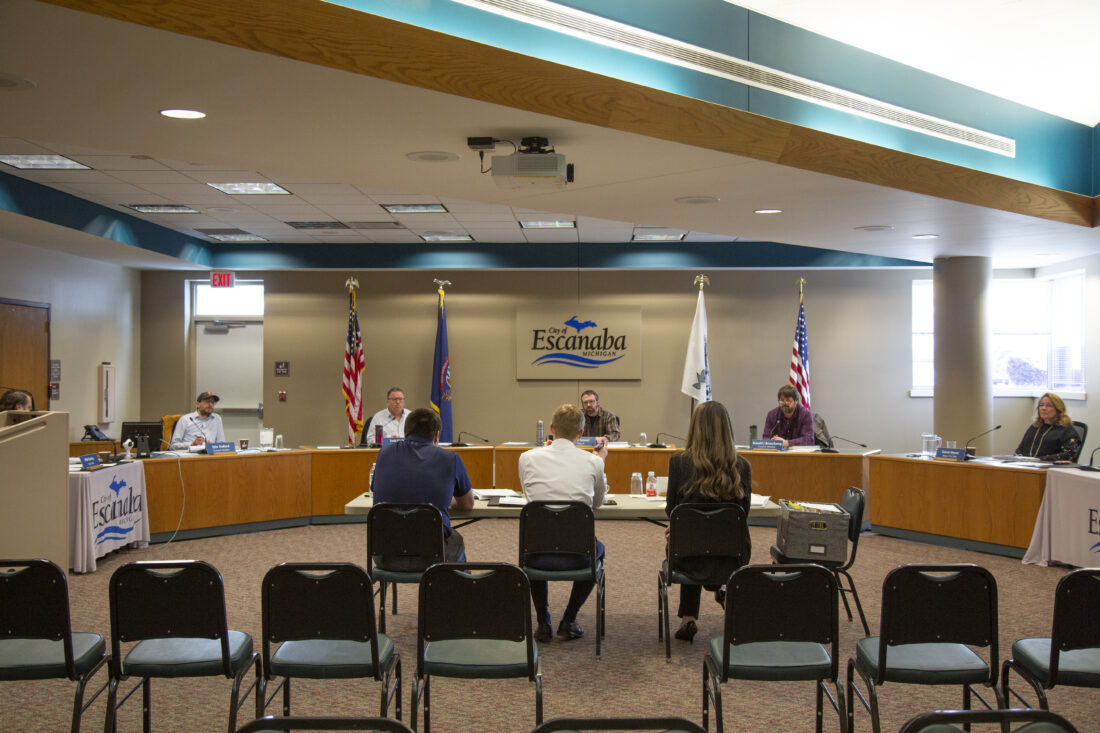
Ilsa Minor | Daily Press Escanaba City Council members, from left, Tyler DuBord, Todd Flath, Mark Ammel, Ron Beauchamp, and Karen Moore listen intently as Escanaba Department of Public Works Director Kent DuBord, City Manager Jim McNeil, and Controller Melissa Becotte speak about the needs of the public works department during the city’s first day of budget hearings Monday.
ESCANABA — Escanaba’s Public Works Department is gearing up for a year filled with construction projects and day-to-day activities that Escanaba Public Works Director Kent DuBord said have been complicated by equipment breakdowns. The City of Escanaba is currently preparing its budget for the upcoming fiscal year. DuBord outlined the department’s needs thursday the the Escanaba City Council. Here’s a look at the department’s plans and what it is seeking in the next fiscal year budget.
STREET WORK
Both major and local streets are expected to be torn up this summer as a result on ongoing lead service line replacements and a storm sewer and streetscaping project on the east end of Ludington Street. In total, about $10 million worth of projects are expected this summer, but much of those funds will be supplied by grants or other outside sources.
“I think I have like 12 different lines of notes on my street worksheet of different funding sources that are all coming in. It’s complicated,” City Manager Jim McNeil told the city council during the public works department section of Monday’s budget work sessions.
Costs related to the projects that are not covered by the grant the city has received from the Clean Water State Revolving Fund are roughly $3.2 million for the city, but other loans and grants have significantly reduced the amount the city’s street funds will ultimately be responsible for. In addition to one State Infrastructure Bank (SIB) loan for $2 million, the city is currently having a $1 million grant from the Michigan Economic Development Corporation reviewed that would further reduce costs. A separate $200,000 grant from the Michigan Department of Transportation could further reduce costs for projects on Ludington Street that have not already been bid out to contractors.
Even the city’s downtown development authority is helping with funding, however the authority’s $500,000 contribution is specifically for extending some of the elements of the streetscaping project on the east end of Ludington Street further west.
With the large amount of projects on the agenda for the department, some other road tasks, like crack filling, will be put on the back burner this year. The department expects to return to crack filling next year.
GARBAGE
One of DuBord’s primary concerns for his department is the continuation of garbage collection — a task that has been complicated by frequent truck breakdowns. According to DuBord, roughly 25% of all time spent by city mechanics working on equipment in the DPW department is spent repairing the city’s garbage trucks. That equates to about 835 hours spent by mechanics and $186,000 in repairs in the last year.
“We don’t get through a shift without something breaking down on those trucks,” said DuBord.
There are a few reasons why the trucks keep breaking down. First, according to DuBord, the trucks have a series of mechanical issues that are inherent to their make and model. Those issues have been compounded by the terrain of city alleys and the way people place their garbage cans out for collection — if the cans are too close to each other, trying to pick them up can damage the mechanical arm.
DuBord argued that now is the time to purchase a new truck because a series of emissions rule changes coming in the next few years are likely to increase the cost of equipment. He anticipated the purchase price would increase by about $90,000 if the city waited a year.
The council made a note to revisit the purchase of a garbage truck when making its final budget determinations, though city-wide equipment purchases are being pushed back due to high costs.
Another concern about garbage collection in the coming year will have less on an affect on the department and more on an affect on residents’ pocketbooks. While garage collection is paid for through a millage, increased tipping charges at the landfill will be passed on to residents’ utility bills.
OTHER EQUIPMENT
Despite DuBord’s desire for a new garbage truck, his overall plan for the department is to streamline the DPW department’s equipment. So far, the department has auctioned off a significant amount of equipment, and DuBord plans to further reduce the 32 pieces that the department has down to 24. The department would then bring in equipment that was in better condition and better met the department’s needs.
One new piece of equipment on his want list for the department is a new tractor, which can be used for a variety of tasks, including plowing bike paths. It was noted by the council that because the tractor was the least expensive item on the list, coming in around $12,000, it might be possible for the department to sell off enough existing equipment to pay for the purchase without fundamentally changing the budget.
DuBord also made comments that were similar to those he made about the city’s garage truck fleet when discussing the city’s plows and other snow removal equipment. However, given the city reluctance to approve equipment purchases and the fact the garbage truck fleet was a daily headache for the DPW department, his primary equipment focus throughout the budget session was on the trash fleet.
WAGES
Early in the session, DuBord made an appeal for better wages for the DPW staff, citing a number of sacrifices that the department had made, the fact the department had taken on many of the projects and responsibilities formerly under the auspice of the city’s recreation department, and pay disparity between DPW and other city departments. While it was noted that there were potentially many DPW workers who were worthy of increases, making changes to wages was something that would likely take place as part of the city’s labor negotiations in the next eight or nine months.
Local News

Judicial candidates in Esky tomorrow
Pole building destroyed in Hyde area fire
HYDE — A large pole building fire in the Hyde area Saturday evening required a significant mutual aid response ...

Seven Acre Gardens advances gradually
Gov. Whitmer seeks Presidential Disaster Declaration to help recover from Severe weather in April
LANSING, Mich. – Friday, Governor Whitmer announced that she is requesting a Presidential disaster declaration ...
Escanaba Farmers Market now open for the 2026 season