
Escanaba Public Safety to begin using body cams
Trending
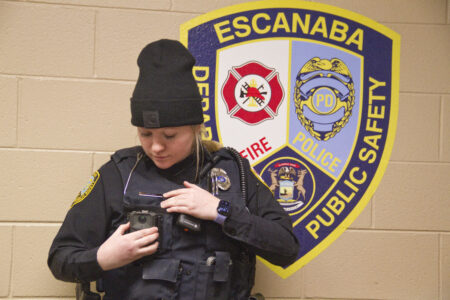
ESCANABA -- The Escanaba Department of Public Safety will soon begin utilizing body-worn cameras for its officers in the field. Both the department and the public reportedly have been largely in support of the technology casually called "body cams," as they are expected to lead to accountability and transparency. The devices are already on hand, and Public Safety Director John Gudwer said the city should begin equipping their officers with body cams before the end of the month.
A grant from the Small, Rural and Tribal Body-Worn Camera (SRT BWC) Program made Escanaba's purchase of 30 Motorola cameras possible by providing $60,000 -- $2,000 per item -- toward the total cost of $96,570, which includes warranties and cloud storage for five years. Gudwer said that the remaining $3,570 will be drawn from the city's funds, possibly offset by further partial coverage from a grant through the Michigan Municipal Risk Management Authority.
Each officer will be assigned their own body cam, which will sit in a charging port in a room at the department's headquarters when not in use.
"All of our new patrol vehicles have Motorola in-car cameras," explained Escanaba Public Safety Captain Darren Smith. "The new body cameras are directly linked to the patrol car cameras. So you can actually take the body camera off, put it in the charging port … when we come back and download it to the cloud, that footage is gonna give you both (the officer's) video and the video from the patrol car, and you can associate with other officers on scene. So you'll have all the different vantage points as like a group."
Freedom of Information Act (FOIA) requests made of Escanaba's Public Safety Department by members of the public has about doubled between 2020 and 2023. Projections are impossible to calculate with accuracy, but Gudwer and Smith anticipate an even greater rise in requests when video becomes included with evidence. Fulfilling a FOIA request takes time, and legally, certain redactions must be made to protect people's privacy.
"I requested in this current budget for our part-time clerical position to turn into a full-time position," said Gudwer, "suspecting that increase in FOIAs in regards to the body cams."
In recent years, body cam usage by law enforcement officials across the country has been increasing. Smith pointed out that Escanaba is "trailing way behind" other local agences; the Hannahville Tribal Police, Gladstone Public Safety, Delta County Sheriff's Department and the Michigan State Police already use them.
"We had a lot of support from the community and our officers, so it's like a win-win, because both sides want these body-worn cameras," said Smith. "It works for us because you got accountability to law enforcement and the community both."
Gudwer said that juries today expect to be able to see body cam footage, and being able to provide it eliminates certain questions.
"It's so needed for the transparency to the community. It helps protect the officer, it helps protect the public. … They're such a great tool," Gudwer said.
Since obtaining the equipment itself, the department has been preparing to bring it into the field.
"One phase (was) implementation of policy and procedures, since it's brand new," said Smith, describing the process. "Next phase was actual training for the specific type of body camera so officers know how to use them. Next phase would be hands-on functional testing them. Then once we get the green light -- we're looking at I'd hope within two weeks."