
Band reviving the music of Chet Marrier
Trending
ESCANABA -- The Marrier Orchestra Revival, a band organized by Joseph ("Joe") Hellberg of Escanaba, is bringing the nostalgic music of Chester ("Chet") Marrier back to light.
Chet Marrier was born in 1917 in Gladstone. From the 1930s to the 1990s, he played with the Escanaba City Band, the Works Progress Administration (WPA) Michigan Music Project's Delta County Unit, the WDBC radio orchestra, The Marrier 5 and The Marrier 7. Up until Chet's death in 1996, his groups played big band and swing from the time of its peak to well after other musicians had moved on to different sounds.
Chet's store, Marrier Music, provided instruments to the musicians of the area and was Escanaba's first record store.
Marrier directed the city band, and later in life, when the Bark River-Harris School found themselves in need of band director, he stepped into that role, too.
Impressing the musicians with whom Marrier played was his knack for arranging music. That is, he took existing pieces of music by popular composers and adjusted them to suit the band, the space, and the range of the particular musicians.
"Chet arranged all this music, he didn't use any stock arrangements, everything was written with his own hand in ink pen -- calligraphy pen," said John Srutowski, who played saxophone and clarinet for the Marrier 7. "So when you're writing that, you really can't -- if you make mistakes writing it out, you have to kind of throw away the whole thing. There's no erasing it. But he arranged the entire library, and when he wanted to add those two extra parts for the Marrier 7, he wrote out more parts for new instruments. He had it all in his head."
The Marrier 7, which played for about the last ten years of Marrier's life on Saturdays at the Dells Supper Club, featured one singer -- and who that singer was would rotate and change.
"He took his Marrier 5 library and he augmented it with another horn part, and then he wrote in a vocal chorus for the singer," Srutowski said. "They usually can't sing in the keys that are good for the horns, so he would change the key -- he wrote in key changes to bring it up to whatever key was better for whatever particular singer he was using at a time, or a common key for singers, either male or female.
"So he adapted the library. There were inserts -- so you'd take the standard two pages, and then he would add a vocal page with the appropriate -- they call it a modulation -- to modulate for the new key. He would write this all down in a separate sheet."
Srutowski said that instead of having full music in front of them, the singers were expected to know the music -- Marrier had them come to his music store and run through the songs, and for performances, the singers had stacks of index cards with the lyrics on them.
Hellberg said that Marrier sold his arrangements, too.
Hellberg first met Marrier in 1988, when Hellberg was a sophomore in high school. His friend Alex Jokipii, a fellow trumpet player in the Escanaba High School band, was graduating and going off to college, leaving his spot in Marrier's band available.
"It was Valentine's Day of 1988 is when I first heard a Glenn Miller record, and I didn't even know what swing music really was," Hellberg recalled. "It wasn't, you know, my favorite style of music at the time, but Alex was -- he had always been a role model for me, and he made the comment that he played every Saturday night and got paid. And getting paid for playing trumpet caught my ear."
Jokipii, who is currently the principal trumpet player for the Buffalo Philharmonic Orchestra, helped put Marrier and Hellberg in touch.
"I got the job from Chet, although I had to audition many times," Hellberg said.
Srutowski started playing with the band two years later when he moved to Esky -- his wife's hometown -- from Chicago with his young family. He said that he stepped into Marrier Music when he was new to town in 1990 and asked the man in the store if he knew of any musical groups he could join.
When Srutowski went home and announced that he'd been invited to play with someone called Chet Marrier, "my wife's face just dropped," he said. "She goes, 'you know, my father played with him.'"
The next six years were filled with shows almost every Saturday at the Dells, a handful of weddings and other special events and Marrier's own wedding to Elaine Drevlow.
Srutowski said that the "theme song" of the band that they began every night with was Moonlight Serenade, but his favorite piece was one called "Medley Number Nine."
"'Number Nine' referred to not that it was the ninth medley -- I always thought that -- but it referred to the fact that there were nine famous songs from the '20s in it," Srutowski said. "When he was looking for things to play, I would suggest that. It was just an exceptionally well done arrangement. … He did it in a very clever way, and by one song leading into the other. So he was quite a musician."
Srutowski said that after Marrier's passing, he asked Elaine -- Chet's widow -- for permission to arrange "Medley Number Nine" for a full band of 40 people.
For another couple years after Marrier's death, the band kept playing, but eventually it fell apart.
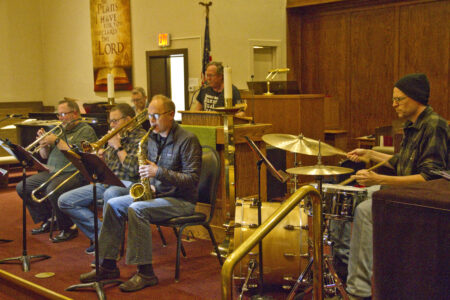
Now, a quarter of a century later, the Marrier Orchestra Revival is performing what could be rounded up of Chet's arrangements. While some sheets have been damaged or lost, Hellberg obtained several boxes of music from Elaine. The revival band, which meets weekly at the First Presbyterian Church in Escanaba to rehearse, has been working from those for now.
"I did a Google search in the computer and found out that there is a museum that has a collection of Chet's original charts because he sent a whole bunch music to this band -- this big band -- somewhere in the United States, and they have them now in this museum. So if I could get copies of those, that would be wonderful, but I don't know how that's going to happen," Hellberg said.
Recordings of the Marrier 7's performances from the '90s have been digitized thanks to Kevin Chown, Hellberg said.
"(Chown) has said that it should be really easy to transcribe from those -- to write out some of the songs that were missing," Hellberg said. "It's just, it takes time, you know?"
The Marrier Orchestra Revival, which has already held two concerts, consists of six people. On keyboard is Bill Rinne -- who bought a trumpet from Marrier and used to fill in for him on piano. Bruce Cassell plays trombone. Kris Pfotenhauer is on alto sax. Bill Sjoquist plays bass. Dave Potvin is the drummer. Hellberg plays trumpet.
"I couldn't have dreamed better the outcome of our first performance," said Hellberg. "Within the first two measures of playing our first notes, people were applauding and hooting and -- we didn't have, you know, applause like that when we played back in the '80s. But this is this is a style of music that people haven't heard."
The next upcoming show for the Marrier Orchestra Revival is on Nov. 22 at the House of Ludington.