Trapshooting club aims for accuracy
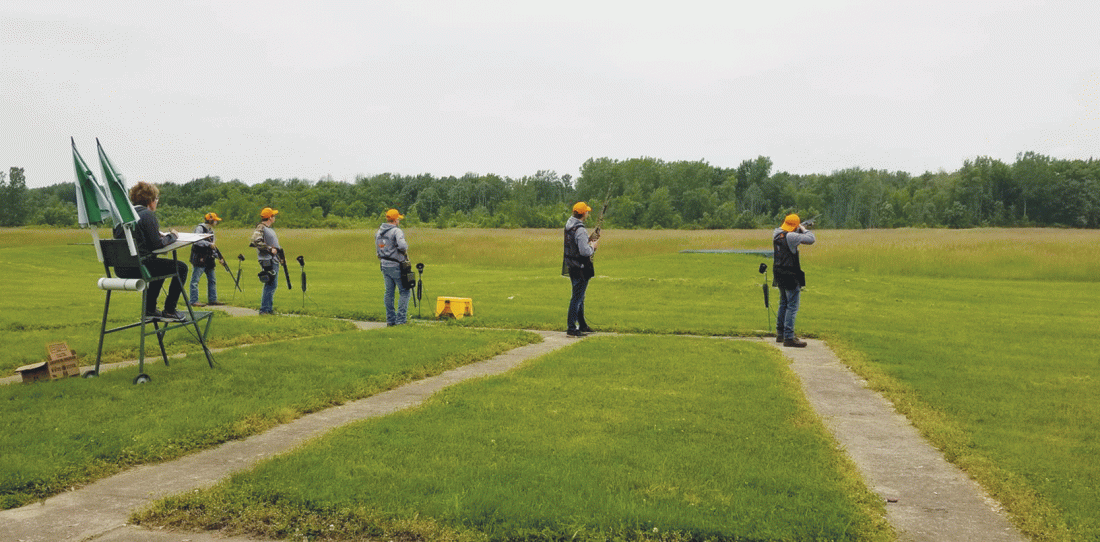
Courtesy photo The Escanaba trapshooting squad of shooters is shown at the Michigan State Championship. Each member has to have firearm handling training, either by Escanaba trapshooting coach Bill Cobb or a hunter safety instructor. High school boys and girls are both welcome and are asked to bring safety glasses, hearing protection, a 12 gauge shotgun and ammunition. The club members shoot at the Great Lakes Sports and Recreation Club in Escanaba.
ESCANABA — Escanaba High School students have a choice of many clubs to join — Robomos Robotics Club, Environmental Club, Key Club, Film Club — and now trapshooting. What is trapshooting? Trapshooting is one of three specific forms of competitive clay pigeon shooting. Clay discs, or “birds”, are hurled through the air at a speed of 42 mph. According to the Amateur Trap Association (ATA), it is a game of movement, action and split-second timing that requires the accuracy and skill of a person to repeatedly aim, fire and break the disc.
“Trapshooting is a sport where there are five stations and there is one trap host that is out front,” said Escanaba Trapshooting coach Bill Cobb. “The ‘birds’ are always on the same plane, but can be hard right, hard left, or in the middle. When the shooter calls ‘pull’, wherever the machine’s at that’s where the “bird” goes.”
When a shooter hits a “bird” it is considered “dead” and they score one point. Whether it is shattered, or a small piece breaks off, it is considered “dead.” As a team, the club members shoot two rounds, 50 “birds”, at their home range — the Great Lakes Sports and Recreation Club (GLSRC).
The club started in the 1A1 conference with Norway. They are the only two schools with a trapshooting club in the U.P. Teams are put into conferences similar in size. Michigan has 54 teams, just under 1,000 students, Escanaba virtually competes against. Each week, students shoot and Cobb enters their scores online into a database. The best go to the Michigan State Championship in Mason, Mich., the Michigan State Trapshooting Homegrounds. In the first season, eight students from the Escanaba club went.
“At the state level they ranked 26th, about in the middle of the pack, 52-54 teams, which is pretty good,” said Cobb. “In our conference we took third, Storm Franks took fourth place boy, and Jillian Cobb took third place girl. The fall league took second in the conference, Storm Franks won third high boy in our conference and Jillian Cobb was first girl, and Jillian Cobb took third overall girl for the whole league for the state.”
Each student in a five-member squad shot 100 targets.
“Without two full squads, everyone competes individually, your scores are your scores for a medal,” said Cobb. “The top five of eight make up the team score.”
Because of the popularity of the Michigan High School Clay Target League, Cobb decided to run a fall league. Escanaba is the only trapshooting club in the fall.
“We ran a five-week competition this fall that ended a week ago,” said Cobb.
In November 2018, Cobb asked the Escanaba School Board to add trapshooting to the activities available to high school students. The board approved, and in March Cobb started a spring club with nine students.
“We registered students in March and shot in April through June. That’s the main shooting season,” said Cobb.
The club is self-funded and held a fundraiser to get team uniforms.
“We are technically a club that is “parent-funded”, and they have been very supportive. Parents are also involved and participate as safety officers on the line and stuff like that,” said Cobb. “We have fund-raised a little with some of the sportsmen groups. It helped us buy shirts we all wore to the state shoot.”
Cobb will start registering students for a third season in March 2020. He has seen an interest from other students and believes there will be a small increase in membership. Cobb plans on another team going to the state championship again and is getting a team together to go to the nationals.
“We’re pretty lucky,” said Cobb. “The national championship will be back in Mason, Mich. in 2020.”
Students interested in joining need to have some firearm handling training, either a training program instructed by Cobb, or hunter safety, to join. Cobb teaches members general safety rules, keeping the gun pointed down range, knowing what the target is before shooting and what’s beyond the target, keeping the finger off the trigger, and loading the gun only when ready to shoot.
“We don’t get into the actual hunting aspects, we get more into general gun safety. In competitive shooting, you’re around other people and sometimes you’re moving from spot to spot,” said Cobb. “Make sure my gun’s unloaded, safety’s on, pointed down range, now it’s safe for me to move to the next spot.”
In addition, students must have safety glasses, hearing protection, a shotgun and ammunition.
“If they don’t have safety glasses and ear plugs, we can provide them. We received a donation of personal protective equipment from Verso,” said Cobb. “We have had kids shoot 20 gauge shotguns. It does make it a little more challenging, a smaller gun, less BBs. We try to encourage them to shoot a 12 gauge if they are physically capable.”
Cobb competed with .22s and air rifles in high school and shot ever since. He advised a small youth trapshooting team at GLSRC before starting the Escanaba club. It is the fastest growing sport in the United States, according to Cobb.
“Michigan has their state competition in one day, where states like Minnesota and Wisconsin have so many kids they have to take three days. It’s huge. Most four-year colleges in Wisconsin have it (trapshooting), and a lot of their high schools,” said Cobb.
Cobb admits he has a lot to learn about being a coach in the high school system.
“I’m very lucky. The kids, they just want to be there and have made it very easy. It’s not like any other sport, it’s all equipment,” said Cobb. “If you put a kid in the right equipment and it fits them, well they can compete with anyone.”
Every student has improved, according to Cobb. A perfect score is 25 — that means no “birds” were missed.
“We have a couple of kids that shoot 25s occasionally,” said Cobb. “Everybody has improved their average. We had kids that could barely break 10 (discs) at the start of the year, now every one is in the double digits.”
For more information about the Escanaba High School Trapshooting Club contact coach Bill Cobb at 906-399-6332.
Local News

Bald Eagle Harley-Davidson hits the road, coming to Escanaba

Bay BPA advancing to nationals in Tennessee

Mugshot released: Local substitute teacher arrested for criminal sexual conduct
Mugshot released: Local substitute teacher arrested for criminal sexual conduct

U.P. students learning about government in Lansing