Iran and world responds to American threats
Global oil supply has been affected by war
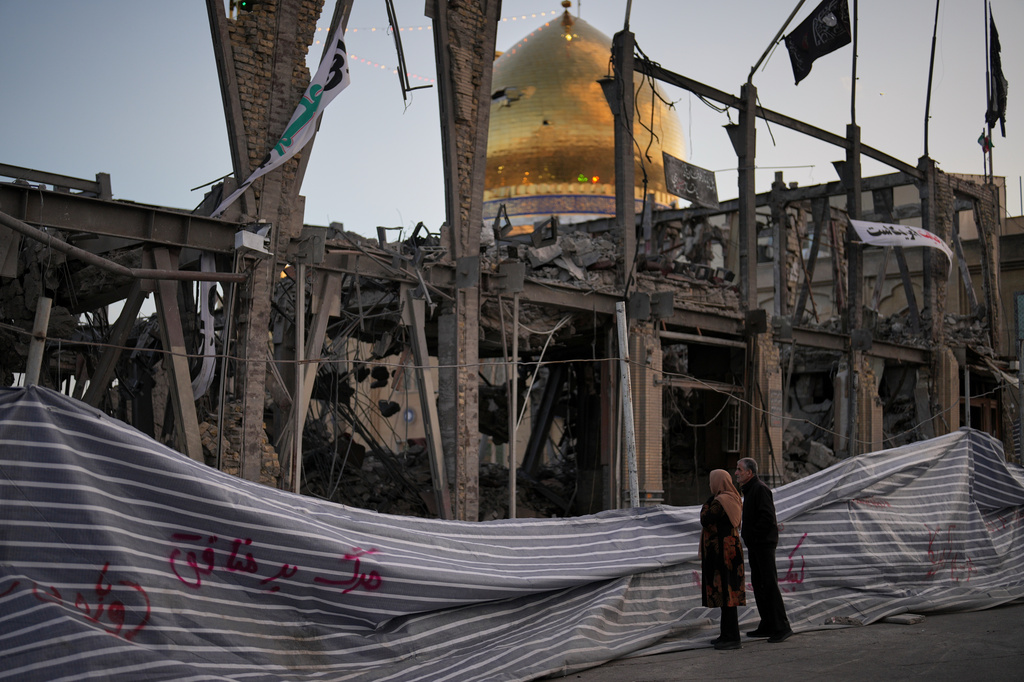
Pedestrians look at a destroyed building within the Grand Hosseiniyeh, with the mosque visible in the background, which officials at the site say was hit by U.S.-Israeli airstrikes Tuesday, in Zanjan, Iran, Saturday, April 4, 2026. (AP Photo/Francisco Seco)
TEHRAN, Iran (AP) — U.S. President Donald Trump on Sunday made expletive-laden new threats to escalate strikes on Iran and its infrastructure if it doesn’t open the Strait of Hormuz by his deadline, after American forces rescued an aviator whose Iran-downed plane fell behind enemy lines.
On March 26, Trump set a 10-day deadline for Iran to reopen the Strait of Hormuz, a key shipping route for the global energy market. Traffic there has stalled since the US and Israel first attacked Iran on February 28.
A defiant Iran struck infrastructure targets in neighboring Gulf Arab countries, challenged the U.S. account of the avaitor rescue and threatened to restrict another heavily used waterway in the region, the Bab el-Mandeb Strait off the Arabian Peninsula.
In a social media post, Trump vowed to hit Iran’s power plants and bridges and said the country would be “living in Hell” if the Strait of Hormuz, crucial for global trade, isn’t opened by Tuesday. He ended with “Praise be to Allah.”
Trump has issued such deadlines before but extended them when mediators have claimed progress toward ending the war, which has killed thousands, shaken global markets and spiked fuel prices in just over five weeks.
He told Fox News on Sunday that Iran was currently negotiating with the US and that he believed the two could reach a deal before the deadline.
Both sides have threatened and hit civilian targets like oil fields and desalination plants critical for drinking water. Iran’s U.N. mission called Trump’s threat “clear evidence of intent to commit war crime.”
Iran’s military joint command warned of stepped-up attacks on regional oil and civilian infrastructure if the U.S. and Israel attack such targets there, according to state television.
The laws of armed conflict allow attacks on civilian infrastructure only if the military advantage outweighs the civilian harm, legal scholars say. It’s considered a high bar to clear, and causing excessive suffering to civilians can constitute a war crime.
“It seems Trump has become a phenomenon that neither Iranians nor Americans are able to fully analyze,” Iranian Culture Minister Sayed Reza Salihi-Amiri told visiting Associated Press journalists in an interview in Tehran, adding that the president “constantly shifts between contradictory positions.”
Diplomatic efforts continue
Trump’s deadline centers on growing alarm over Iran’s grip on the Strait of Hormuz, critical for shipments of oil and gas from the Persian Gulf to Europe and Asia as well as humanitarian supplies. Some ships have paid Iran for passage.
An Iranian presidential spokesperson, Seyyed Mohammad Mehdi Tabatabaei, said on social media that the strait can reopen only if some transit revenues compensate Iran for war damages.
A top Iranian adviser, Ali Akbar Velayati, warned on social media that Tehran also could disrupt trade on the Bab el-Mandeb, a key waterway to and from the Suez Canal.
Oman’s Foreign Ministry said that deputy foreign ministers and experts from Iran and Oman met to discuss proposals to ensure “smooth transit” through the strait. Oman has often served as a mediator between the U.S. and Iran.
Egypt said that Foreign Minister Badr Abdelatty had spoken with U.S. envoy Steve Witkoff and Iranian Foreign Minister Abbas Araghchi, and with Turkish and Pakistani counterparts. Russia said that Araghchi also spoke with Russian Foreign Minister Sergey Lavrov.
Response to American threats
Iran’s culture minister has dismissed President Donald Trump’s latest threats: “Iranian society generally does not pay attention to his statements, as it believes he lacks personal, behavioral and verbal balance, and constantly shifts between contradictory positions,” Sayed Reza Salihi-Amiri said Sunday.
He added the Strait of Hormuz is “open to the world but closed to Iran’s enemies.”
Seyyed Mohammad Mehdi Tabatabaei, a presidential spokesperson, wrote Sunday on the social platform X that the reopening of the vital waterway can only happen if transit revenues are partially earmarked to compensate Iran for war damages.
In a social media post on Sunday, Iran’s parliamentary Speaker Mohammad Bagher Qalibaf dismissed Trump’s recent threats of targeting Iran’s infrastructure as “reckless.”
“You won’t gain anything through war crimes,” Qalibaf wrote on X. “The only real solution is respecting the rights of the Iranian people and ending this dangerous game.”
The Council on American-Islamic Relations, a nationwide advocacy group, assailed Trump for invoking Allah in his Truth Social post threatening Iran: “President Trump’s deranged mocking of Islam and his threats to attack civilian infrastructure in Iran are reckless, dangerous, and indicative of a mindset that shows indifference to human life and contempt for religious beliefs,” CAIR said in a statement.
Top Iranian official threatens closure of the Bab al-Mandeb Strait
A former foreign minister and adviser to the supreme leader warned Sunday that “the resistance front” could target the Bab el-Mandeb Strait off the Red Sea, through which about 12% of the world’s trade typically passes.
“If the White House thinks of repeating its stupid mistakes, it will quickly realize that the flow of global energy and trade can be disrupted with a single signal,” Ali Akbar Velayati said on social media, signaling possible closure of the vital waterway if the U.S. escalates attacks.
Iran leads the so-called “Axis of Resistance,” which includes armed groups in Lebanon, Iraq and Yemen, where Houthi rebels had in the past cut off transit through Bab el-Mandeb with attacks on vessels.
Iran has effectively stopped cargo traffic through the Strait of Hormuz during the conflict, leading to higher oil and gas prices globally.
Oil-producing countries decide on symbolic output increase
Eight countries from the OPEC+ oil cartel say they will increase production again in May to ensure stability on the oil market — a decision overshadowed by the effective closure of the Strait of Hormuz to tanker traffic due to the Iran war.
The countries said in a statement carried Sunday on the Organization of the Petroleum Exporting Countries website that production would be increased by 206,000 barrels per day.
That, however, remains largely on paper due to the loss of an estimated 12 million barrels a day from Persian Gulf producers due to the Hormuz closure.
The countries — Saudi Arabia, Russia, Iraq, the United Arab Emirates, Kuwait, Kazakhstan, Algeria and Oman — warned that damage from attacks on oil infrastructure will take “a long time” to repair and return supply to previous levels.
Such attacks, as well as disruption of navigation, undermine efforts to support stable prices “for the benefit of producers, consumers and the global economy,” they said.
Strikes from all sides
In the United Arab Emirates, authorities said that four people — one Nepali and three Pakistani — were hurt in fires caused by debris from the interception of an Iranian projectile at Khor Fakkan port, and intercepted debris caused fires at a petrochemical plant in Ruwais, halting operations.
In Kuwait, Iranian drone attacks caused significant damage to power plants and a petrochemical plant. They also put a water desalination station out of service, according to the Ministry of Electricity.
In Bahrain, a drone attack caused a fire at one of the national oil company’s storage facilities and a state-run petrochemical plant, the kingdom’s official news agency said.
In Israel, rescue authorities said that they were searching for three people in the northern city of Haifa after an apartment building was hit. It wasn’t immediately clear what struck it.
More than 1,900 people have been killed in Iran since the war began.
In Gulf Arab states and the occupied West Bank, more than two dozen people have died, while 19 have been reported dead in Israel and 13 U.S. service members have been killed. In Lebanon, more than 1,400 people have been killed and more than 1 million people have been displaced. Eleven Israeli soldiers have died there.
The Gaza Strip has seen near-daily Israeli fire and strikes since a fragile ceasefire was reached in October, and more than 700 Palestinians have been killed since then, according to figures from the Gaza Health Ministry.
International News
Pope Leo urges peace in first Easter Mass
Iran and world responds to American threats
Sweden releases sanctioned tanker due to lack of evidence it caused oil spill
Artemis shatters Apollo record
HOUSTON (AP) — The Artemis II astronauts are already the champions of a fresh new era of lunar exploration. Now ...
US journalist kidnapped in Baghdad and security forces hunt captors, Iraqi officials say
BAGHDAD (AP) — An American journalist was kidnapped Tuesday in Baghdad and Iraqi security forces are pursuing her ...