
Urania reborn
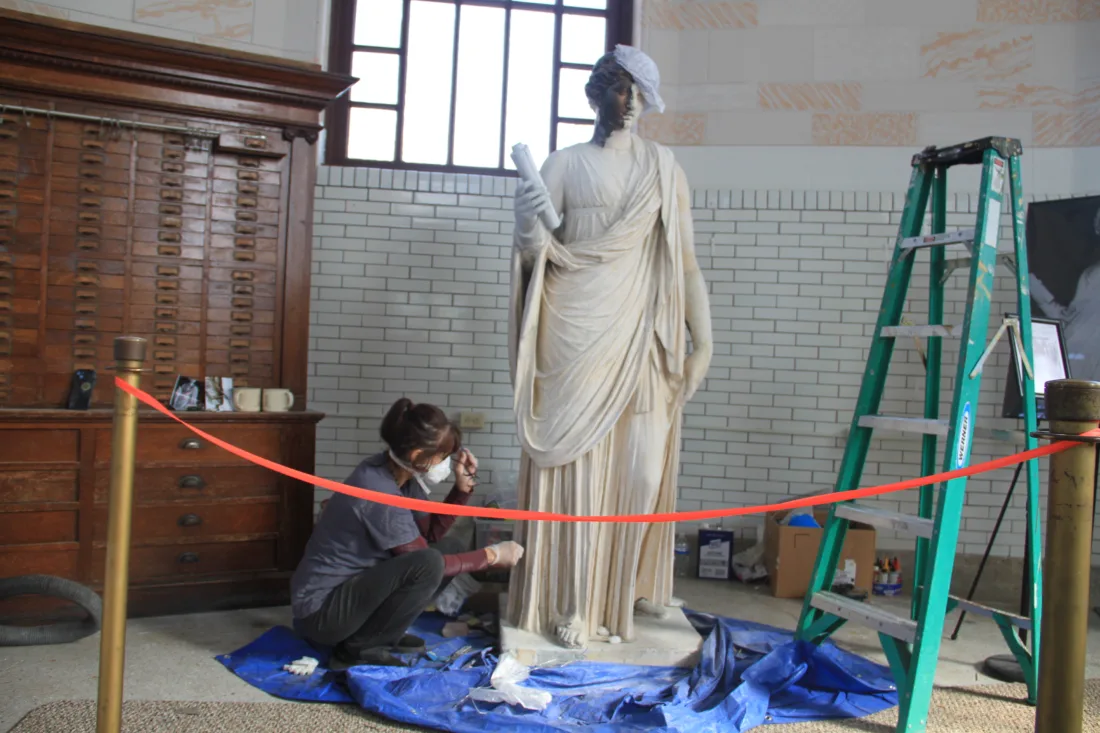
Renata Palubinskas is the art conservator with decades of experience in the Detroit area restoring priceless works, returns a piece of Manistique history to its former glory. (R. R. Branstrom | Daily Press)
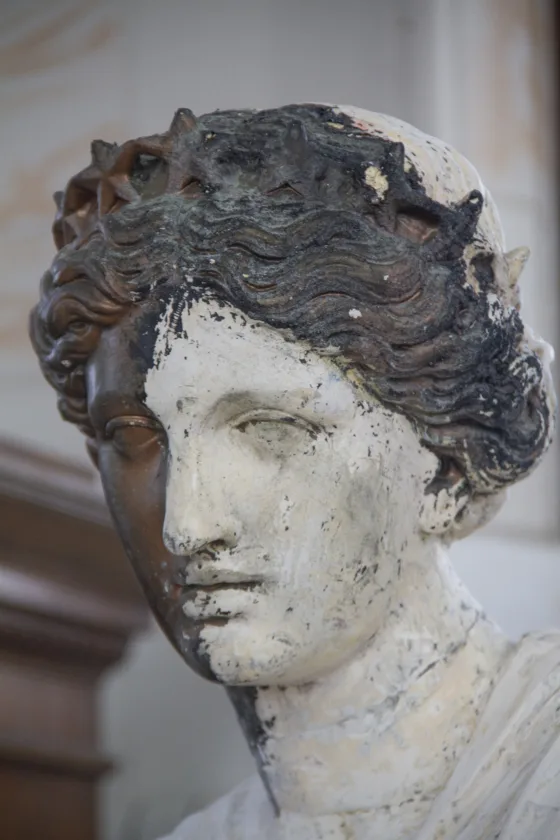
An outer coat of bronze-colored paint and a black undercoating is seen partially removed from a plaster statue of the Greek goddess Urania, whose head is decorated with stars. The statue was donated to the Manistique High School by the class of 1922 and is in the process of being restored. It will be kept in the Old Manistique Water Tower, which serves as the museum for the Schoolcraft County Historical Society. (R. R. Branstrom | Daily Press)
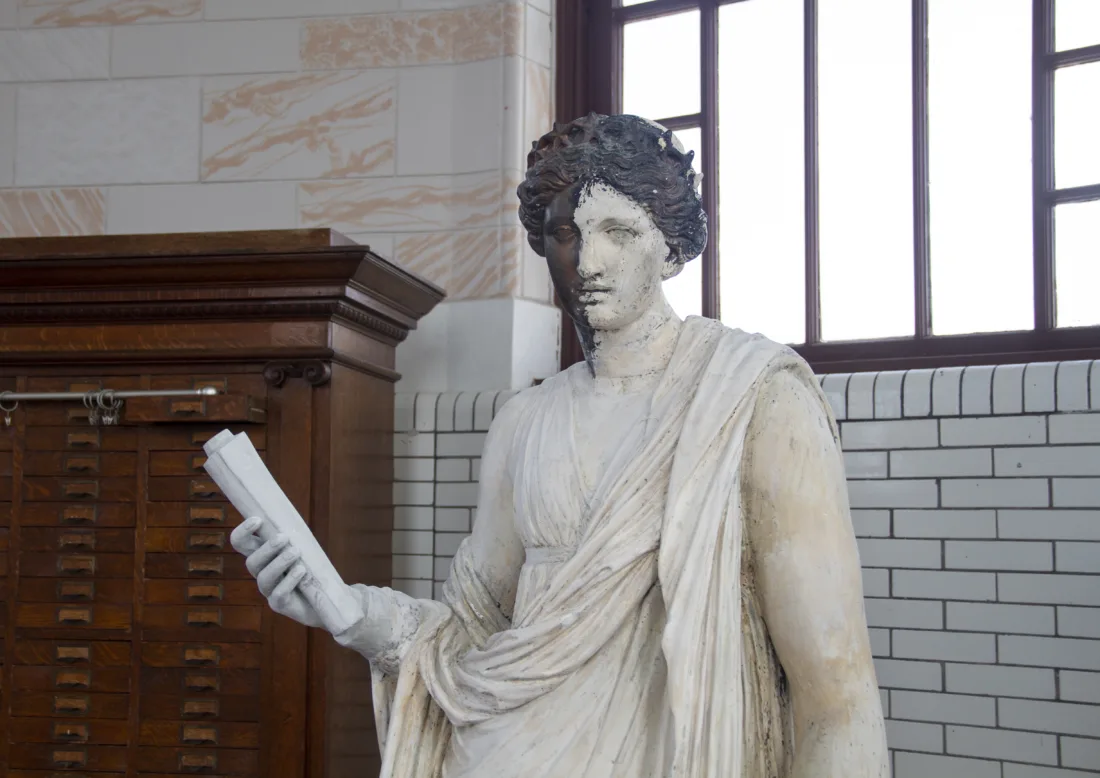
Just days ago, a 100-plus-year-old statue that had been missing her hand got a new one fashioned by an esteemed art conservator. (R. R. Branstrom | Daily Press)
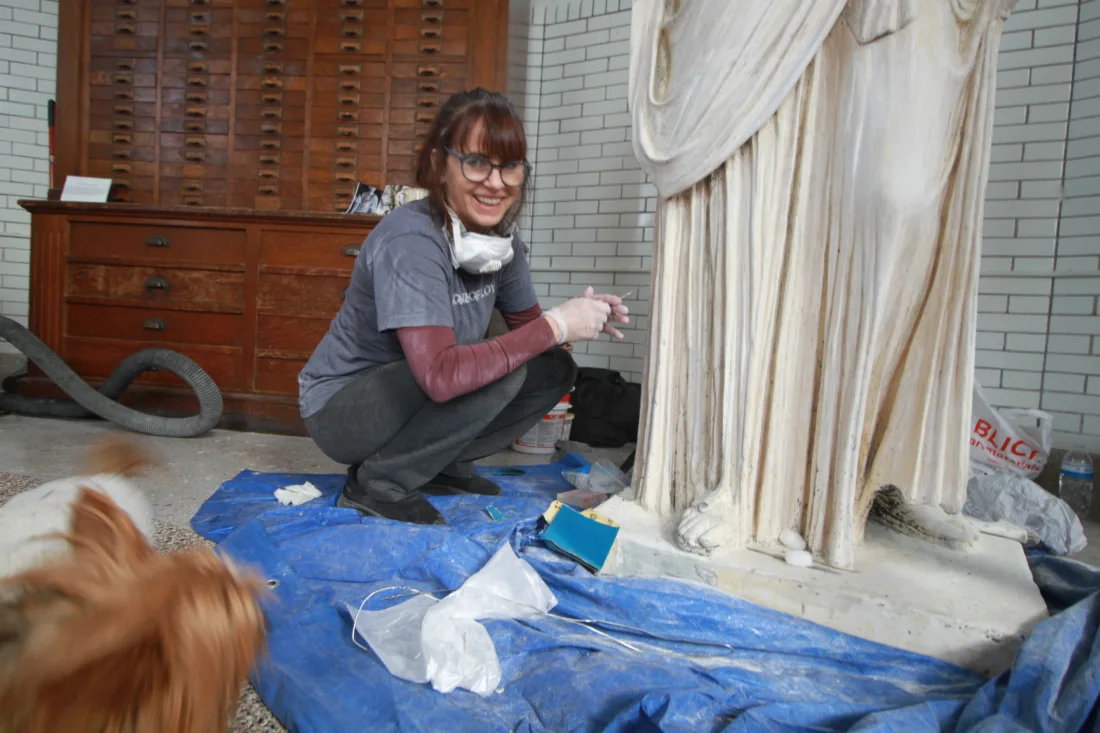
While working in Manistique, artist Renata Palubinskas laughs as her friendly "assistant," Schnook the Yorkshire Terrier, insists on being petted by the photographer instead of posing. (R. R. Branstrom | Daily Press)
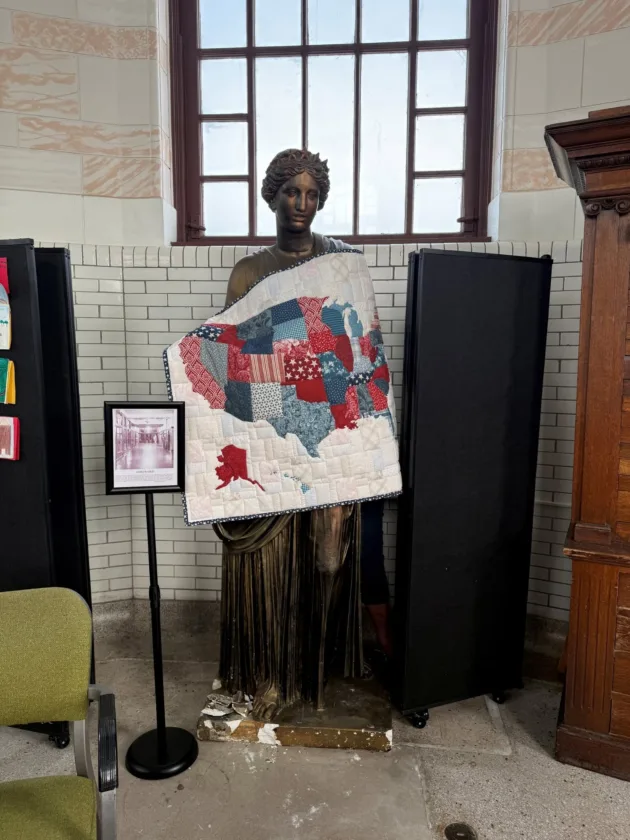
Before funds had been raised to restore the statue, Urania holds a quilt that donors could be entered to win in a raffle. (Photo courtesy of Schoolcraft County Historical Society)
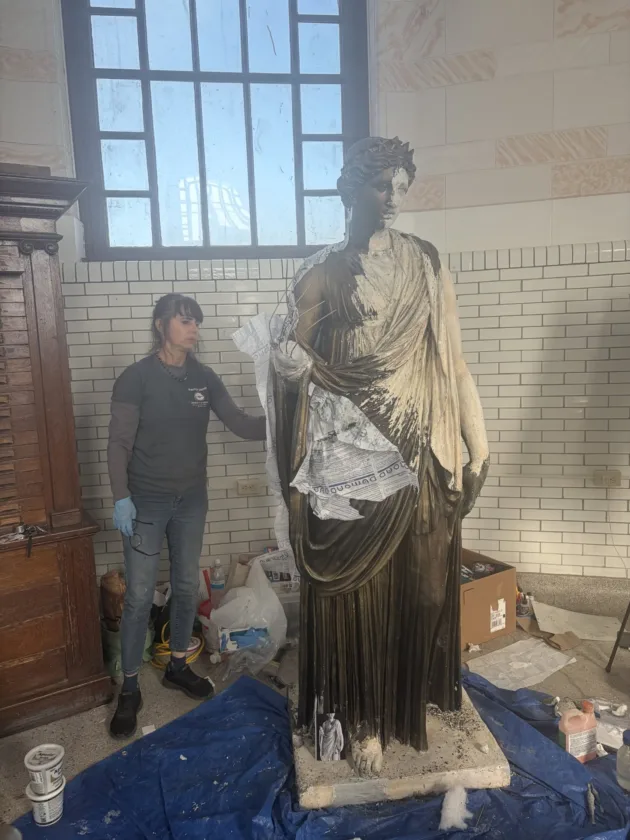
Preparations have been made to sculpt a new hand for an old statue. Renata Palubinskas (pictured) has now nearly completed restoring the artifact that stood in two Manistique High Schools. (Courtesy photo)
Renata Palubinskas is the art conservator with decades of experience in the Detroit area restoring priceless works, returns a piece of Manistique history to its former glory. (R. R. Branstrom | Daily Press)
An outer coat of bronze-colored paint and a black undercoating is seen partially removed from a plaster statue of the Greek goddess Urania, whose head is decorated with stars. The statue was donated to the Manistique High School by the class of 1922 and is in the process of being restored. It will be kept in the Old Manistique Water Tower, which serves as the museum for the Schoolcraft County Historical Society. (R. R. Branstrom | Daily Press)
Just days ago, a 100-plus-year-old statue that had been missing her hand got a new one fashioned by an esteemed art conservator. (R. R. Branstrom | Daily Press)
While working in Manistique, artist Renata Palubinskas laughs as her friendly "assistant," Schnook the Yorkshire Terrier, insists on being petted by the photographer instead of posing. (R. R. Branstrom | Daily Press)
Before funds had been raised to restore the statue, Urania holds a quilt that donors could be entered to win in a raffle. (Photo courtesy of Schoolcraft County Historical Society)
Preparations have been made to sculpt a new hand for an old statue. Renata Palubinskas (pictured) has now nearly completed restoring the artifact that stood in two Manistique High Schools. (Courtesy photo)
Trending
MANISTIQUE -- Memories of a plaster statue that once stood in the hall of a local school were nearly lost, but historians of Manistique tracked down the artwork about eight years ago. During the last week and a half, the sculpture has been under the hands of an art conservator.
According to information pieced together by the Schoolcraft County Historical Society, the Manistique High School class of 1922 purchased the statue and gifted it to the school in honor of locals who had fought in World War I. The statue, a replica of an older piece, also meant to celebrate the signing of the Treaty of Versailles, which ended the war in 1919.
The figure is said to be Urania, a minor goddess and the muse of astronomy in Greek mythology. Urania is usually depicted carrying a globe and sometimes a pointer or plotting compass, with a halo of stars around her head. Her likeness appears on the official seal of the U.S. Naval Observatory.
The statue in Manistique was created by P.P. Caproni and Brother, a Boston-based manufacturer of plaster reproductions. Back in the late 1800s, Pietro Paulo Caproni obtained permission from museums to make casts of classical statues from which to make imitations that could be used as educational tools.
Though she’s called Urania, the statue in Manistique is not carrying a globe -- though she does have the stars, a symbol of the goddess, encircling her head. In her right hand is a scroll -- uncommon for Urania -- so there are a couple theories about why that may be. It’s possible that the centuries-old statue from which the mold had been made had been broken and its hand improperly remade; alternatively, perhaps this version was meant to be holding a chart of the heavens. Some could argue that the 1920s version was holding the Treaty of Versailles.
The art conservator believes that when the original ancient statue of Urania, made of marble, was excavated in ancient Greece, a broken hand was refashioned with a scroll by 17th-century sculptors who didn’t know what the muse was meant to hold.
The Caproni reproduction stood in the old high school in Manistique until a new one was built in 1976, and she was relocated to the new facility’s library. During a building remodel in 1997, the sculpture was put in storage.
When Schoolcraft County Historical Society Vice President Sherri Krause was reading “Stique Stories,” a book by John B. Anderson about growing up in Manistique in the 1940s and ’50s, she came across mentions of the statue of Urania -- including a prank by the football players that involved relocating her.
Krause and others had vague recollections of seeing the statue at school in their youth, but didn’t know about its history. One former student was Jane Kopecky, now the curator for the Historical Society. She attended school in the ’60s.
“We were oblivious to her,” said Kopecky, referring the Urania statue. “She was like a piece of brick because nobody knew her history. Over the years, the history had faded. The people that did know her history had passed away, and even our teachers never mentioned her.”
At various points, the statue was moved again, painted, became used as a prop in plays, and moved to the the mechanical shop, according to Kopecky.
Around July 2018, Krause said, she put out an advertisement asking if anyone knew what had become of the statue. Retired teacher Richard Wodzinski answered the ad, responding that it had occupied his wife Sandy’s art room, Krause said.
Both Rick and Sandy had been teachers at Manistique. According to the word-of-mouth anecdotes relayed to the historical society, it appeared that someone representing the school told the historical society they could have the Urania sculpture, but after the society didn’t collect it after a couple years, the district was preparing to sell it at a school garage sale.
It was at that point that Rick Wodzinski bought it, the former teacher shared. Sandy was a painter, and both were interested in art; the couple ran Christopher’s Antiques after retiring from the school system.
“I bought it and gave it a new home in our home,” Wodzinski said. He was still working for the schools at the time under Superintendent Ken Groh and tried to find info on the statue’s background in the library, but found nothing in the old yearbooks.
After the old statue spent about 25 years in the Wodzinski home, Rick donated it to the Schoolcraft County Historical Society.
Lisa Busch, a highly active member of the society, conducted a lot of research and learned about the Caproni plaster reproductions and other history. She also made contact with art conservationists downstate, who connected her with Renata Palubinskas, owner of Decorative Object and Sculpture Restoration. Palubinskas, originally from Lithuania, is well-practiced in fine arts as well as preservation and was employed with Conservation and Museum Services in Detroit for about 30 years before forming her own private business a few years ago.
When the society in Schoolcraft County began hunting for a conservator and raising money seven years ago, the estimated price tag was around $3,000, reported the Pioneer Tribune in August 2019.
Last spring, Palubinskas visited the historical society (housed in Manistique’s historic water tower on Deer Street) to assess the century-old statue. She outlined a plan for restoring the work, which had one hand broken off, several chips, and thick coats of two different kinds of paint.
The cost ended up climbing to around $10,000. Funds were finally collected thanks to a number of community donations, including several multi-thousand-dollar contributions from local and anonymous parties.
Anyone who donated over $250 was entered into a raffle to win a quilt, which helped draw some attraction, Krause said.
Palubinskas was hired and arrived to begin the job of bringing Urania back to her former glory about two weeks ago. The job was expected to take ten days, but reached its 12th yesterday.
Palubinskas has been working long hours inside the old water tower with an open door leading to several rows of seats positioned facing the sculpture. As the artist worked on the nearly-forgotten piece of Manistique history, members of the public flowed in and out to watch the process.
Removing the paint to return the statue to her original color -- which simulated light marble -- was difficult, Palubinskas said, describing the black paint under the final bronze-colored coat as “tar-like.” When her first method of paint removal didn’t work, she used a chemical process. When specks of dark paint still lingered, especially in places like the folds of the goddess’s clothing, Palubinskas resorted to using sandpaper and scalpels to scratch them off.
As for the broken hand -- it’s a common affliction for old sculptures, the artist noted.
“During my restoration career, you know, I have to fabricate a lot of missing hands because it’s very typical,” Palubinskas said.
She re-created the hand, scroll, pieces of the base and parts of the statue’s clothing using plaster.
“As an art conservator with education in in conservation, we have you ethics,” Palubinskas said, explaining that her goal was to bring this statue back to the way it had looked, as opposed to replacing the missing hand with the globe Urania usually carries.
“If we do fabrication, we have to solidly know what to fabricate. Or if there is missing part, you know, we very closely… follow intention of the artist. And not over-paint, not over-restore. Because one restoration like that can be carried many centuries and change the meaning of the piece,” Palubinskas explained.
The statue was nearing completion early this week, and the public will soon be able to see Urania the way she looked in 1922.
Though the sculpture had been called “not very pretty” when the society first received the damaged Urania, “she’s actually beautiful,” said Krause, admiring the statue that had been brown for so long.
Wodzinski, the statue’s previous owner, told the Press on Tuesday he’d visited the museum during one of Palubinskas’s first days working, and was looking forward to seeing the finished result.
“The permanent home, evidently, will be in the water tower. So that’s nice. A lot of people will see it,” Wodzinski said. “It should be a piece that will now stay in the community forever.”
Kopecky said that a plaque would be going up, “so that history doesn’t get lost again. She won’t get lost again.”
– – –
Writer R. R. Branstrom can be reached at rbranstrom@dailypress.net.