The making of America’s first president
George Washington's military, political careers began in Winchester, Virginia
-
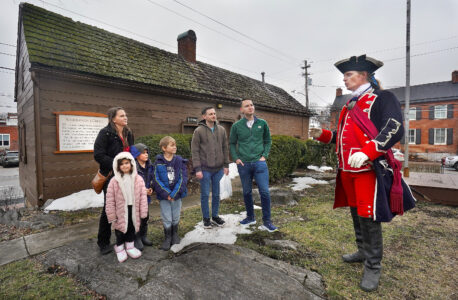
- Ryan Williams, right , dressed as George Washington talks to visitors to the Washington’s Office Museum on Monday. The visitors are from left, Alissa Curtis with her children, Dottie 6, Shepherd 6 and Bear Curtis 7 of Clarke Co. and Tony Salerno and Brian Harrin of Chantilly. Williams is a lead interpreter at the museum. (Photo by Ginger Perry)
-
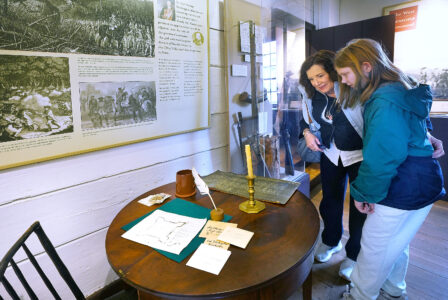
- Teri Pierce of Stephens City, left and her grandaughter, Abigail Blevins 10 look at items on a desk at the Washington’s Office Museum on Monday, President’s Day. Blevins, a 4th grader from Warrenton has been study about George Washington in school. (Photo by Ginger Perry)
-
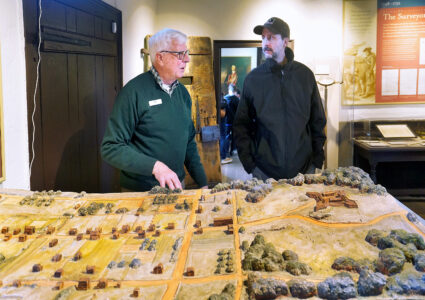
- Gene Schultz, left, volunteer and board member of the Washington’s Office Museum talks with Brian Armel about Winchester in 1757 at the museum on Monday. (Photo by Ginger Perry)
-
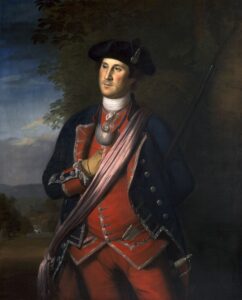
- George Washington
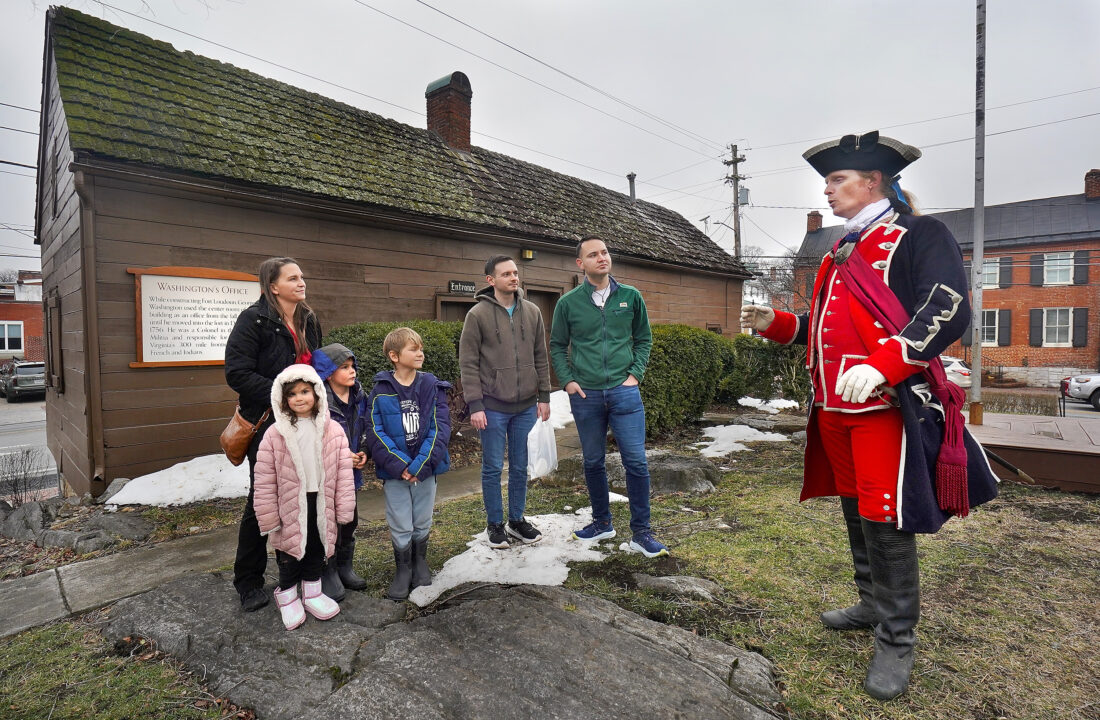
Ryan Williams, right , dressed as George Washington talks to visitors to the Washington's Office Museum on Monday. The visitors are from left, Alissa Curtis with her children, Dottie 6, Shepherd 6 and Bear Curtis 7 of Clarke Co. and Tony Salerno and Brian Harrin of Chantilly. Williams is a lead interpreter at the museum. (Photo by Ginger Perry)
Editor’s note: This is the first in a series of 12 weekly stories focusing on America’s 250th birthday, as told through the lens of our communities and the role many of the places we call home played in shaping the nation before, during and after the Revolutionary War. This week we begin in Winchester, Va., more than a quarter-century prior to the revolution — a time when colonists’ loyalty to the monarchy remained high — where a young George Washington began to emerge as a leader. That experience in Winchester — and also throughout the western front as a surveyor and then a military commander — helped lay the groundwork for the man that would help shape a nation.
WINCHESTER, Va. — Before he was the father of our country, before he led Continental Army soldiers across an icy Delaware River, before he inherited his family’s Mount Vernon estate in Northern Virginia, America’s future first president was just a kid named George.
It wasn’t until a young George Washington came to Winchester, Va., that he started to become the man whose face would one day adorn the $1 bill.
Washington was born on Feb. 22, 1732, at Popes Creek Plantation (now Wakefield) near Colonial Beach, Va., and moved with his family to Ferry Farm near Fredericksburg, Va., when he was 3 years old.
When his father, Augustine Washington, died in 1743, an 11-year-old George inherited Ferry Farm while his older half-brother, Lawrence Washington, inherited a family estate near Alexandria, Va., called Mount Vernon. Lawrence and George became particularly close over the next few years, and the older brother, along with his in-laws in the prominent Fairfax family in nearby Belvoir, Va., wanted to ensure he would have the skills to succeed in life.
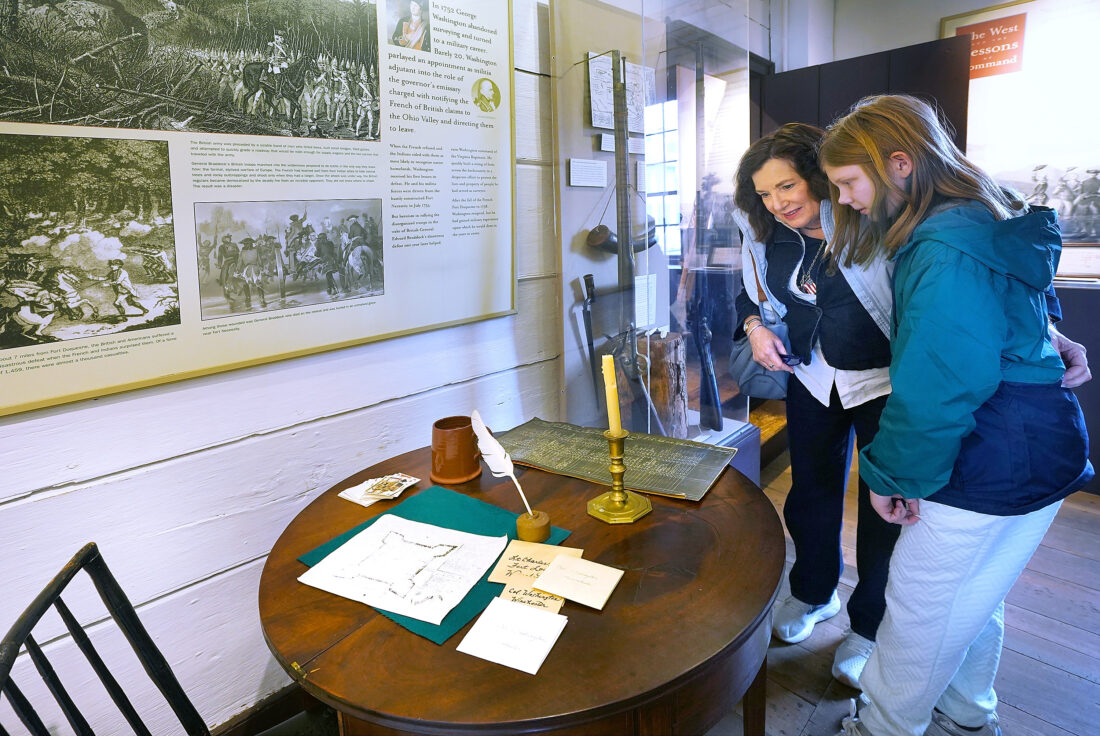
Teri Pierce of Stephens City, left and her grandaughter, Abigail Blevins 10 look at items on a desk at the Washington's Office Museum on Monday, President's Day. Blevins, a 4th grader from Warrenton has been study about George Washington in school. (Photo by Ginger Perry)
In 1748, the head of the Fairfax family, Thomas, Sixth Lord Fairfax of Cameron, invited a 16-year-old George Washington to join a surveying expedition of Virginia’s Northern Shenandoah Valley, which was part of Fairfax’s approximately 5 million-acre Northern Neck Proprietary. Washington agreed and arrived in Frederick Town, Va., on March 16, 1748, marking the start of the most formative decade of his life.
Washington spent the next three years surveying Frederick Town — which, in February 1752, changed its name to Winchester — and surrounding land parcels owned by the Sixth Lord Fairfax. He also visited Barbados with his brother in 1751 in an effort to help Lawrence Washington overcome tuberculosis, but Lawrence succumbed to his illness on July 26, 1752.
Also in 1752, George Washington joined the Virginia Militia with the rank of major and established his base of operations in Winchester. Meanwhile, France and Great Britain were competing for territory in the Ohio River Valley.
Virginia Lt. Gov. Robert Dinwiddie sent Washington to western Pennsylvania in late 1753 to demand that French forces leave the Ohio Valley. When the French refused, Washington launched a surprise attack on May 28, 1754, that killed 10 French soldiers and marked the start of the French and Indian War. The Battle of Jumonville Glen happened near what today is Uniontown, Pa., at that time part of the Ohio Country.
Following the skirmish, Washington and his men hastily built Fort Necessity in nearby Farmington, Pa. On July 3, 1754, French and Native American soldiers attacked, forcing Washington to surrender the fort and return to Mount Vernon, which was passed down to him following his brother’s death.
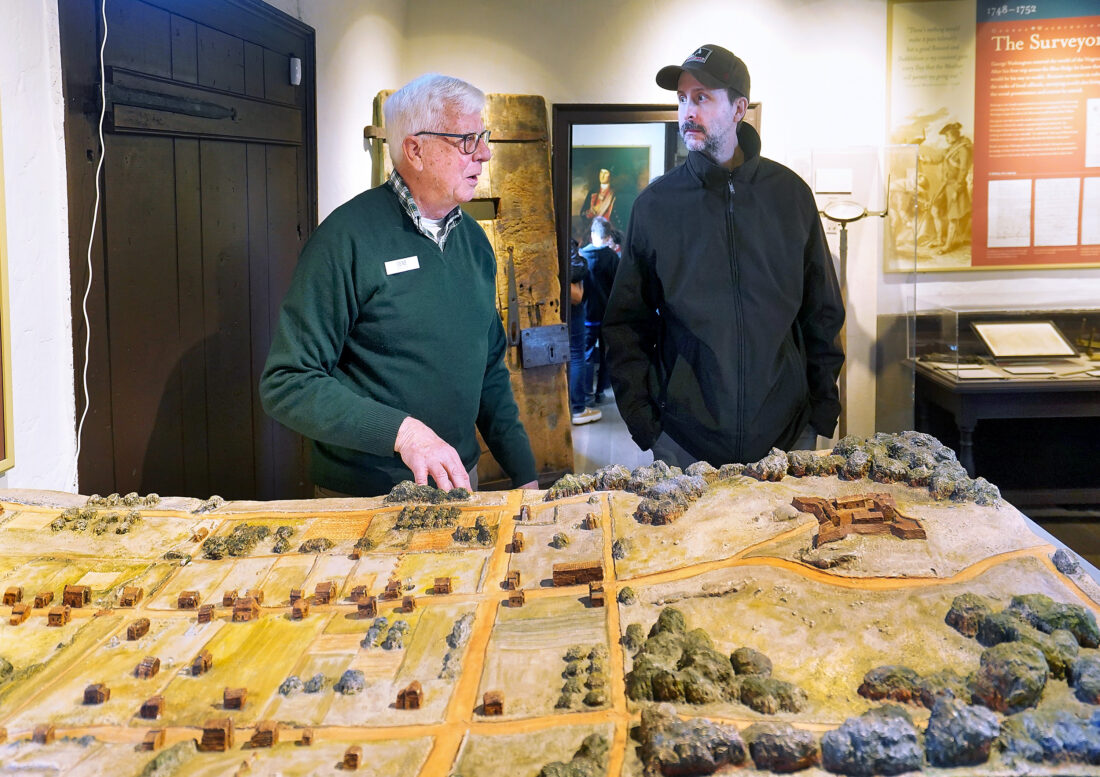
Gene Schultz, left, volunteer and board member of the Washington's Office Museum talks with Brian Armel about Winchester in 1757 at the museum on Monday. (Photo by Ginger Perry)
After the defeat at Fort Necessity, Washington considered resigning from the militia but stayed on and delivered a detailed report regarding his Ohio Valley mission to the Virginia House of Burgesses in Williamsburg. The report was subsequently published in several newspapers in the colonies, making Washington a well-known figure and leading to his promotion to lieutenant colonel.
In May 1755, Washington joined British Gen. Edward Braddock on an expedition to Pittsburgh with the intent of capturing the French stronghold of Fort Duquesne. Braddock’s troops were ambushed on July 9, 1755, and Braddock was mortally wounded, leaving Washington in command as his soldiers fled south.
Washington was then promoted again, this time to colonel, and put in charge of the entire Virginia Regiment. He returned to Winchester in October 1755 and based his command there.
In December 1755, Washington was still living in Winchester when he launched his first political campaign. With three candidates seeking two available seats in the Virginia House of Burgesses, Washington finished a distant third to Hugh West and Thomas Swearingen. He returned his focus to his military career.
To protect Winchester from enemy incursions, Washington ordered the construction of Fort Loudoun, with work continuing for nearly a year and a half.
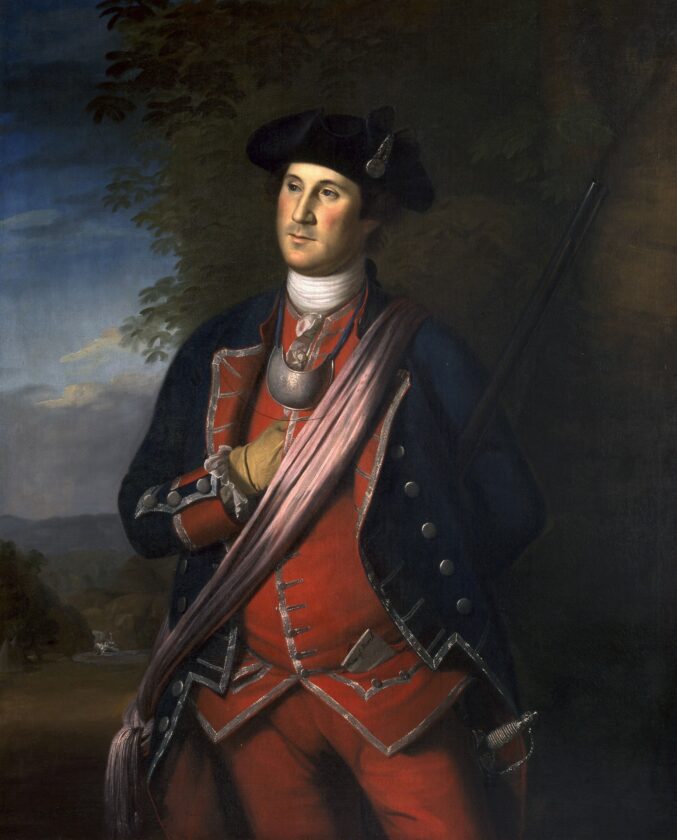
George Washington
Fort Loudoun had timber and earthen walls that were 16 to 17 feet high and about 8 feet thick, plus bastions in each corner to store weapons and supplies. The barracks inside the fort were designed to house up to 450 soldiers, but historians say that no more than 125 men stayed there at any one time. From December 1756 through December 1758, one of the fort’s residents was Washington himself.
In July 1758, Washington took another shot at the House of Burgesses. Learning from his political defeat three years prior, he and his campaign manager, James Wood, spent $51 — the modern-day equivalent of about $2,500 — on beer, rum punch, wine, cider and brandy, and offered libations to any man who voted for Washington.
The ploy worked and, even though Washington was seeing to military duties in Maryland on Election Day, he and candidate Bryan Martin soundly defeated incumbents Swearingen and West.
After a decade spent mostly in Winchester, Washington left the city for the final time in December 1758. He returned to Mount Vernon and, one month later, married Martha Dandridge Custis. Washington settled into the life of a gentleman farmer until 1775, when he was appointed commander of the Continental Army for the duration of the American Revolution.
As it turned out, Fort Loudoun was never needed because fighting in the French and Indian War had died down by the time construction finished. The fort’s stones and timbers were repurposed by local residents for the construction of homes and businesses, and the only remaining vestige of the fort, not far from Winchester’s downtown pedestrian mall, is a water well that was dug by Washington’s men.
But the office that Washington used in Winchester from September 1755 to December 1756 is open seasonally for tours. The little log building that he occupied is now the middle room of George Washington’s Office Museum, located at the corner of Braddock and Cork streets in downtown Winchester.
On the grounds is a cannon that was left by Gen. Braddock in Alexandria. It is among a number of artifacts displayed at the office, which include some of Washington’s personal effects, surveying equipment and a scale model of Winchester circa 1755 that shows Fort Loudoun.
In the next installment, as the war for independence from British rule breaks out in the colonies, we’ll examine the role cities such as Frederick, Md., had in serving as vital supply routes during the Revolutionary War. We’ll also learn about Dr. Matthew Thornton of New Hampshire, the final of 56 signers of the Declaration of Independence.