
An unofficial guide to mountain climbing
Trending
Andie Balenger photo
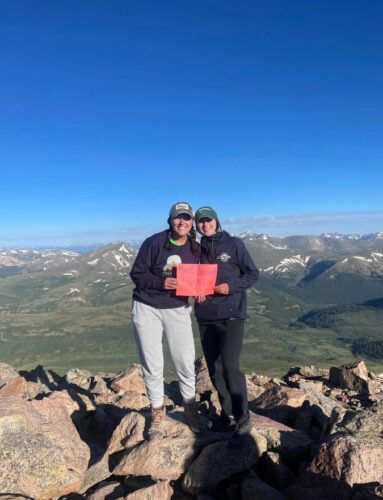
My friend Taelor and I pose with a sign after summiting Mount Bierstadt. This was Taelor's first 14er and my fifth, but many more are to come.
I recently returned from a nearly two-week hiking trip in Colorado. While my vacation was defined by exploring new cities and testing my flavor palette, most of it was spent hiking. Within the 12 days I was out of state, my friend and I completed seven hikes: trekking over 30 miles, gaining nearly 9,000 feet in elevation, and spending roughly 14 hours moving our bodies.
To say we were physically drained when driving home would be an understatement.
But we set out on this trip to test our physical limits. When I initially asked my friend to accompany me to the Centennial State, I was upfront that it would be difficult. Perhaps unknown to some, when hiking you question your sanity as you gasp for air halfway up a mountain. Questions like "Why did I sign up for this?" or "Is that point up there really where we are going" are only a glimpse into the emotional spiral that is endured when climbing.
Yet, my friend stated matter-of-factly in response to my proposal to climb a 14,000-foot mountain back in January: "I mean, it wouldn't be a trip to Colorado if we didn't."
It was settled. After sorting through the abundance of recreation areas and parks, we set out to conquer some of the highest mountains Colorado has to offer. Of the seven hikes we completed, two were to mountain summits: Mount Audubon (13,209 ft.) and Mount Bierstadt (14,060 ft.).
However, summiting these mountains wasn't something that just happened. We spent the months leading up to these hikes preparing ourselves, physically and mentally, for the trek. What exactly does that entail? Let me assure you that it extends well beyond selecting a trail and showing up the morning of.
To start, climbing a mountain is unlike any other form of physical activity because the largest challenges exist outside yourself. Before starting a hike, you must spend a couple of days acclimating to the high elevations you wish to reach. This can be done in several ways, like slowly gaining elevation on short hikes or driving to the summit of a mountain.
We chose both of these options on our trip. We began with shorter hikes at lower elevations that did not gain too much elevation in a short distance. After a few "easy" hikes (there are no easy hikes in Colorado), we drove to the summit of Mount Evans (14,261 ft.) and walked around, waved at the mountain goats, and took pictures of the surrounding peaks.
Equally important to acclimation is understanding the tumultuous nature of the environment, particularly weather and terrain. My friend learned this when we drove to the top of Mount Evans, refusing to get out of the car until the dash displayed 40 degrees Fahrenheit.
High mountains are subject to unpredictable weather patterns. During the climbing season (April to October), lightning strikes, high winds, and snow flurries are expected. With low temperatures and icy conditions, the possibility of hypothermia and frostbite is relatively high. That is why wearing the proper attire, checking the weather, and getting below the tree line before noon is crucial to having an enjoyable hike.
And because you have to get off the summit before noon, your hike must start at the crack of dawn. Most summit trails are lengthy and require a great deal of time to complete (depending on your physical shape and experience). Starting early is not as dreary as it sounds, however, because you have the rest of your day to be lazy and eat delicious food. Additionally, you are almost guaranteed a parking spot if you arrive at the trailhead before 5 a.m.
Unfortunately, this early start means you will be packing your tent and driving on winding mountain roads in the dark while battling the exhaustion you feel from the hike the day before. It is exhilarating, to say the least.
Arguably the most essential aspect of hiking is packing for the trek. Carrying a backpack holding all the items necessary to survive in the wilderness is required - no ifs, ands, or buts. Of these items, you must have some form of light, first aid, navigation, and an emergency shelter.
I will be completely honest, I have never had to use any of my emergency items while hiking - including the can of bear spray lying in wait in my pack's side pocket. Yet, I would never leave the trailhead without them because I know as soon as I remove any of these items I will need them.
Who knows, you may not even be the person in need of assistance. Someone in your party or a stranger may require help on the trail. To be overprepared, in my opinion, is to be well-prepared.
However, the most important items in your pack are water and nutrition. Ensuring you pack enough water for your hike depends on exertion levels, temperature, and personal preferences. A general rule of thumb is one half-liter of water per hour of activity. I carry two 32-ounce Nalgene bottles and a spare bottle in my pack, although I usually only drink 48 ounces.
As for nutrition, you want food that is either salty, high in protein, or contains complex carbohydrates. On our trip, our packs were stuffed with peanut butter and jelly sandwiches, Snickers, trail mix, and beef jerky. We also ate protein-packed yogurt, granola bars, and bananas for breakfast in the morning.
It should be noted that I am by no means an expert on this topic. I am speaking from personal experience and relaying knowledge I have acquired over the years from experienced climbers and mountain guides. If you are interested in the topic or are looking to climb a mountain yourself, I highly recommend literature written by the Colorado Mountain Club Foundation.
My friend and I were well prepared for the muscle fatigue and mental roadblocks that are expected to be encountered while adventuring outdoors. But in our quest to overcome these challenges, I was surprised at how open we were to welcoming them. Sure, we were rewarded with panoramic views of the Rocky Mountains, but this trip also helped strengthen our sense of will and being.
Don't believe me? I know it sounds a bit cliche, but my friend summed it up quite well at the end of our trip. While doing more touristy things, like driving through Rocky Mountain National Park or taking a bus to the top of Pikes Peak, my friend turned to me and said: "This is cool, but nothing will compare to climbing a mountain, because we did that ourselves. We saw those views because of the work we put in. We are trail bosses."
We laughed in agreement. The views are just better when you work your way to the top.
-- -- --
Andie Balenger is a native of Gladstone and is currently attending Northern Michigan University. Her column focuses on college life and runs Thursdays in the Daily Press.