
Divers get training in frigid waters
Trending
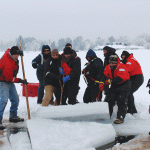
GLADSTONE -- First responders from New York to Delta County participated in an ice diving operations certification class hosted by the Delta County Sheriff's Dive Rescue Team last weekend. Two instructors from Dive Rescue International put on the three-day training class on March 8, 9 and 10.
Jon Smith, director of the dive rescue team, said 21 people attended -- including three from Delta County.
He explained the benefit of hosting instead of sending out divers to be trained elsewhere, they can do it right in their backyard.
Delta County Deputy Mike Groleau, who is also the assistant director of the dive rescue team, said the local team tries to host training whenever new divers join.
"Most times you get people from other counties in Michigan or Wisconsin," he said. "This time we were drawing people from a wide range of areas," Smith said.
The field experience part of the course took place Saturday and Sunday at the Gladstone Harbor.
Due to the number of participants, four holes were cut in the ice so there could be two groups training at the same time.
When setting up for the field exercises, Groleau explained they shovel a path through the snow-covered ice to connect the smaller holes to the bigger holes. He said this creates a glowing path for the divers to view while under the ice. He said they add chevron-like arrows to point divers back to the hole they originally entered through.
"On a day like today the holes will standout like a window in a darkroom though," said Groleau about the sunny Saturday morning.
One group was comprised of all the police officers and firefighters from New York City.
One New Yorker from the New York Police Department scuba team noted the differences between Delta County and New York.
"I'll be honest with you, the Hudson never looks like this," said NYPD Sgt. Adam Grimmett. He explained the water is as cold as Lake Michigan, but the river in New York lacks the thick ice.
The other group was made up of all the other participants. In addition to local residents, others came from Lansing, LaCrosse, Wis., and even Sioux City, Iowa.
Groleau explained the participants would be running the exercises out of the two main holes one at a time.
"There is the primary diver in the hole, the back-up diver sitting on the edge of the hole and the 90 percent diver," he said.
The divers rotate through so there is always someone in those positions.
Four men from the U.S. Coast Guard were also in attendance, but were not participating in the course.
Joseph Toth, of the Coast Guard, said they were observing the course because they run their own course. He explained they were looking to see the similarities and differences of the two courses.