Michal seeks to oust Bergman in US House’s 1st District
-
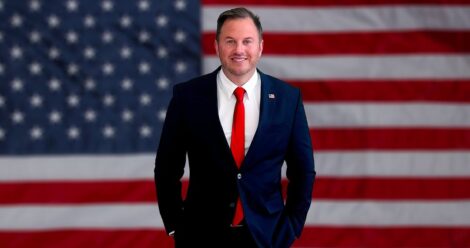
- Justin Michal is running in 2026 as a Republican against incumbent GOP U.S. Rep. Jack Bergman for the First District congressional seat. (Contributed photo)
-
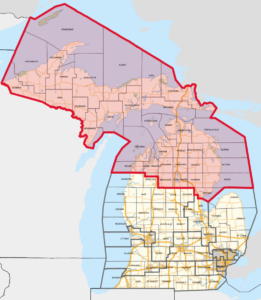
- A map shows Michigan’s First Congressional District, which includes all of the Upper Peninsula and a number of counties in the northern Lower Peninsula. (Contributed map)
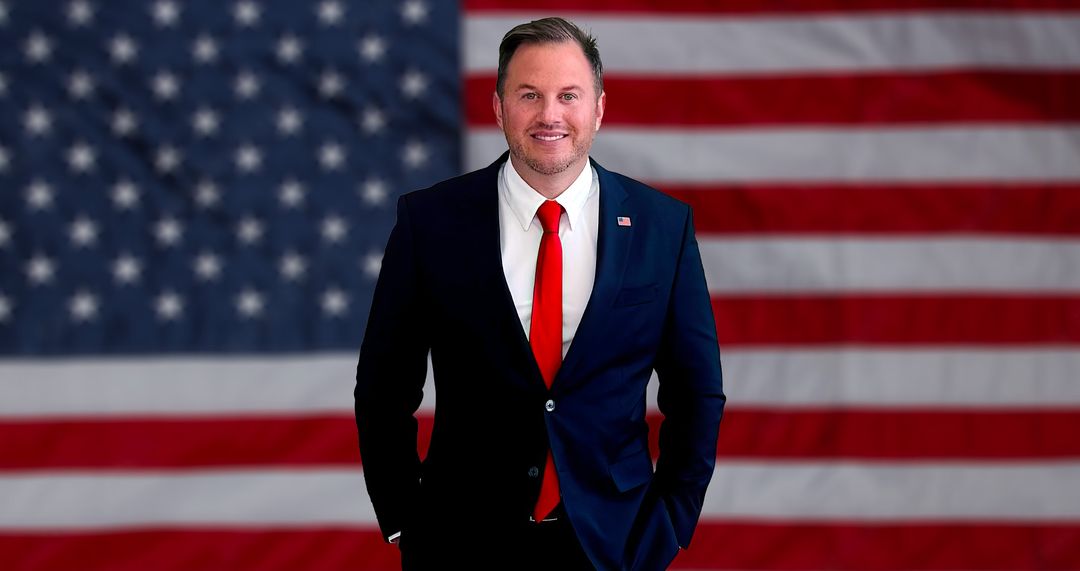
Justin Michal is running in 2026 as a Republican against incumbent GOP U.S. Rep. Jack Bergman for the First District congressional seat. (Contributed photo)
ESCANABA — Republican candidate Justin Michal is challenging incumbent Jack Bergman for the chance to represent Michigan’s First Congressional District in the U.S. House of Representatives.
Bergman has had the position for five terms, since 2017. Michal, an army veteran working on a doctorate in conflict analysis and resolution, believes the quality of life in the district has fallen in the past eight years and he has been traveling the district and talking to people to find out what needs to be better.
Referencing the division that’s permeated political spaces lately, Michal said he wants to hold town halls open to all, including people with opposing viewpoints, but would prefer that communication is honest and thorough and civil instead of belligerent, “out of respect for what we’re trying to accomplish.
“Help me learn. Help me understand your side,” Michal said. “I think most people will find some common ground somewhere.”
Though Michal’s values are conservative, Republican, fairly aligned with President Donald Trump, and he has beliefs of his own, he said that his own personal opinions shouldn’t be relevant when he’s aiming to serve the residents of the Upper Peninsula and northern Michigan. He aims to listen to all constituents, he said.
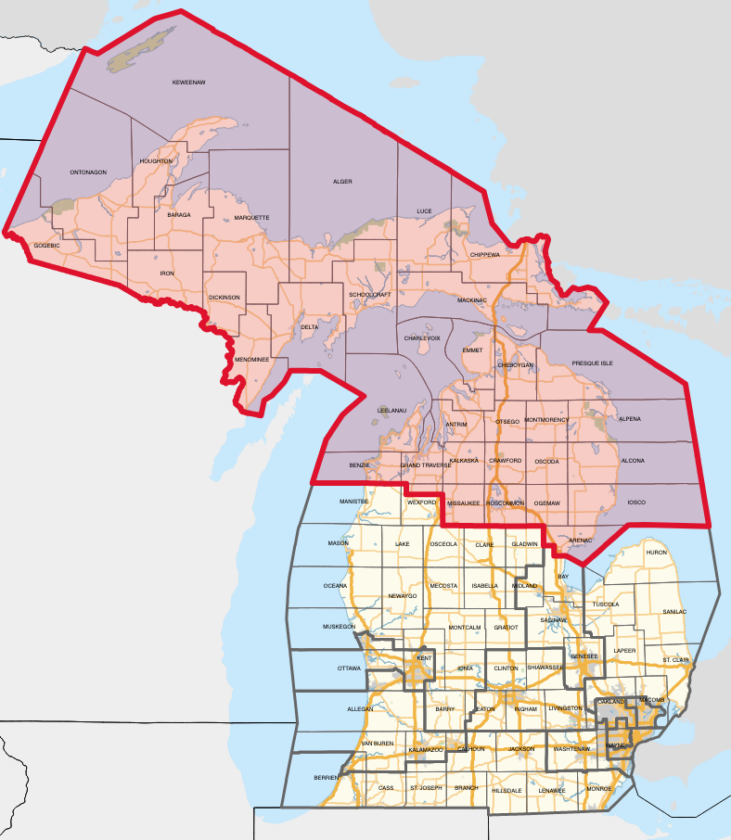
A map shows Michigan's First Congressional District, which includes all of the Upper Peninsula and a number of counties in the northern Lower Peninsula. (Contributed map)
“I want to be the most accessible congressman or congressperson in the U.S. House of Representatives. If I don’t need to be in Washington, D.C., I will not be in Washington, D.C., I will be here,” Michal said.
Michal grew up in the Grayling area before joining the military. After serving on a special operations team in Iraq, he found that returning to civilian life wasn’t what he expected and trying to find a job without a college degree was difficult. He pursued a bachelor’s degree in entrepreneurship and aeronautical science, then went on to get his master of business administration from Florida Atlantic University, where he built skills in organizational leadership, strategic planning and economic development.
The Republican primary will be Aug. 4. So far, Michal and Bergman are the only GOP members running for the U.S. House seat. The deadline to file is in April. Nov. 3 will be the date of the final general election, where the winner of the Republican primary will face off with the Democratic candidate — potentially Wayne Stiles, Callie Barr or Kyle Blomquist — and independent Zebulon Featherly.
Here’s what Michal had to say about certain issues:
DISASTER RELIEF
Parts of Michigan had severe damage from the ice storm that plagued the northern Lower Peninsula for three days in March. After witnessing the destruction and the way it left residents requiring things such as temporary lodging, fuel, generators, chainsaws, cleanup equipment, emergency transportation, first aid and survival supplies, Michal drafted a federal bill proposing that people affected by federally declared emergencies could deduct up to $50,000 from their federal income tax to help recover from such extreme and unexpected costs.
Michal’s bill, titled the “DISASTER Relief Act” — with the first word an acronym for “Deducting Immediate and Sustained Allowable Spending Toward Emergency Recovery” — is prepared to be introduced to Congress. The entire document may be read online at justinmichalforcongress.com.
CLEAR-CUTTING
Michal said he became frustrated seeing forests near Grayling clear-cut. He acknowledges the forest products industry is big and that trees are a renewable resource, but he doesn’t believe the way the woods in his area are being managed is helpful, because they only seem to regrow one type of tree.
“They mow down great forests with beautiful trees, oak trees, and replant jack pines,” Michal said. “So problem with that is, it’s a really sappy and dry tree. The forest fires just erupt … and it’s built in the sand deserts of our high plateaus in the AuSable River Valley, which makes it even worse when the fires blow because the wind kicks up.”
His frustration with things like land management and poorly maintained roads prompted Michal to first seek public office. He had the idea to run for state representative of the 105th state House District, a position now held by Ken Borton, but political consultants Michal met with convinced him to instead pursue the representation of Michigan’s First Congressional District.
STRUGGLING COMMUNITIES
Michal said people keep getting sold on the idea that bringing big companies into small towns is going to somehow revitalize their communities, when the reality is such change often happens in a way that harms people who’ve lived in the area for generations. He said he’s learned this by meeting poorer residents in the district and hearing their stories.
“When you sit down with people who are really struggling, you start to realize that there’s a pattern of behavior and a mass exodus that we have because people are just leaving small towns, or they’re just getting pushed out by ecotourism and other other facets,” Michal said.
He explained that when wealthy people from elsewhere come to northern Michigan and buy property and open businesses, “or if big corporations come in and start shutting down shops that were second- or third-generation owned… they make it impossible for people who’ve grown up here their whole lives.”
Sometimes, communities and governments even create incentives for those companies. “I think that a lot of times, when small towns are hurting, that also gets exploited, because you get sold on, ‘We’re going to bring high-paying jobs into the community,'” Michal said.
“Those companies come in, and they usually work out deals for tax breaks or other things, and then they reap the benefits of the area, and they don’t have to contribute to it. And maybe one or two people you might know in town gets a job, but a lot of those jobs get relocated from elsewhere, and then those people then buy the homes that you wish you could afford, raising the cost of living up,” he said.
PUBLIC RADIO AND TV
“I think the funding for those is important. I know it’s been cut, but I also think that we have to have a checks and balance to make sure that we’re not making those political,” Michal said when asked his opinion about outlets such as the Public Broadcasting Service and National Public Radio being defunded.
He said that nationally-funded media can be seen as “an extension of government propaganda,” and that “if we’re going to fund these programs, then we need to make sure that we’re doing a very good job of staying as neutral as possible and not trying to influence people.”
PFAS
Per- and polyfluoroalkyl substances, also known as PFAS and “forever chemicals,” which have been linked to health detriments in people and animals — are present in bodies of water and in the soil. Michal said funding for research into the contamination would be difficult but necessary for cleanup. As the role he seeks is at the federal level, not the state, Michal pointed out that the focus to obtain such funding may have to be on cleaning up all bodies of water in the country, not just the Great Lakes and nearby tributaries.
IMMIGRATION
“Illegal immigration is a problem,” Michal said. “I’m a huge proponent of legal immigration. I think if you look at our country, historically, immigration has been a driver for not only our economy, but also the growth and development and expansion of cultural diversity. America is the melting pot of the world.”
But immigrants who come here illegally to work under the table make it harder for people trying to work legitimately, Michal said. A company paying its employees well, in accordance with the law, and providing them with benefits will charge customers more for their services than one doing the same sort of work with no paperwork. Many customers would choose to go for the cheaper service, exacerbating the problem.
As far as the way U.S. Immigration and Customs Enforcement, or ICE, has handled detainments of immigrants over the past year, Michal admitted it was “a bad look” both in our country and internationally, but he was concerned by people using words like “Nazi” to describe the administration for using detention centers.
He suggested part of the negative portrayals of the so-called “Alligator Alcatraz” could be a scare tactic meant to encourage people in the U.S. without authorization to self-deport.
“I hope that the places that they put detainees are safe, and we’re giving as much humanitarian assistance as we can to help relocate those individuals,” he said.
Local News

Escanaba to have Christmas parade, Christmas in the Village events
Report: Michigan farm values growing faster than the national rate
Michigan farm property values are going gangbusters, rising 7.8% in the past year and leading the nation, according ...
Michal seeks to oust Bergman in US House’s 1st District
Partial Ludington Street closure to start today
ESCANABA – The westbound lane of the 1400 block of Ludington Street will be closed starting today and continuing ...
Escanaba house fire leaves one person with minor injuries